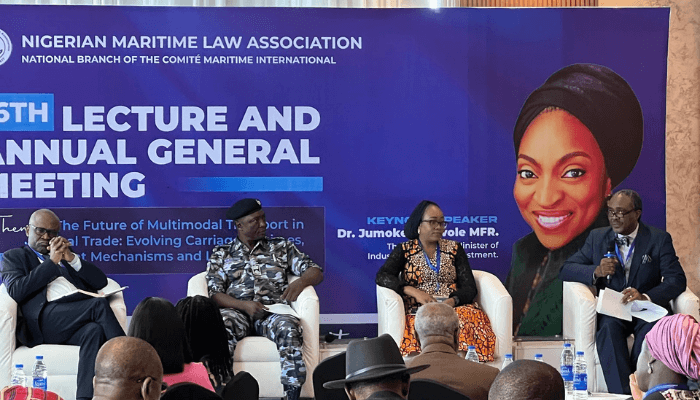
Industry stakeholders and legal practitioners have underscored the need for Nigeria to modernise its multimodal transport legal framework, strengthen enforcement mechanisms, and enhance inter-agency coordination to remain competitive in global trade and realise the country’s Blue Economy ambitions.
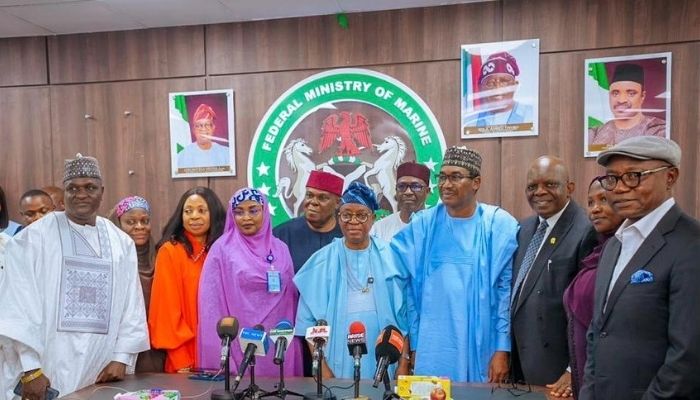
The call was made during the 16th Annual Lecture and Annual General Meeting of the Nigerian Maritime Law Association (NMLA) held in Lagos on Friday. Themed “The Future of Multimodal Transportation in Global Trade: Evolving Carriage Regimes, Enforcement Mechanisms and Legal Certainty”, the event brought together policymakers, maritime lawyers, regulators, and security officials to explore the challenges and opportunities of an increasingly complex global logistics landscape.
Welcoming participants, NMLA President Funke Agbor (SAN) described the gathering as a “rich congregation of ideas, bridging theory and practice, strengthening our profession’s capacity and reinforcing the role of maritime law within Nigeria’s dynamic and growing maritime industry.”
She highlighted the association’s commitment to ensuring that Nigerian maritime laws are “fit for purpose, modern, integrated and enforceable” in the face of growing complexities in supply chains.

The keynote address, delivered on behalf of Jumoke Oduwole, the minister of industry, trade and investment, by Oyindamola Ade-Alli, the legal adviser, Lagos State Waterways Authority, highlighted the urgent need to align Nigeria’s legal frameworks with modern multimodal transport realities.
Read also: NSIB takes bold step towards unified transport safety framework
Oduwole noted that “Transport systems across sea, road, air, rail, and inland waterways are evolving faster than the legal frameworks that support them. As maritime lawyers and policymakers, we must bridge this gap.”
She explained that Nigeria’s aspirations in the Blue Economy, covering ports, waterways, maritime services, fisheries, offshore activities, and coastal tourism, depend on modern, investor-friendly legal frameworks.
Oduwole pointed to the Rotterdam Rules as a benchmark for modern carriage regimes, advocating a framework that supports single contracts for multimodal transport, electronic documentation, fair liability allocation, efficient dispute resolution, and alignment with global best practices. She further emphasised the role of enforcement, arguing that it must be “transparent, predictable and technologically enabled” through digital documentation, vessel tracking, e-verification, and inter-agency coordination.

Enforcement challenges in multimodal transport, regulatory overlaps, and dispute resolution from a Nigerian perspective was examined during a panel session, moderated by Michael Abiiba, partner at Bloomfield LP.
Bankole Sodipo, SAN, highlighted the absence of a centralised legal framework, noting that multiple legislative regimes governing air, rail, road, and maritime transport create inconsistencies and complicate liability allocation. “We have issues such as lack of a single policy framework…sometimes, who is going to be in charge is unclear,” he said.
Aderonke Adekanye, deputy director of legal services at NIMASA, emphasised the importance of inter-agency collaboration, noting that implementing multimodal transport policies requires alignment with existing federal policies and cooperation with regulators. She added that while the current legal framework is fragmented, NIMASA is committed to working within federal policy and strengthening coordination with other agencies.
Read also: Developing a multi-modal transportation system: Legal and policy priorities for Nigeria
Justice Ayokunle Olayinka Faji of the Federal High Court provided insights into judicial approaches to multimodal transport disputes. He noted that while the Federal High Court has broad jurisdiction, the absence of comprehensive legislation leads to uncertainties. “Even though there is no tough court here, our jurisdiction extends from the time goods are placed on the ship to delivery to the consignee, whether or not there is an intervening land transportation,” he explained, urging progressive interpretation and judicial activism to bridge gaps in the interim.
AIG Chinedu Oko of the Marine Police highlighted operational enforcement challenges, including cargo theft, vandalism, weak prosecution frameworks, logistical constraints, and evidence-gathering difficulties. He stressed that improving enforcement requires well-trained personnel, interoperable operations across agencies, and investment in technology.
“One of the best ways to tackle this issue is to ensure personnel are trained on evidence gathering, from when we get to the crime scene to how we handle and present evidence,” he said.
Stakeholders agreed that Nigeria’s future in global trade and economic development depends not only on infrastructure but also on robust legal frameworks, clear carriage regimes, effective enforcement, and technology adoption.