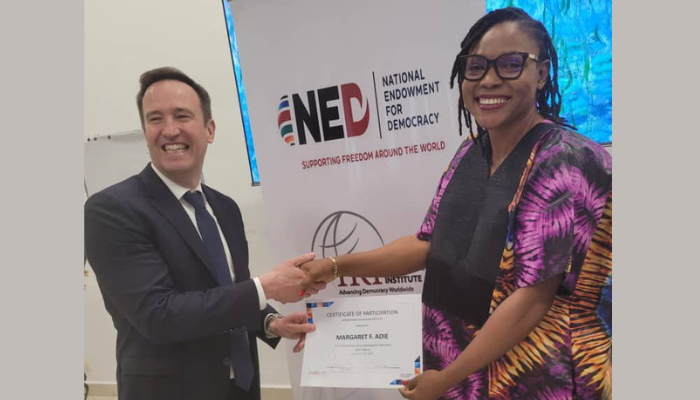
Margaret Funmilayo Adie, a second-year PhD student in English (Rhetoric and Composition) at Kent State University, has been honored with a certificate of participation by the International Republican Institute’s (IRI) Vice President for Programs, Scott Mastic, following her prominent contribution at a high-level policy development workshop in Lagos.
The three-day program, held from June 25 to 27, 2025, at the Black Diamond Hotel in Lagos, brought together leaders from multiple political parties, heads of political institutes, party state chairmen and secretaries, women and youth leaders, and representatives of civil society organizations.
Organized by IRI in partnership with the National Endowment for Democracy (NED), the workshop focused on strengthening Political Party Policy Development in Nigeria.
Adie participated as a delegate of the Peoples Democratic Institute (PDI), Abuja, alongside the Director-General, and emerged as one of the standout contributors during the technical sessions. She served as a breakout-group rapporteur and spokesperson, translating group deliberations into a concise policy note and presenting recommendations to the plenary.

According to her, the goal was to ensure each discussion produced “practical, people-centered outcomes rather than abstract talk.”
She explained that she proposed a simple “evidence–options–impact” framework to help guide policy conversations:
“Balancing clarity with evidence helps parties stay grounded. Each policy idea must show the real problem, the practical options, and the measurable impact. That discipline makes policymaking more credible,” Adie said.
Her research interests—political rhetoric, feminist rhetoric, writing, and critical discourse analysis—shaped her inputs throughout the workshop. Drawing from her rhetorical training, she urged groups to use plain language, data-backed claims, and inclusion-focused design.
According to her, “Research should not stay in the classroom. It should help political actors communicate honestly, clearly, and responsibly.”
One of the highlights of the program was a presentation she delivered on crafting persuasive messages, a session participants described as timely for Nigeria’s evolving political communication landscape. She emphasized that persuasive messaging “must be simple, truthful, inclusive, and rooted in evidence if it is to earn public trust.”

During group exercises, Adie pushed for equal participation across gender, age, and party lines, ensuring quieter voices were not overshadowed. She also introduced a rule requiring each party to provide at least one real example from their state and one measurable outcome for every policy proposal—an approach participants praised for grounding discussions in reality.
Among the practical outputs of the workshop were a cross-party drill where broad promises like “job creation” were converted into 90-day action cards with clear budget lines and responsible units.
A message-testing session that adapted policy text for radio and WhatsApp audiences, and the adoption of a reusable policy template centered on problem definition, options, trade-offs, inclusion plans, and indicators.
IRI awarded Adie a certificate in recognition of her clarity, evidence-based reasoning, and commitment to inclusion. Officials noted that her contribution demonstrated the value of integrating academic expertise—particularly in rhetoric and communication—into Nigeria’s political development processes.
Adie said the recognition affirmed the importance of bridging academic research and political practice.
“It shows that rigorous analysis and public communication belong at the same table. If parties can adopt evidence-based, people-centered communication, political discourse in Nigeria will become more trustworthy,” she said.
She added that the workshop strengthened her network across parties and civil society and clarified new opportunities to apply rhetorical research to real-world policymaking.
Looking ahead, she hopes Nigeria’s political actors will adopt the tools developed during the workshop and that parties will issue plain-language policy briefs with clear costs, timelines, and inclusion metrics.
“If we normalize evidence-based policy communication, campaigns will become more issue-driven and governance will become more accountable,” she said.