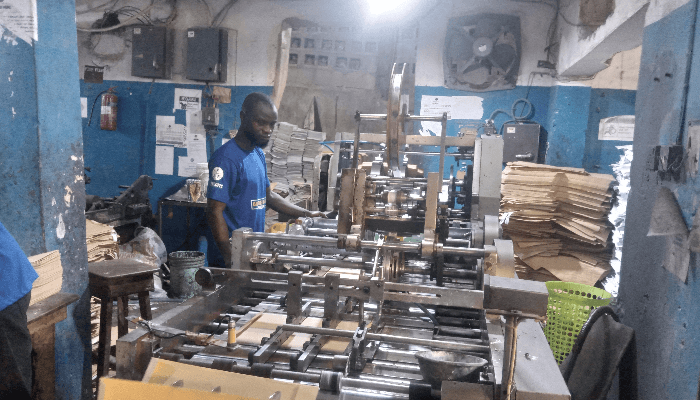
It was the usual hum of conveyor belts and the pounding of hammers at an Agbara, Ogun State-based factory. Outside the factory was a set of newly arrived machines that could process 4,500 semi-finished food items into finished products in 15 minutes.
The food processing machines cost $3.6 million to import from China in 2023 and contained smart tools that would require less manual labour. There was palpable excitement among factory workers who knew the machines would make their jobs easy without displacing any of them.
“We acquired these machines because they are fast and efficient,” said one of the factory managers, who preferred anonymity.
“And, no worker will lose their jobs because we are expanding and there is more work to be done.”

Like the Agbara-based company, more than 2000 members of the Manufacturers Association of Nigeria (MAN) raised their investments in plants, machines, buildings and other fixed assets by 32 percent in 2023 on the back of rising confidence in the economy.
They pumped N427.18 billion into the manufacturing sector in 2023 as against N323.98 billion in 2022, exclusive documents obtained by BusinessDay from MAN show.
“The surge in investment spending reveals a growing level of confidence in the economy for 2024, with expectations of resurgence,” MAN said.
In spite of that, the real value of the investments declined on the back of inflation and devaluation after the exchange rate float of 2023.
“At the sectoral level, five out of 10 groups experienced investment increases, led by food, beverages and tobacco at N93.16 billion (up 57 percent) in the second half,” MAN said.

Other sub-sectors that drove the investments include: chemical and pharmaceuticals, and vehicle assembly.
Read also: Manufacturers lose $27bn annually due to power shortages – Minister
Implications of Investments
When compared with 2014, manufacturing investments dropped by 38.2 percent, showing that fewer investments have occurred in the sector over the nine-year period.
Manufacturers invested N691.77 billion in 2014, which dropped to N489.55 billion in 2015. In 2016, they pumped N614.55 billion into the sector and N508.98 billion in 2017.
Total manufacturing investments of N552.64 billion and N496.11 billion were made in 2018 and 2019 respectively.
Companies Driving Investments
Some of the companies that invested in 2023 were: Dangote Cement, Dangote Sugar, BUA Cement, BUA Foods, Flour Mills of Nigeria, Nestle, FrieslandCampina WAMCO, Nigerian Breweries, Guinness, Emzor Pharmaceutical Industries Limited, among others.
In 2023, Emzor secured €13.85 million from European Investment Bank (EIB) to develop a $23 million plant to combat malaria.
Similarly, Nestle began investing N61 billion in the expansion of its lines at the three factories located in Agbara, Sagamu and Abaji in 2023.
BUA Cement secured a $500m loan from the International Finance Corporation (IFC) in 2023 to fund the expansion of its integrated cement plants in Kalambaina, Sokoto State.
In February 2023, Dangote Industries Limited (DIL) signed a deal with China Sinoma International Engineering to build a six million tons per annum cement plant in Itori, Ogun State. The project started late last year.
Critical challenges
Amid these investments, Nigeria’s manufacturers are hard hit by several challenges such as high energy cost, foreign exchange crunch, policy flip-flops, insecurity, high logistics costs, lack of funds, among others.
For local manufacturers, the foreign exchange crunch has made importation of raw materials nearly impossible.
Naira has weakened by over 70 percent since President Bola Tinubu came to power. Naira exchanged at N1,631.17/$ at the NAFEM market on October 30. The naira fell to a 9-month low of N1,740 per dollar at the parallel market on Tuesday.
Olaoluwa Boboye, economist at CardinalStone, attributed the situation to speculations in the forex market.
Read also: FG tells manufacturers to embrace renewable energy
“The major driver of the depreciation is the speculation around the market, people are buying ahead of an expected rate hike,” he said.
More than 400 chief executives of manufacturing firms in Nigeria ranked foreign exchange scarcity as the fifth major challenge facing them.
Also, manufacturers are also facing high energy costs due to the high prices of diesel, petrol and other forms of fuel. Petrol and diesel costs above N1000/litre.
“One is naturally worried about the impact on the already lackluster performance of the manufacturing sector. In particular, there is no doubt that petrol price hike will add to production input and logistics costs. These will lead to higher prices and in the face of dwindling disposable income of the average Nigerian,” Segun Ajayi-Kadir, director-general of MAN, said in response to petrol price hikes.
High cost of funds is also a major challenge, with the benchmark interest rate at 27.25 percent currently.
“The average rate we got loans by the second half of 2023 was 28.1 percent,” MAN said.
In 2023, the maximum benchmark interest rate set by the Central Bank of Nigeria (CBN) was 18.75 percent. But things have since changed with the CBN raising rates from 18.75 percent to 27.25 percent.