Ada sat outside a bank in Anambra, gripping her automated teller machine (ATM) card as if it were a lifeline. She could hear the quiet hum of air conditioning inside, the rhythmic beeps of transactions being processed, and the occasional click of polished shoes against the tiled floor.
But for Ada, the bank’s entrance was an unyielding wall. The steps leading inside, the absence of a ramp, the heavy doors designed without thought for a wheelchair user—each one a silent message that she did not belong.
She waved at the security guard, who hesitated before sighing and calling a banker outside. “Madam, you should come with someone next time,” the official muttered, barely meeting her eyes. Ada swallowed her frustration. Next time. As if she had not spent a lifetime battling barriers that others barely noticed.
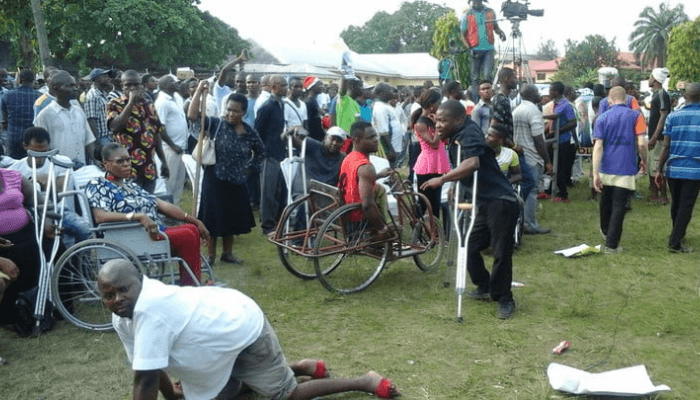
Ada’s story is the reality of millions. According to the National Bureau of Statistics (NBS), at least 8 percent of Nigeria’s 128 million adult consumers—5.1 million people—live with disabilities. Yet, the financial industry continues to treat them as an afterthought. Banking halls remain inaccessible, ATMs are designed without consideration for the blind, and even something as simple as obtaining a debit card can become a humiliating ordeal.

Burden of assumptions
Too many financial institutions perceive people with disabilities as charity cases, and their economic potential is dismissed before it is even considered. But reality tells a different story.
Take Chuka, a visually impaired entrepreneur in Lagos. When he applied for an ATM card, the bank manager refused, citing “security concerns”. Instead, Chuka was asked to sign an affidavit absolving the bank of any liability should he “misuse” his card.
Meanwhile, his sighted peers simply signed a form and walked out with theirs. This assumption—that people with disabilities cannot manage their finances independently—traps them in a cycle of exclusion and dependence.
Economic and ethical imperative

Banks measure success in two ways: economic performance and ethical reputation. Both suffer when a significant portion of potential customers is locked out.
Let’s break down the numbers. If just half of Nigeria’s 5.1 million adult persons with disabilities were actively banked, saving as little as ₦20,000 monthly, the total annual savings would amount to ₦1.2 trillion—more than the combined 2024 annual budgets of Ekiti and Osun states. This excludes the financial activities of carers and family members who prefer to engage with businesses that support accessibility.
Beyond profit margins, there is the matter of ethics. All Nigerian banks have signed the National Sustainable Banking Principles, which emphasise environmental, social, and governance (ESG) considerations. Yet, these principles remain vague when it comes to disability-specific interventions. A bank’s commitment to inclusion cannot exist solely in its corporate social responsibility (CSR) reports—it must be evident in its operations.
A glimpse of progress
Not all banks are blind to the issue. Access Bank and Standard Chartered have introduced disability-inclusive banking initiatives. Sterling Bank has taken steps to employ persons with disabilities. But these efforts, while commendable, remain the exception rather than the norm. True inclusion demands more than token programmes—it requires a systemic shift.
Learning from global best practices
Nigeria does not need to reinvent the wheel. Countries like Kenya, South Africa, and the United Kingdom have successfully implemented disability-inclusive financial ecosystems. Here’s what must change:
1. Regulatory action: The Central Bank of Nigeria (CBN) must update the National Financial Inclusion Strategy to explicitly include disability-specific policies. This means enforcing accessibility standards in bank branches, requiring disability sensitivity training for staff, and ensuring banking apps and websites meet Web Content Accessibility Guidelines (WCAG). ATMs should have interactive voice prompts and braille keypads for visually impaired users.
2. Human-centred design: Financial products must be designed with input from persons with disabilities. UBA’s introduction of Braille account opening forms was well-intentioned but impractical—blind users cannot submit forms in Braille. Instead, banks should prioritise accessible digital onboarding processes.
3. Inclusive financial programmes: Government agencies and non-governmental organisations promoting financial literacy must ensure their programmes explicitly include persons with disabilities. Start-up funding initiatives should require bank accounts for entrepreneurs with disabilities, reinforcing their economic participation.
4. Accessible currency: The CBN, in collaboration with the Nigeria Minting and Printing Company, must make currency more accessible for the blind. In the UK, for example, banknotes have tactile markings that help visually impaired individuals distinguish denominations independently.
Beyond inclusion—A future of economic empowerment
Nigeria’s financial sector stands at a crossroads. The exclusion of people with disabilities is not just a matter of fairness—it is an economic miscalculation. An inclusive banking system does not only serve the disabled; it strengthens the economy, fosters innovation, and expands the customer base.
It is time for financial institutions to stop seeing persons with disabilities as burdens and start recognising them as economic actors. Not as recipients of charity, but as contributors to a thriving economy. Not as problems to be managed, but as customers to be served.
For Ada, for Chuka, and for the millions like them, the doors to financial independence must open—not just in words, but in action.
Rasak Adekoya is a disability inclusion specialist and author of four books. With extensive experience in promoting the economic inclusion of people with disabilities across African countries, he advocates for policies that foster accessibility and equal opportunities. He contributes opinion pieces on disability rights and economic empowerment.