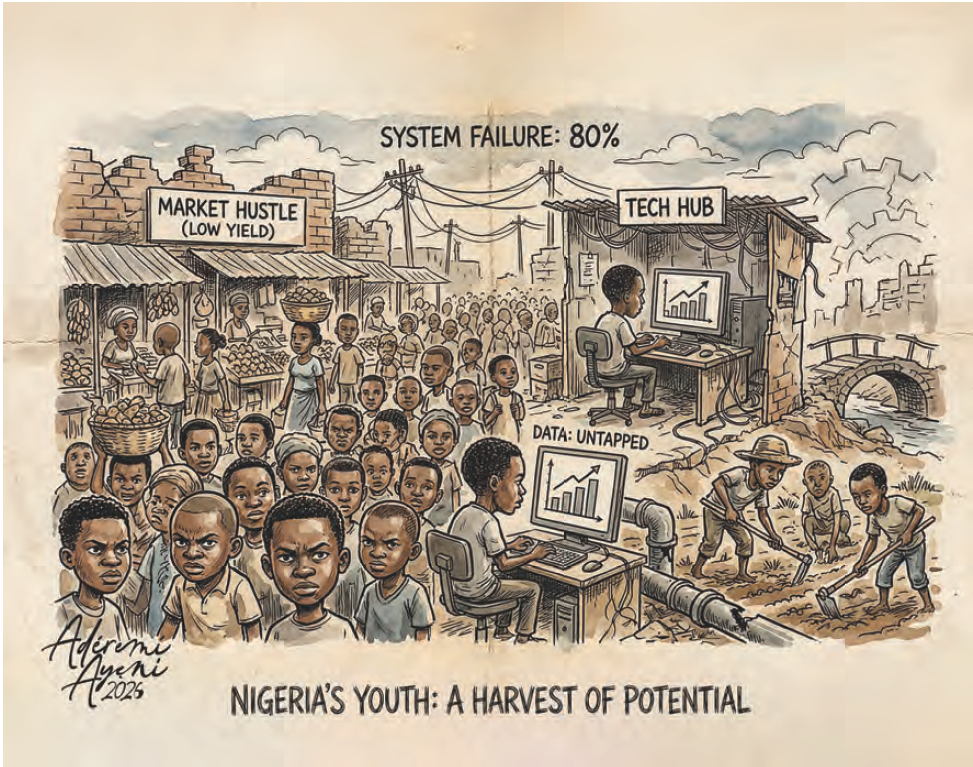
As Nigeria enters 2026 amid a stormy tax reform debate and a seemingly intractable security gridlock, the national outlook is further clouded by an all-too-familiar irony of a young, energetic population whose productive potential remains structurally constrained. While Nigerian youth are visibly and extensively engaged across the economy, their economic presence has not translated into commensurate productivity or output. This disconnect places Nigeria’s often underplayed third tier of government – the local government – at the centre of efforts to convert youth presence into measurable productivity across fiscal, security, and development policy debates.
With over 60 per cent of Nigerians under the age of 25, youth participation should be a central driver of growth. However, Nigeria continues to struggle with low labour productivity and weak output per worker. Even the 2025 GDP rebasing, which better captured informal and digital economic activity where young people are heavily represented, did not resolve this contradiction. The economy still reflects a pattern in which youth labour is widespread but economically diluted by systemic constraints. This suggests that Nigeria’s youth challenge is not merely about employment numbers, but about the structures that shape how and where productive activity occurs.
At the heart of this challenge is a critical governance question of whether improved local government autonomy can meaningfully change the trajectory of youth economic participation and productivity across Nigeria. Most young Nigerians live and work within local economies where access to skills, infrastructure, markets, and capital is determined largely at the local level. Yet economic planning remains highly centralised, with local governments playing a marginal role despite being the tier best placed to translate national policy into place-based productivity.
Much of the under-realised potential of Nigerian youth is therefore rooted in structural constraints at the local level. Limited fiscal autonomy, weak planning capacity, and misalignment between local economic initiatives and youth skills continue to restrict productive outcomes. The problem is not simply job scarcity, but the absence of local systems that convert youth effort into value. Vocational centres, feeder roads, digital hubs, local markets, agribusiness value chains, and enterprise support systems – critical enablers of productivity – remain underdeveloped across most local governments.

For decades, local governments have operated with limited discretion over funds, personnel, and priorities. State-level interference, caretaker committees, and administrative dependency have weakened their capacity to act as engines of local development. The result is a generation of young people concentrated in low-productivity informal work, subsistence agriculture, or prolonged underemployment. Productivity, after all, is place-based; when local institutions fail, national outcomes suffer.
The national debate shifted in 2024 following a landmark Supreme Court judgment affirming full financial autonomy for Nigeria’s 774 local governments and prohibiting state governments from withholding statutory allocations. The logic was clear: empowering councils to plan, invest, and respond to local economic realities could unlock productivity and expand youth contributions to GDP. In theory, local government autonomy was positioned as a development lever, not merely a constitutional correction.
However, the experience of 2025 revealed the limits of autonomy without institutional reform. A fiscal transparency assessment showed that 751 out of 774 local governments performed poorly on accountability and service delivery indicators. Many councils remained administratively dependent on state governments, while political interference continued through control of personnel and finances. Autonomy on paper did not translate into development capacity in practice.
This does not invalidate the premise; it clarifies the conditions under which autonomy matters. When effectively implemented, fiscal and administrative independence allows local governments to plan strategically, attract investment, and respond directly to youth economic needs. Simplified licensing for youth-led enterprises, local storage facilities, digital connectivity, buyer–seller registries, and inclusive programmes function best locally. Without control over resources and decisions, councils remain administrative extensions rather than productive institutions.
International experience reinforces this point. In China, decentralised fiscal authority enabled county and municipal governments to invest aggressively in industrial parks, vocational training, and small-scale manufacturing, embedding productivity within territorial governance. Vietnam and Indonesia similarly leveraged decentralisation to support small enterprises and agricultural value chains. These cases demonstrate that productivity gains are often locally generated, even when national strategy sets the direction.

Nigeria’s own experience offers partial confirmation. High-revenue local governments in Lagos State, such as Alimosho, Ajeromi-Ifelodun, and Kosofe, tend to exhibit stronger service provision and youth-focused initiatives, reflecting the productivity potential of fiscally capable local institutions. Although governance outcomes remain uneven, the pattern underscores a central lesson: economic participation scales where local capacity exists.
Translating autonomy into productivity, therefore, requires more than legal reform. State governments must respect fiscal independence, while transparency mechanisms ensure accountability. Local councils need technical support to design economic development plans that integrate youth skills, enterprise growth, and labour productivity. Federal and state frameworks should track local contributions to job creation and output, not merely expenditure. Crucially, local governments must be enabled to co-invest with private actors, cooperatives, and development partners.
As Nigeria navigates 2026, local government autonomy remains an under-utilised lever for unlocking youth productivity. When empowered, accountable, and development-oriented, local governments can shift youth participation from presence to performance. If Nigeria is serious about converting its demographic advantage into economic strength, the path forward must run through functional local governance. Productivity is not abstract; it is built where people live, work, and create value.