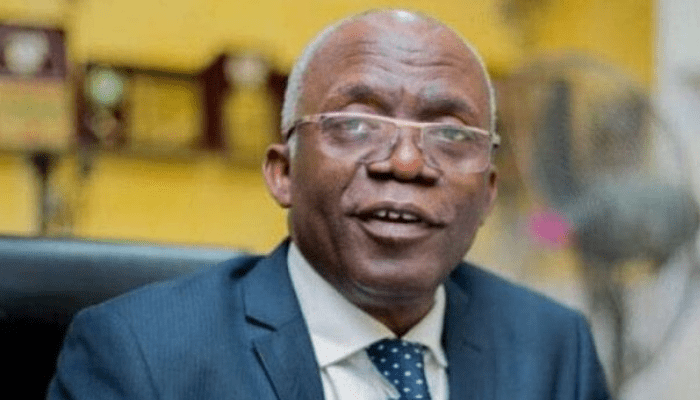
Leading lawyer and activist Femi Falana is seeking a clear timeline for the elimination of Nigeria’s multiple foreign exchange (FX) rates which some blame for holding back badly needed foreign investment from the country.
Falana has written to Godwin Emefiele, governor of the Central Bank of Nigeria (CBN), requesting precise information on the abolition of the multiple exchange rates in the country.
Writing under Nigeria’s Freedom of Information law, he wrote to Emefiele asking him to provide information about CBN’s plans to unify the exchange rates in the country.
The senior advocate of Nigeria quoted remarks by Emefiele and Zainab Ahmed, minister of finance, budget and national planning, where the duo noted that exchange rates would be unified around the I & E Window (NAFEX) exchange rate.

The Freedom of Information Request sent to Emefiele on May 24, reads: “While speaking at a virtual investors conference with the Federal Government of Nigeria organised by Citi Bank on June 23, 2020, the Governor of the CBN, Emefiele, disclosed that the various exchange rates would be unified around the NAFEX exchange rate.
“Furthermore, Emefiele dismissed activities in the parallel market as an illegal business, adding that people patronising the market are doing dealings that are not recognized by authorities.”
He added, “The CBN has always maintained that the black market is not a good determinant of the value of the naira. You’ll find that people who are in a hurry and do not want to procure the kind of documentation required, will sometimes rush to those markets. But we have used the period of this pandemic to prove that anybody dealing in that market is dealing in an illegal business.”
Falana said Ahmed confirmed the plan of the CBN to unify the exchange rates in the country.
He said: “The minister, who spoke at the interactive session on the Medium Term Expenditure Framework, organised by the House of Representatives Committee on Finance in Abuja on August 17, 2021, said the policy would end the multiple exchange rates that had bedevilled the country.

“In view of the foregoing, we hereby request you to furnish us with information on the date fixed by the Board of the CBN to end the multiple exchange rates regime and unify the exchange rates in the country.
“As this request is made under the Freedom of Information Act, 2011 you are required to furnish me with the requested information not later than 7 days upon the receipt of this letter.”
Read also: Foreign investments into Nigeria drops by 28% to $1.6bn in Q1
Investors say the multiple rates are confusing and also create chances for corruption and uncertainty.
David Malpass, World Bank president, who spoke at the International Monetary Fund (IMF) Spring Meetings in April 21, 2022, said keeping subsidies and multiple exchange rates had a huge cost deficit to the economy.
“We have encouraged the Nigerian government to rethink subsidies and multiple exchange rate systems in its foreign exchange management. Multiple exchange rate system is complicated and not as effective as it would be on a stable exchange rate,” Malpass said.
At an event in 2019, officials of CBN, IMF, and financial experts differed on the controversial issue of multiple exchange rates and its implications for the economy.
Amine Mati, the then Senior Resident Representative and Mission Chief for the IMF Nigeria, said: “Multiple exchange rates have different implications across different countries in the world. We have analysed the situation in Sub-Saharan Africa and have noticed that each country is able to succeed as a result of the policies that have been put in place to counter challenges.
“The IMF’s policy has been consistent on this issue, such that, we advise for the unification of exchange rates, and the Central Bank of Nigeria and Economic Recovery and Growth Plan are already working in this direction to ensure that the country has a unified exchange rate.”