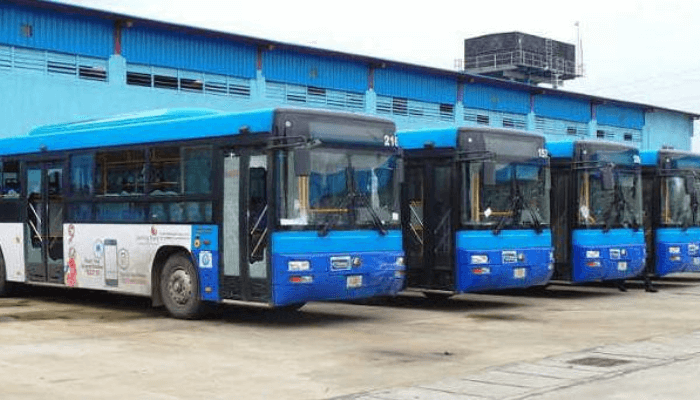
Lagos Metropolitan Area Transport Authority (LAMATA) has unveiled plans to transform urban mobility in the state through an interconnected, multimodal system.
LAMATA stated that over 90 percent of transportation in Lagos is done by road’ and over 75 percent of that is done by informal transportation.
Abimbola Akinajo, managing director of LAMATA, made this known while speaking on the Mobility Redefined Podcast hosted by Kaan Yildizgöz, mobility expert.
“We are trying now to bring about a formalisation of our public transport system. We are now in the business of trying to ensure that we have mass public transportation,” Akinajo said.

She said LAMATA has done a Strategic Transport Master Plan to identify how the authority can make that transition from the informal sector, which carries most of the informal buses, also known as danfo.
Read also: LAMATA utilises mahogany, iroko wood to construct flood drain covers
She noted that those informal buses carry from 10 to 14 passengers in each bus, while noting that over 75,000 of those buses are running around Lagos, and that is not taking cognisance of the three-wheelers and the two-wheelers.
“Now, from where Lagos is sitting, we would like to see a transition from those many buses to mass transportation,” Akinajo said.
She said LAMATA’s vision is to ensure that Lagos has an integrated, interconnected, and multimodal system.

“From our perspective, when we go mass, we would then utilise our BRT buses, which will carry nothing less than 70 to 90 to 120, depending on the length of the bus.
“We want to utilise also high capacity buses, even in mixed traffic, the rail systems that can do anything to 1,000, 1,500 passengers in one trip. So the vision is to go mass transportation,” Akinajo said.
She further said that LAMATA is carrying out a study which is the Bus Industry Transition Program, where they’re looking at ways in which they can encourage the informal sector to work with the government to go down the route of becoming players in the mass transit systems.
Read also: LAMATA engages stakeholders on purple line rail project
“So there’s the BRT buses, which are sitting in dedicated traffic or dedicated lanes, the standard route buses which are high capacity or medium capacity, which will be in mixed traffic, and then we have what we call the first and last mile buses, which are the smaller buses which is where we see the informal sector playing a larger role.
“Areas where you can’t easily reach or where the utilisation of a high capacity bus may be inefficient because of the number of patronage that we’re getting from those areas, we will use the first and last mile buses,” Akinajo said while noting that’s its taking people from as close to their homes to a bus terminal, a rail station, or a BRT terminal.
“In that sense, you will have an integrated system where every journey that you need to make from start to finish can be catered to by a public transport mode or a public transport system and obviously, when we’re talking integrated, intermodal systems, there’s so many things that has to be integrated,” LAMATA MD said.
She added that the transition is not only about replacing the vehicles or deploying technology, but a lot of impact in terms of the society and economics in the city, because you are completely reforming a full industry.