Lagos State is intensifying efforts to tackle its long-standing coastal erosion challenge with an over N3 trillion groyne technology project inspired by the Netherlands model.
Surrounded by over 20 percent water, Lagos is particularly vulnerable to coastal erosion, which regularly damages homes, displaces communities, and threatens infrastructure.
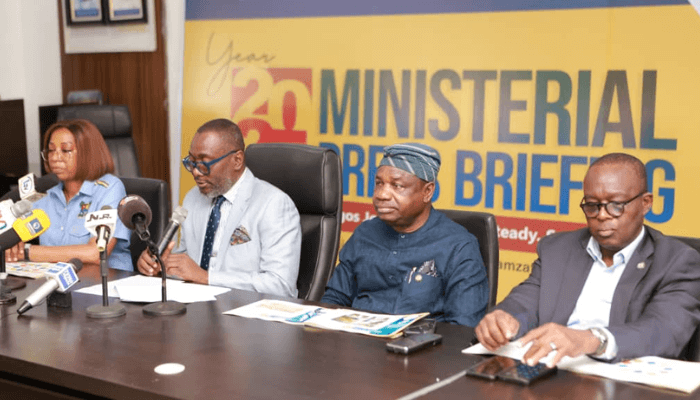
During a press briefing Monday, Ekundayo Alebiosu, commissioner for Waterfront Infrastructure Development, announced the Lagos government plans to scale up the deployment of groyne technology — a proven coastal defense structure
He noted that groynes have been successfully used to prevent beach erosion in countries like the Netherlands, where similar coastal challenges exist.

Alebiosu explained that a groyne is a rigid hydraulic structure built from an ocean shore or riverbank that interrupts water flow and limits the movement of sediment.
“Though Lagos State has already begun implementing this technology, the sheer scale of the challenge to stretch the usage along the 180 km stretch of shoreline presents a significant financial burden.”
“It costs a huge amount to construct a single groyne, and with a targeted 180 km coastal stretch, the projected cost exceeds N3 trillion, a figure that makes it clear that strategic collaboration is required,” he added.
Read also: Policy consistency key to Nigeria’s transport future – Sanwo-Olu
Alebiosu stressed the need for a Private Public Partnership (PPP), adding that the Dutch model, which integrates groynes, sand nourishment, and nature-based solutions, provides insights into how sustainable and economically viable approaches can be adapted to suit local conditions in Lagos.

“We cannot afford to delay. Entire communities are at risk, and if left unchecked, the consequences of coastal erosion could be devastating, not only to the environment but also to livelihoods and investments across our coastal zones,” he noted.
Beyond infrastructure, Alebiosu also addressed recent progress in resolving land disputes. He announced the peaceful resolution of a decade-long land dispute in Okun-Ajah and Mayegun, which had endangered the homes of hundreds of residents.
He revealed that the dispute, which had threatened the homes and livelihoods of hundreds of residents within the state schemes, was brought to a peaceful and lawful end through the visionary leadership of Governor Sanwo-Olu
“What we have achieved here is a testament to Mr Governor’s belief that governance must prioritise people, their dignity, their security, and their future. Rather than demolish homes and uproot lives, we brought stakeholders to a roundtable and crafted a legal pathway for regularising occupancy.”
“This isn’t just a resolution,” Alebiosu added. “It’s a message that in Lagos, people come first and that development will never come at the expense of humanity.”
The successful resolution is expected to set a new precedent for how land disputes and settlement issues are addressed in the state, reaffirming Lagos as a model of progressive urban governance in Nigeria.