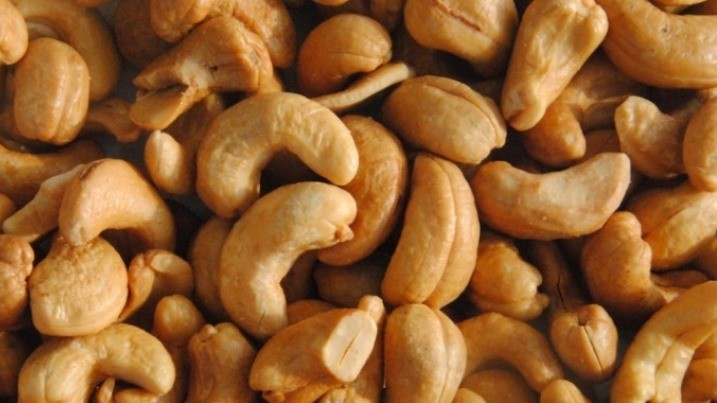
The cashew tree produces a soft, shiny and juicy fruit, known as cashew apple, which bears a single-seeded nut in its bottom covered with a hard grey shell.
This nut is the most valued product and is commonly consumed as snack or used in confectionery and cooking.
The cashew tree is a multipurpose species, and cashew products have a wide range of uses. The kernel of the cashew nut, the pseudofruit (cashew apple) and the leaves are edible. Almost all parts of the cashew tree are reported to have ethnomedicinal properties (Morton, 1987).
Cashew nuts kernels are a nutritious food as they contain large amounts of fats, protein, carbohydrates, vitamins and minerals.

Discarded cashew nuts are nuts unfit for human consumption. In the literature they are often referred to as cashew nut meal or cashew nut reject meal. They are used to feed livestock.
Cashew apples (pseudofruit) are fragile to be suitable for transport and relished only in areas of production, such as Brazil, Mozambique and Indonesia. They can be eaten fresh in salads, pressed to make juices, cooked in syrup or made into jams to preserve them.
Cashew pulp is the residue of the separation of the nut from the pseudofruit, and cashew bagasse (cashew pomace, cashew apple waste) is the residue of the juice extraction from the pseudofruit. Both products are suitable for livestock feeding. It should be noted that the term “cashew pulp” is ambiguous and sometimes used for the bagasse (Geron et al., 2013).
Cashew nut oil meal, or cashew nut oil cake, is the residue of the oil extraction from kernels. It is suitable for livestock feeding.
Cashew nut testa are the red skins that are manually or mechanically removed in the final step of preparing cashew nuts for confectionery. These skins may contain pieces of broken kernels and can be used as feed (Donkoh et al., 2012).

Cashew tree leaves can be cut and eaten fresh or cooked.
Cashew tree timber provides good firewood and can make valuable charcoal. The nut shells can be burnt to produce heat to be used in the processing of Cashew Nut Shell Liquid.
Cashew Nut Shell Liquid (CNSL), also known as cashew shell oil, is contained in the fruit mesocarp. It is a mixture of 70% anacardic acid (a salicylic acid analog, and a strong skin irritant) with 18% cardol, and 5% cardanol.
Cashew nuts is produced in 27 states in Nigeria, including the South Eastern states of Abia, Anambra, Enough and Imo. Kwara is the leading state in production volumes, but most of the exported cashew nuts are produced in the South West region.
Nigeria is currently the 6th largest cashew nut producer, with annual production of 220,000 metric tons with export value of over $160 million annually.
Cashew nuts are one of Nigeria’s most significant non-oil exports, renowned for their quality and flavor. As a major player in the global cashew market, Nigeria offers abundant opportunities for cashew nut Exporters.
Nigerian cashew nuts are highly sought after in international markets, with significant exports to countries in Europe, Asia, and North America. Vietnam and India are the largest importers, while the Netherlands is a key European destination.
The major importing countries are
Asia: Vietnam, India (largest importers)
Europe: Netherlands, Germany
North America: United States and Canada.
To boost Nigeria’s cashew production, Sonnie Uzoechi, chairman, Board of Trustee, National Cashew Association of Nigeria, urged Governors in the South-East region to initiate agricultural policies and programmes that would enhance cashew farming in the zone, like reintroduction of extension farmers, to train farmers on how to grow their crops.
This is as he also called for the establishment of processing plants for cashew, noting that most farmer still dry their produce on bare floor.
He pointed out that farmers are stampeded by merchants to sell off cashew nuts and appealed to government to build good storage facilities and rent out to farmers to store their produce.
He also called on the Nigerian Export Promotion Council (NEPC) to create synergy between government and Cashew Association to form clusters.
Uzoechi, alleged that Produce Inspectors have turned into revenue collectors instead of monitoring activities in the sector, noting that if they do their real job, which is inspection of farms that Nigeria will have quality cashew nuts for export.
The Nigerian Export Promotion Council (NEPC), the country’s lead agency responsible for the promotion of non-oil export, urges cashew farmers to add value to their nuts to create jobs and generate foreign exchange for the country.
Nonye Ayeni, executive director/chief executive officer of NEPC, in a keynote address at a-day workshop on development and production of quality cashew nut for export, organised by the Abia State Coordinating Office of the Council in Umuahia, affirmed that Nigeria currently, is the 6th largest producer of cashew, noting that the global demand for cashew has been growing at 7-10% annually, which provides great opportunities for local investors to leverage on.
The NEPC Chief Executive noted that cashew business is rewarding and more profitable, especially with value addition, through effective processing to global quality and standard, including other specific market buyer requirements, namely packaging and kernel grade.
She however regretted that in spite of huge potentials inherent in cashew nut and its derivatives, that the sub-sector is yet to experience the required growth, due to lack of skills, aged plantations and inability to add value to the produce.
In order to increase the production and develop its markets, she noted that cashew nut and its production, technology have to be promoted among the farmers, processors and other stakeholders.
According to her, adding value to Cashew nut by processing it into cashew kernels and packaging it for export, would reduce exploitation, by the foreign buyers and other middlemen.
“It is pertinent to note that if cashew nut is properly processed, packaged and exported, it would not only generate foreign exchange, but also create jobs for the unemployed youths”.
Ayeni, explained that the NEPC over the years has employed a number of promotional strategies, aimed at motivating stakeholders in non-oil sector, stressing that the hosting of the export workshop was a strategy to educate stakeholders in cashew nut sub-sector on how to progress from exporting raw cashew nut to processed cashew (kernels).
“Certainly, stakeholders in the sub-sector will discover the hidden treasure in the sub-sector and so redevelop and adapt their production techniques and products to meet requirements of the international markets in terms of harvesting processing, storage, preservation and packaging”, she stated.
Chioma Nnorom, State coordinator, Raw Materials Research Development Council (RMRDC), Umuahia, Abia State, said that the RMRDC, recognize the potential of cashew, as a strategic non-oil export commodity capable of driving industrial growth, job creation and rural development.
She said that workshop aligns perfectly with RMRDCs. mandate to promote value addition and ensure sustainable utilisation of Nigeria’s raw materials.
She said that RMRDC has made some key achievements towards the development and production of Cashew in Nigeria, like donation of Cashew Nutshell Oil Extractor to the Federal University of Agriculture, Abeokuta (FUNAAB) and the Abia State University, Uturu (ABSU).
She noted that the donation was part of a memorandum of understanding (MoU) between RMRDC and ABSU, aimed at enhancing value addition, in extracting oil from cashew nut shell.
Also, in 2015-2016 and also in 2020 planting seasons, RMRDC, distributed “Jumbo” cashew seeds/improved cashew varieties across States to replace old/low yielding trees, thus boosting production.
Policy advocacy and strategic value chain planning.
“RMRDC has emphasized utilization of non-kernel parts of Cashew (shell liquid, kernel oil among others) for industrial uses (Paints, propellants, feed among other products), thereby broadening what ‘Value’ means beyond just exporting raw kernels,” she stated.