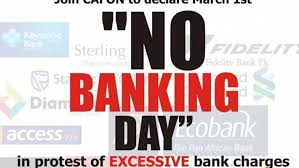
The “No Banking Day” protest conducted yesterday by some advocacy groups to push home public displeasure with the perceived excess transaction charges imposed on customers by deposit money banks, met with low compliance in many parts of the country.
BusinessDay findings indicate that this was due to poor awareness and a lack of commitment amongst the public.
The ‘No Banking Day’ was targetted at grounding at least 15 percent of banks’ revenues for the day.
The Consumer Advocacy Foundation of Nigeria (CAFON) and the Coalition of Nigerian Consumer Protection Associations had called customers nationwide to boycott banking halls.
Some of the bank charges listed by the protesters include those for SMS alert, Commission on Turnover (CoT), account maintenance fee, Value Added Tax (VAT), stamp duty, email/text messages, monthly deduction, card maintenance fee, and money transfer charges.
A visit to some bank branches in parts of Lagos State, Abia State and Abuja, show that business activities were normal as customers were seen going in and out of the banking halls without restriction.
In Abuja, the nation’s capital, lack of awareness marred the exercise as customers at various bank branches at the National Assembly Complex went ahead with normal business activities and many claimed they were not aware of the call to boycott.
Chibuzo Onyekachi, a staff of the National Assembly said he was hearing of the ‘No Banking Day’ for the first time, while another bank customer, Ahmed Idris said he thought the boycott meant all banks in Nigeria would not open for transactions on March 1.
But Shola Salako, Founder CAFCON, insisted that the protest recorded significant success, being the first time it is being convened. Salako threatened to call for subsequent actions if the banks decided to do nothing afterwards.
“Though we did not expect 100 percent compliance because we did not have enough money for mobilisation and awareness creation, what we saw today shows that we are on the right track. We visited banks in Ikeja, Adeniyi Jones, Ogba, Acme, Agidingbi and we are moving to other banks to check compliance”, Salako told BusinessDay by phone.
“I am not expecting to see any impact on the earnings of the banks, rather the impact will be more on compliant customers and businesses”, Ayodeji Ebo, head, investment research, Afrinvest Securities limited, told BusinessDay by phone.
Bank officials in some of the branches visited who spoke on condition of anonymity said business went on as usual.
The boycott was not observed in Aba, the commercial hub of Abia State.
Commercial banks in the commercial city were burstling with transactions.
The normal early morning rush was witnessed at almost all the banks visited by BusinessDay.
A banker who prefered anonymity, said she knew that the campaign would not work in Aba. She added that the average Aba businessman by his enterprising nature would see such protests as an impediment to his business.
Meanwhile, the Lagos Chamber of Commerce and Industry (LCCI) on Tuesday lauded the efforts of the Consumer Advocacy Foundation of Nigeria (CAFON) in sensitising Nigerians on the numerous charges by commercial banks.
The Director-General of LCCI, Muda Yusuf, gave the commendation in an interview with the News Agency of Nigeria (NAN) in Lagos.
He said that the “No Banking Day” boycott was a reflection of the awakening of banks’ customers to their rights, adding that the protest would put the banking institutions on their toes.
HOPE MOSES-ASHIKE, GODFREY OFURUM, OWEDE AGBAJILEKE and CHINWE AGBEZE