At TIIM’s Festival of New Work, Afro-diasporic movement artist Joachim Keke merges Afro-contemporary dance, communal ritual, and embodied storytelling in a performance where memory, care, and collective breath converge.
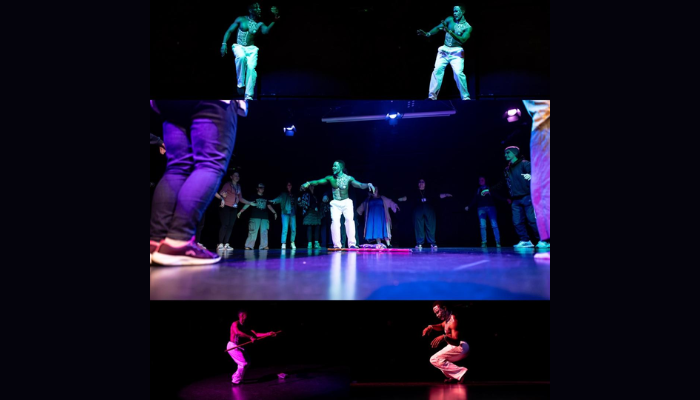
On 13 November 2025, at Theatre in the Mill Bradford’s flexible black-box studio at the University of Bradford, Afro-contemporary choreographic artist Joachim Keke begins the clinic of remembering in a quiet stillness that settles across the room almost immediately.
The stage sits at ground level, with audiences rising in tiers above it, creating a view that feels clear yet intimate. Soft amber light catches the white-and-ochre markings on his torso, designed in collaboration with multidisciplinary artist Ruth Agbolade of Upcycle Art CIC.
The lines read like fragments of memory, small inscriptions of protection. With one slow inhale, Keke draws the room into a ritual that feels both familiar and newly formed.

Developed for Theatre in the Mill’s Speculative Care programme and presented during the Festival of New Work, the piece steps away from conventional dance-theatre.
Keke is less concerned with narrative and more with examining how care appears when it is fractured, distorted, or deliberately rebuilt across diasporic lives.
Before the solo begins, he invites the audience into the space. After the room settles, he teaches a simple call-and-response phrase in a West African dialect.
At first hesitant, people begin echoing him with growing confidence. The exchange expands into a gentle rhythmic chant. Keke adds small gestures, which the crowd mirrors easily. Around twenty participants took part per showcase, the number registered for the interactive segment and the atmosphere warms quickly.
He guides everyone through a collective breath and a short sequence of African traditional healing movements: grounded, steady actions that help bodies arrive more fully in the moment. A brief spoken-word reflection follows. By the time the solo begins, the audience is woven into the fabric of the work.

The solo opens under red light. Keke’s movements are tight and angled, his breath clipped, as if bracing against an unseen weight. The imagery suggests a form of care that is conditional or withheld.
Shadows fracture the space into uneven planes as he circles a central, unspoken question: What do we lose when care becomes something we must earn?
A shift in sound ushers in warm gold.
The body softens; circles unfurl; gestures open outward. Elements of Afro-contemporary and West African vocabulary surface, shaped through Keke’s grounded, introspective style. The markings on his torso deepen the imagery, turning him into a quiet archive of memory and resilience.
At the midpoint where red fades into gold the emotional core emerges. He moves between falling and rising without offering resolution.
The soundscape, drawing on rhythms associated with Oxalá, the textured vocals of Facesoul, and long stretches of near-silence, holds the work with gentle care.
As the performance approaches its close, the movement dissolves into stillness. No return to audience participation, only a quiet, collective exhale.
When Keke steps out of the light, the room remains seated for a moment, reluctant to let the atmosphere break. If there is a tension in the work, it lies in its pacing; at times, the stillness stretches just beyond its emotional edge. Yet this slight overreach also reinforces the piece’s preoccupation with lingering, waiting, and the slow reconstruction of care.
The clinic of remembering positions Keke among a rising group of UK-based diasporic artists shaping the future of experimental performance. Here, memory becomes a kind of medicine, and the stage a site where care, breath, and possibility converge.