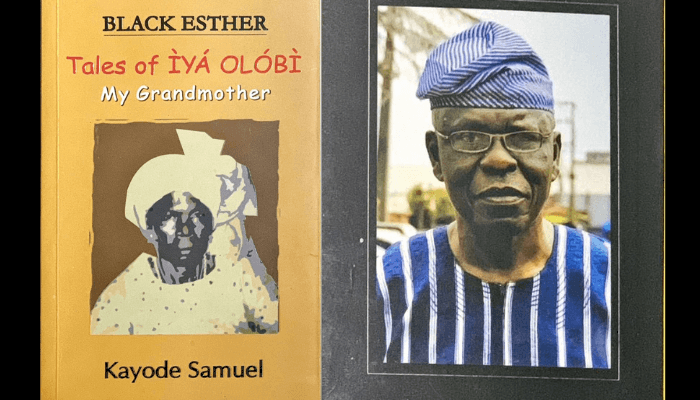
Kayode Samuel (2025), Black Esther: Tales of Iya Olobi, My Grandmother. Ibadan: Bookcraft. ISBN: 978-978-60060-4-8. 158 pages.
Kayode Samuel’s Black Esther is a poignant tribute to love, family, and the remarkable strength of women, embodied by his late grandmother. This concise yet richly detailed ode, organised into 22 evocative chapters, surpasses a simple memoir. Samuel skilfully employs a “literature of nostalgia” to guide the reader through six decades of Nigerian history, politics, and social life, all viewed through the intimate perspective of his family.
The heart of the book is Esther Asabi Samuel, known as Iya Olobi, the author’s paternal grandmother.
She is the heroine whose life provides a glimpse into a fading Lagos—a city yet to swallow its outskirts, still clinging to the charm of a rural community that will soon be lost to relentless expansion.

After spending their first five years at their maternal home in Uratta, the author and his brother returned to the family house on Old Ipaja Road. There, Iya Olobi became their pillar and the very symbol of familial love. Samuel thoughtfully examines the complexities of this relationship, depicting a woman whose deep devotion to her grandchildren contrasted sharply with her intense dislike of their Igbo mother. He navigates these contradictions with admirable patience, detachment, and understanding, sharing the story with love while remaining honest about its harsh realities.
A narrative that showcases the book’s distinctive charm is the chapter “Gowon in Kampala.” It recounts the 1975 coup that deposed Head of State General Yakubu Gowon while he was attending an OAU conference in the Ugandan capital. Samuel contrasts the international political drama with the local reality: back home in Agege, “Kampala” was the name of a house of ill repute, a brothel scorned by Iya Olobi. Upon hearing that Gowon was overthrown in a place sharing that name, she imaginatively conflated the two, reaching her own unchangeable conclusion. Such short, instructive, and often humorous vignettes appear throughout the book.
Black Esther is not a linear narrative but a collection of episodic tales, reminiscent of a television series.
This structure, while captivating, raises questions of classification: is this a memoir suitable for senior secondary schools, or a valuable reference for sociology and political science courses?
This book makes for enjoyable reading. The author shows journalistic candour, detachment, and attention to detail. His love of Iya Olobi does not result in syrupy endorsement. It is balanced yet retains the colour.

More than any other characteristic, Black Esther is a contribution to the sociology of Nigeria. It captures vignettes of the cultures and mores of Nigerians.
The lack of linearity may pose a challenge in engaging readers with the book. Should it be for senior secondary schools? Or better as a reference textbook in Sociology and Political Science?
Iya Olobi traded in kola nuts. Through this, she built networks with Nigerians from both the north and south of our two main rivers. These contacts proved valuable and responded with strong representation at her funeral in 2000.
From the title and through the narrative, the reader can feel the author’s reverence for the heroine. Take the title Black Esther.
A source book states:
“Historically and biblically, Esther is a Jewish queen from the Persian Empire, whose story is told in the Book of Esther in the Hebrew Bible. She was dark-skinned or a person of colour, given the Persian context. Her Hebrew name means “Hidden One,” since she concealed her Jewish identity while becoming queen.
Esther signifies courage, self-preservation, and bravery—risking her life to save her people from genocide. As a biblical figure, she symbolises strength, faith, and the triumph of good over evil.
The name Esther itself means ‘star’ in Old Persian and is associated with the Near Eastern goddess Ishtar, symbolising love, beauty, justice, and fertility. The story of Esther can be seen as a symbol of light shining in darkness, representing hope and divine purpose even in difficult times.
Kayode Samuel is a retired public servant who started his life as a journalist and later worked in international development. He was schooled at Comprehensive High School, Aiyetoro, Government College, Ibadan and read Political Science at the University of Lagos.
Black Esther is his first attempt at creative writing. As per the blurb, “the book is a journey through his childhood and early adulthood in post-colonial Nigeria, anchored on the tutelary presence of his late grandmother Madam Esther Asabi Samuel, Iya Olobi.
Kayode Samuel’s first work is Political Transition in Nigeria: Commentaries on Selected Themes, a collection of his newspaper essays in the Vanguard newspaper.
Samuel is a visiting fellow at the Institute of Commonwealth Studies, University of London.
Benefiting from rich production values, _Black Esther_ is an enjoyable and insightful read. It takes readers on a journey through childhood and a nation, skilfully anchored by the guiding presence of a remarkable woman.