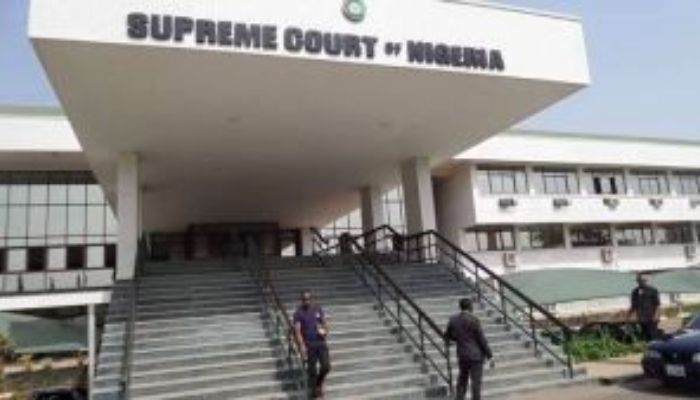
Justice comes slowly in Nigeria if you are not a politician. For many seeking justice, it comes after death. And that is because the politicians have skewed the process of getting justice at the Supreme Court in their favour.
“As at today, the apex court of the land is processing appeals from 2006-2007 and assigning hearing dates in 2020-2021” Chidi Odinkalu, former Chairman of the National Human Rights Commission tweeted on September 26, 2018.
He cited the popular case of Mojekwu –V- Mojekwu [1997] 7 N.W.L.R 283 which was decided at the Court of Appeal in 1997 after 31 years in court. The matter was to do with Ili-Ekpe customs and tradition of some parts of South-East Nigeria. The custom has to do with the right of inheritance of a female child.
The deceased died without a male child and according to the tradition the deceased’s closest male relative is to inherit his properties. The appellant, being the deceased’s nephew instituted the action against the deceased’s wife. The same matter went on appeal to the Supreme Court and judgement was delivered in 2004 – Mojekwu v. Iwuchukwu [2004] 4. S.C. (Pt.II). 1.
By the time judgement came, the original respondent (deceased’s wife) had died. In fact, by the time the matter got to the Supreme Court, she was already dead and she was substituted by her daughter. Odinkalu also raised the case of a widow whose husband died in 1981 and the matter was only decided at the Supreme Court in 2017, which was 36 years after the case was first filed. This how slow the wheels of justice winds in Nigeria.
READ ALSO: ‘PPP model is best alternative to tackle Nigeria’s massive education sector challenges’
The issue of delay is not peculiar to customary matters, it cuts across commercial, land, matrimonial and chieftaincy matters- in fact, all matters except electoral matters. Examples of corporate litigations that dragged for years include General Electric –v- Harry Akande and ors SC.337/2008. The case was filed at the trial court in 1990 and judgement delivered in 2002 (12 years after), the court of Appeal delivered its judgement in 2008 and the Supreme Court in 2012. The whole process took 22 years.
The problem seems to have been with us for long. A more painful scenario is where it took years for a matter to reach the apex court and yet the court order trial de novo. This means that the matter should start all over again at the trial court. Example of such instance can be found in the case of ARIORI V. MURAIMO ELEMO (1983) 1 SCNLR 1-the matter was filed at the High Court of Lagos State in 1960 and it reached the Supreme Court 23 years after. Painfully, the court ordered that the matter should start all over at the trial court.
The delay in the judicial process also impacts the housing sector negatively as investment in this area is often tagged as high risk investment. It takes several years for land matters to be decided. This is something developers dread as nobody wants to get stuck in prolonged litigation. An example of this situation is the legal battle between the Lagos State Government and the landlords of Magodo Shangisha Estate Scheme over the land ownership in the area. The matter was in court for 27 years. Another prominent land matter that dragged for years is the matter between the Registered Trustee of Anglican Church and the Iwaya Community in Lagos. The matter started in 1984. The matter was at the High Court for 14 years, 4 years at the Court of Appeal and 15 years at the Supreme Court (33 years altogether).
The Central Bank Governor, Godwin Emefiele, speaking at a workshop for judicial officers on mortgage noted said that the slow determination of land disputes is one of the impediments to housing sector financing in the country.
“it is generally acknowledged that one of the modern-day determinants of development in any environment is the effective protection of property and contract rights, and that this in itself requires a modest legal infrastructure embedding precise rules that are easily enforceable” Emefiele said.
This has not been the situation in the country even for matters that would have considered insignificant.
Take the case of Chief V.C Obumseli V. Chief Chinyelugo Amechi Uwakwe CA/E/36/2006. The subject of dispute in the case was a vehicle. The matter started before the Anambra State High Court in 1989 and only got to be heard at the Supreme Court in December, 2018. No final decision was reached after 29 years of legal battle. The appeal to the Supreme Court was in 2008.
The chieftaincy matter over the stool of Akire of Ikire in Osun state dragged from 1987 and the Supreme Court delivered judgement in 2014- 27 years after the action was filed in court. It must be pointed out that the matter was first filed at the apex court in 2001.
Obono- Obla, former Special assistant to the president on prosecutions and former chairman of the presidential panel for the recovery of public property, was reported to have decried the state of things at the Supreme Court through his facebook page when he stated that he filed several appeals at the Supreme Court since 2007 and has had no date for hearing ten years after.
But after his facebook post, he returned with another facebook post five days after that said he got a letter from the Supreme Court requesting that he should send a list of his cases pending at the Court of Appeal and Supreme Court. This has given fuel to allegations that registrars at the country’s apex court ask for gratification from those seeking to have a date at the Supreme Court, a grave allegation by all standards, which the apex court must seek to dismiss by introducing a high level of transparency into how dates are fixed for cases coming to the court.
A former Chief Justice of Nigeria spoke about the difficult pathway to the Supreme Court while delivering a speech at the 2013 legal year on September 23. 2013- She noted that “exhausting complete remedy in a case – from trial court to Supreme Court could take up to 20 years with the original litigants dead and substituted and in some cases the substitutes also dead and substituted”. This simply means it may take up to three generations of litigants to pursue a matter to the end in Nigeria.
But for Nigeria’s privileged political class, the road to the country’s Supreme Court has been made easy, especially when it concerns settling their legal right to rule the country. They have ensured that political cases take precedence over all other matters.
Election related disputes are treated as different from ordinary civil and criminal matters and governed mainly by the provisions of the Constitution and the Electoral Act. The provisions of the Electoral Act have been written by the National Assembly in a way as to favour quick and easy dispensation of justice.
There are special tribunals established to hear election matters only. Furthermore, the provisions of the Act outline how the whole process should go i.e. Section 134(1) of the Act states that “an election petition shall be filed within 21 days after the date of the declaration of the election result”. Also, section 134(2) provides that “an election petition tribunal shall deliver its judgement in writing within 180 days from the date the petition was filed”.
The Act further provides for how an appeal is to be treated in its section 134(3) when it stated that “An appeal from a decision of an election tribunal or court shall be heard and disposed off within 90 days from the date of the delivery of judgment of the tribunal”. Another interesting provision is in the section 134(4) of the Act, where it gives appellate courts hearing an election matter the right to first give judgement and reserve the reason for the judgement to a later date.
The provisions have been inserted to ensure that election disputes are treated with utmost urgency and this is a major reason why election matters move from Election Petition Tribunals to the Supreme Court speedily. Appeals on Governorship and Presidential matters ends at the Supreme Court while that of National Assembly and States Houses of Assemblies ends at the Court of Appeal. This also lends credence to the argument put forward by some legal practitioners that not all cases should end up at the Supreme Court.
Explaining why the National Assembly found it necessary to make create a special pathway for political justice, Deputy Senate President, Ike Ekweremadu said the inclusion of time frame in election matters was deliberate so that election petition matters can be speedily resolved.
“I recall after the election in 2003 when one of my colleagues in the 5th Senate victory was challenged. He had already finished his tenure and was in the 6th Senate when the tribunal ruled that he did not win the initial election into the 5th Senate. Therefore, what we did in 2010 was to amend the Constitution to set a time frame for filing, hearing and delivery of judgment on election petitions”.
Before the 2010 amendment of the electoral act, significant delays exist in the process of determining a winner of an election in court. There were delays in Ondo, Edo, Ekiti, Sokoto and Kogi state election matters after the 2007 general election. It took 42 months to determine former president Yar Adua’s election petition matter.
In the case of Buhari V. Obasanjo (2005) 13 NWLR (part 941) 1, Justice Pats Acholonu said “a situation where an election petition lasted more than two years for a 4-year presidential term leaves very much to be desired. It is an affront to the rule of law”. In fact, the then governors of Anambra, Osun and Ekiti; Chris Ngige, Olagunsoye Oyinlola and Olusegun Oni all stayed as governors of their respective states for three years before their election was nullified.
After 2010 Electoral Act amendment, the court’s approach to electoral matters changed as speed became an important part of the process. The election petition on the 2011 presidential election was determined the same year. Jimi Agbaje’s election petition on 2015 gubernatorial election against Akinwunmi Ambode was determined in the same year.
Analysts are now asking why are other priority matters like corporate litigations, corruption not given similar treatment- especially ones that obviously requires urgency. Various reforms to our administration of justice system have been suggested by scholars and legal practitioners.
These suggestions are aimed towards reducing the time it takes to get justice. Some of the reforms suggested are –that the windows of stay of proceedings in civil matters should be shut. This is because majority of appeals to higher courts are based on interlocutory applications and not from final decision. The implication of this is that the lower court will stop hearing the matter till the interlocutory application is determined.
It has also been suggested that the number of appellate judges be increased as the few judges in the appellate courts tend to be over burdened by the load of appeals before them. There should also be a way of quickly doing away with matters and applications that are frivolous in nature and targeted at delaying or clogging the wheel of progress in a case. No doubt, there is need for a general overhaul of our judicial system to ensure quick dispensation of justice for all Nigerians and not just for the politicians. What is good for the political class, should be good enough for the people they seek to govern.