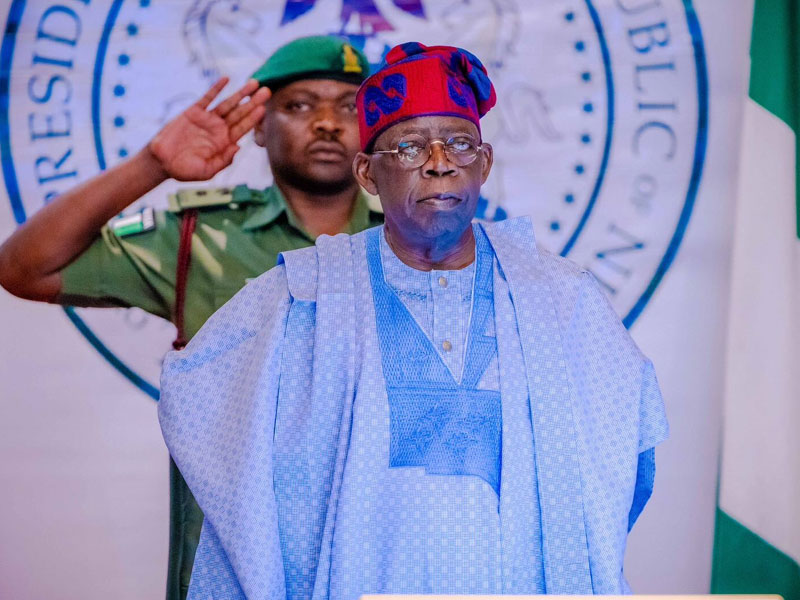
As President Bola Tinubu marks two years in office, a key question confronts many Nigerians: Is the country safer today than it was before he took power?
While government officials point to tactical successes and policy reforms, critics and security experts warn that underlying weaknesses continue to threaten national stability.
At the 2025 Ministerial Press Briefing held in Abuja, Mohammed Abubakar, Minister of Defence, highlighted the administration’s key security achievements over the past two years.
According to him, these include: improved border management, strengthened regional cooperation, and the expansion of Nigeria’s domestic defence capabilities.

One notable success, Abubakar noted, is the role of the Multinational Joint Task Force (MNJTF) in the Lake Chad Basin, where coordinated operations led to the elimination of several insurgent leaders and the recovery of previously seized communities.
Enhanced naval efforts, he added, have reduced piracy in the Gulf of Guinea, while an electronic content management system was introduced to streamline operations within the Defence Ministry.
Read also: Interrogating two years of Nigeria’s foreign policy under President Tinubu
The defence minister also reported advances in the local production of defence equipment, expansion of Special Operations Forces, and welfare improvements for personnel.
According to him, Nigeria is leveraging partnerships with neighbouring countries and regional bodies such as the Economic Community of West African States (ECOWAS) and the African Union to boost intelligence sharing and conduct joint border patrols.

However, Abubakar was quick to acknowledge that Nigeria still faces a complex security landscape, marked by banditry and kidnappings in the Northwest, farmer-herder clashes in the North-Central, and continued insurgent activities in the North-East.
He stressed that the government is pursuing a balanced strategy in combining military action with socio-economic development, civic engagement, and regional diplomacy.
Fragile situation
Yet, despite these efforts, many analysts say Nigeria’s security situation remains fragile and deteriorating.
President Tinubu’s ‘Renewed Hope’ manifesto promised sweeping reforms in the security sector, including the overhauling of the national security doctrine, the establishment of elite counterterrorism units, the deployment of advanced technology, and the protection of critical infrastructure.
Two years on, while some of these pledges have seen modest implementation, analysts warn that progress is uneven, and the security challenges facing the country have only become more sophisticated.
Mike Ejiofor, a former director of the Department of State Services (DSS), told our correspondent that early gains against terrorism and criminal networks are being undermined by political distractions and poor budget implementation.
“The shift in focus to the 2027 elections has slowed down earlier momentum. Security has become a back-burner issue as leaders turn their attention to political calculations”, Ejiofor said.
He also criticised the chronic underfunding of security agencies.
Read also: Two years of President Tinubu: Has agribusiness moved forward or merely shifted gears?
Despite significant allocations in the national budget, he claimed that less than 40 percent of approved funds are released, hampering efforts in training, procurement, and intelligence gathering.
He called on the National Assembly to strengthen its oversight to ensure full and timely disbursement of budgeted funds.
Ejiofor also emphasised the need to decentralise Nigeria’s security architecture, beginning with the creation of state police.
He argued that insurgency is a cross-border issue, making it crucial to empower local communities to serve as the first line of defence.
He also supported the controlled liberalisation of arms to responsible citizens as a deterrent measure.
On the proposed forest guard units, Ejiofor was sceptical.
He warned against the proliferation of under-equipped and poorly coordinated outfits, insisting instead on pilot projects for state-based policing systems to assess their effectiveness.
Shehu Sidiq, a security analyst, echoed these concerns, saying that despite some territorial gains against Boko Haram in the North-East, violence is rising sharply, especially in the North-West.
Sidiq identified small arms proliferation, weak border controls, and overstretched security forces as key enablers of the country’s insecurity.
According to him, Nigeria has robust policy frameworks such as the Terrorism Prevention Act and the National Counter-Terrorism Strategy (NACTEST) but they are often undermined by inter-agency rivalry, corruption, and poor coordination.
He also flagged the limited capacity of financial intelligence units to track illicit funding for terror operations through informal channels and unregulated trade routes.
Without a centralisd intelligence-sharing system, he said, security agencies continue to work in silos, leading to critical operational lapses.
Read also: Two years of President Tinubu: A business perspective
What next?
To address this, Sidiq proposed deeper institutional reforms focused on decentralisation and interoperability, including the creation of joint command centers for integrated operations.
He also called for the formal involvement of communities through mechanisms like civilian joint task forces, conflict mediation councils, and early warning systems.
Sidiq supported the forest guard initiative but suggested it be integrated into the Nigeria Security and Civil Defence Corps (NSCDC) and be clearly assigned roles related to forest surveillance and environmental crime.
“Recruitment should target locals familiar with forest terrain,” he added.
Kabiru Adamu, MD/CEO of Beacon Security and Intelligence Limited, noted that Nigeria’s security infrastructure remains weak largely due to the government’s inability to dismantle the financial, logistical, and recruitment networks of terror groups.
He noted that the military is currently engaged in multiple fronts, from the North-East and North-West to the Niger Delta and that this overstretch is increasingly unsustainable.
“Insurgents have grown more brazen, even attacking military bases to seize weapons,” Adamu said.
Despite a range of counterterrorism laws and strategies, he insisted that implementation remains patchy and inconsistent.
Adamu called for stronger public engagement and education as part of counterterrorism efforts.
“Many Nigerians still don’t know what to look out for or how to report threats,” he observed.
He also linked the worsening security outlook to regional instability in the Sahel, where jihadist groups affiliated with ISIS and Al-Qaeda are expanding.
Read also: Nigeria’s shock therapy: Why President Tinubu should press on
“The withdrawal of Nigerien troops from border regions has created security vacuums now exploited by militants,” he stated.
On forest guards, Adamu recommended a ‘take, hold, and rebuild’ model where military forces clear insurgents, forest guards hold the ground, and developmental projects follow to stabilise communities.
However, he cautioned against arming forest guards in an environment already saturated with illegal weapons.
He also criticised the lack of synergy between federal and state governments, citing incidents where governors take unilateral security decisions or negotiate with militants.
While commending Tinubu’s call for greater coordination, he stressed that only a unified, actionable national security strategy can bring lasting peace.