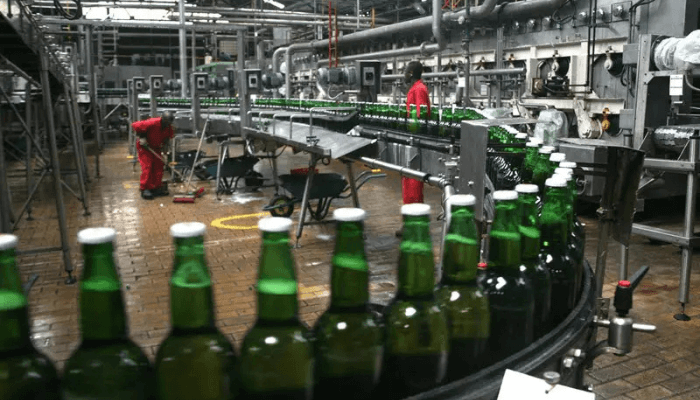
The International Breweries facility in Onitsha has become the unlikely centre of a heated political debate, merging conversations about infrastructure, governance, and economic foresight.
The frequent public spats between Anambra State Governor Charles Soludo and Labour Party presidential hopeful Peter Obi sparked the debates.
Read also: Nigerian Breweries’ Sade Morgan elevated to director of Heineken Africa
During President Bola Tinubu’s visit to Anambra, Governor Soludo took a jab at his predecessor’s priorities. “The last time a president came to this state was in 2012, ostensibly to commission a brewery,” he remarked, while pointing to the new government house and other infrastructure projects the current administration had brought the president to inaugurate. That comment ignited a spirited debate, with supporters and critics weighing in on what holds greater value—a brewery or a government house.

The Onitsha brewery had already been a point of political contention in the lead-up to the 2023 presidential elections. Critics accused Obi of investing state funds into a business allegedly linked to his family. Obi, however, consistently defended the decision, positioning it as a strategic move to attract long-term private capital to Anambra.
In a 2022 Arise News interview, Obi touted the brewery as the “biggest brewery in Africa,” stating, “Anambra State is the single highest shareholder in the facility, and I invested in over $20 million.” At the 2012 commissioning, he announced that the state government had contributed around N2 billion to what was then a new industrial venture.
Things to note about International Breweries Onitsha “SABMiller”
International Breweries Onitsha, originally known as Intafact Beverages Limited and popularly referred to as “SABMiller”, is a core subsidiary of International Breweries Plc, which also owns operations in Ilesa, Sagamu, and Port Harcourt. The Onitsha plant was launched with a capital outlay of $100 million. At inception, SABMiller held a 75 percent stake in the venture, while Anambra State retained 10 percent equity.
The ownership landscape shifted in 2016 when SABMiller merged with global beverage giant Anheuser-Busch InBev (AB InBev) in a $107 billion deal. As part of the merger, AB InBev acquired SABMiller’s interests in all Nigerian subsidiaries—International Breweries Ilesa, Pabod Breweries Port Harcourt, and Intafact Beverages Onitsha. By late 2017, AB InBev consolidated these entities into a single publicly listed company: International Breweries Plc.

Read also: How Champion Breweries defied the odds to remain profitable
This merger triggered a large-scale share swap that left Anambra State with 407.32 million International Breweries shares, roughly a 4.7 percent stake. However, subsequent rights offerings in 2019 and 2024 diluted the state’s holding to just 0.25 percent, as AB InBev consistently exercised its full entitlement and expanded its position. Where AB InBev once owned 75 percent at the end of 2017, it now controls 97.4 percent of International Breweries.
Return on Investment
Anambra State’s original N2 billion investment in SABMiller has appreciated in book value to roughly N3.7 billion. However, since the 2017 merger, International Breweries has not declared any dividends, meaning the state government has yet to realize any cash returns on that stake.
Nevertheless, the economic footprint of the brewery in Onitsha remains significant. It ranks among the highest contributors to Anambra’s internally generated revenue, primarily through taxes, levies, and the broader economic activity it stimulates. The facility has also created jobs, catalyzed downstream businesses, and reinforced Anambra’s status in Nigeria’s manufacturing ecosystem.
In 2024, the Onitsha plant played a major role in International Breweries’ total revenue of N489 billion. The momentum has continued into 2025, with the company reporting Q1 revenues of N173.6 billion, a substantial jump from N103.2 billion in Q1 2024. Meanwhile, the company’s stock has surged 63 percent year-to-date—from N5.55 to N9.05.
Read also: Legend Internet, Champion Breweries, UBA top stocks to watch this week
Government house vs Brewery
Comparing a government house to a brewery may seem like a clash between symbolism and substance. A government house stands as a monument to political power and institutional order—important, but largely ceremonial in economic terms. A brewery, however, is a functional economic engine. Backed by an initial N2 billion investment, the Onitsha brewery has evolved into a critical source of fiscal inflow for Anambra through tax contributions and industrial impact.
It remains unclear whether Intafact Beverages paid dividends between 2012 and 2017. Yet even in the absence of direct cash returns, the facility has offered broader economic benefits—employment, private sector growth, and a steady stream of tax revenues