…Farmers, agropreneurs share success stories, innovations, resilience
Once considered merely a staple food, plantain is now a rising star in Nigeria’s agribusiness sector.
With a growing demand for fresh plantains and value-added products like plantain chips, experts say farmers can earn up to N600, 000 per acre in just eight months.
Nigeria boasts a thriving market for plantain chips—a popular snack enjoyed across all age groups. According to Foraminifera Market Research, national demand for plantain chips is estimated at 5,250 tonnes annually, while current supply stands at approximately 4,575 tonnes per year.

This leaves a demand-supply gap of about 675 tonnes annually, highlighting a strong market opportunity for new and existing players in the industry.
The market size of plantain itself is about N2 trillion.
Read also: Aging trees, farmers dim Nigeria’s palm oil prospects
Urbanisation and shifting dietary preferences are fuelling demand for plantain-based products, as early entrants into the sector are already seeing strong returns and expanding their footprint.
Solid market

One of such players is Precious Otuekong, CEO of AwesomeGod Agro-Allied Industries Limited, who transformed a small NYSC empowerment initiative into a multimillion-naira plantain agro-enterprise.
“I launched my non-governmental organisation in 2012 as a platform to empower young people. However, what started in my backyard has grown into a multi-million naira plantain enterprise,” she said. “Plantain farming and processing are highly profitable—if you do them right,” Otuekong stated.
Otuekong also noted that while plantain export demand is growing, local needs remain underserved. “My passion is to help close that gap while contributing to food security in Nigeria,” she said.
In a study entitled ‘Profitability of plantain farming in Rivers State’ by Bethel Oye and his research team, it was revealed that cultivating just 0.78 hectares (2 acres) of plantain in 2024 yielded about 128 percent profit.
“In terms of estimated costs and returns, overall production cost stood at N482,010.27, while total revenue reached N1,638,000, resulting in a net income of N1,155,989.75,” the researchers noted. “This signals over 100 percent profit, indicating the viability of plantain production,” they added.
Others, like Lazeez Lawal, have built steady community-based businesses from the crop. Starting in 2020 with a modest backyard plot, he began selling plantain suckers and bunches in his area.
“From 2020 when I started plantain farming to date, my family and I have gained tremendously from it,” he said. “It has also served as a means of food and livelihood for us,” he noted.
Beyond profitability, the crop’s resilience and quick turnaround make it attractive to smallholders.
“One unique advantage of plantain farming is its early maturity (about eight months) and long lifespan of between 25 and 50 years,” said Akinwunmi Famuyiwa, a member of the Plantain Farmers Association of Nigeria (PFAN).
“Every value chain in the sector—whether farming, processing, or exports—can yield enormous returns if done the right way,” he added.
Read also: Firm distributes 266,000 cocoa seedlings, 6,000 shade tree seedlings to farmers
Why invest in plantains?
Recent Food and Agricultural Organization (FAO) data rank plantain as the fourth most important food crop globally—after rice, wheat, and milk—due to growing demand, medicinal value and its industrial relevance.
Nigeria, a top producer with 2.8 million metric tonnes (MT) to 3.1 million MT annually, exported only about $45,000 worth of fresh plantains in 2023, which is just a small fraction of the $141 billion global market, according to UN trade data.
This gap underscores untapped investment opportunities across the value chain, with players like Zifort Nigerian Enterprise, Cyrotech Farms, and Broadworld Integrated Services Limited leading in the subsector.
From plates to profits
Plantain farming now employs over 500,000 rural Nigerians, according to the National Bureau of Statistics (NBS).
Anthony David, CEO of ChiDav Agricultural Hub, highlighted how these rural farmers are tapping into fresh plantain farming and value-added products like plantain chips to earn a decent living.
“Rural dwellers are earning a living from farming plantains and making chips from it. After the first year, you don’t need to replant. Each plant can produce eight to 10 suckers annually, with the farmer earning between N300 and N1500 per sucker,” he said.
“The passion to build a life-transforming business from plantains drove me to expand. Today, I process plantains into products like organic fertilisers, hair extensions, and paper,” Otuekong noted. “Over 20 products can be derived from plantain, and no part of the plant goes to waste,” She added.
Experts note that fibre from plantain stems is now used to make sanitary towels, fertilisers, and hair extensions. Famuyiwa also highlighted opportunities in food sales. “Plantain, whether boiled, fried, or roasted, is loved by many. Selling these dishes could serve as a steady income stream,” he noted.
Its health benefits, especially for diabetic patients, and profitability are attracting more entrepreneurs. While farmers thrive, plantain suppliers now earn between 10 percent and 15 percent return on investment (ROI), analysts say.
What does it take to invest?
Plantain farming requires access to suitable land with well-drained, moist loamy soils. “Land is usually the main issue, and the cost of one hectare ranges from N500,000 to N5 million, depending on the location,” said David.
For large-scale farming, start-up costs range between N1 million and N2.5 million per hectare, according to Famuyiwa. Planting materials are a major expense. “A sucker sells for N300 to N1,500, and you’ll need about 2,500 to plant a hectare,” David explained. “While small scale farmers can use the small empty spaces in their backyards to plant suckers which will generate moderate income over time,” he added.
Read also: Oyo approves extra loan for farmers to promote food security
Farm setup includes land mapping, manuring, sucker treatment, planting, and weeding. A hectare of plantain farm can take about 2,500 stands at 2x2m spacing, though the International Institute of Tropical Agriculture (IITA) recommends 1,600 using 2.5x3m spacing. Experts say July and August are the best planting periods.
David recommended the Giant Elephant plantain variety.
“Its yield is massive from the first year, if well managed,” he disclosed.
“A big bunch of plantains currently sells for between N12,000 and N20,000, depending on size and location,” Otuekong noted.
Small-scale processing offers an easy entry. “With less than N100,000, you can start a plantain chips business,” said Famuyiwa. “All you need is unripe plantains, vegetable oil, a slicing tool, and air-tight packaging materials,” he noted.
Challenges and solutions
Farmers cite challenges such as farm theft, post-harvest losses, poor market access, and limited processing outlets. To tackle these, Otuekong advised living near the farm, owning a farmhouse, and prioritising marketing.
“I haven’t experienced farm theft because I live on my farm,” she said. “Also, most businesses fail due to poor marketing. It is important to invest in social media advertising, B2B platforms, or hire marketing managers,” she noted.
Famuyiwa, earlier quoted, stressed the need for the modernisation of farming operations. “You can’t thrive in the business if you don’t employ modern skills,” he said.
David, on his part, added that, “It is important to get well-trained farm managers or, better still, be actively involved in the business to avoid losses.”
Read also: Farmers dump rice as global glut slashes profits
Global outlook
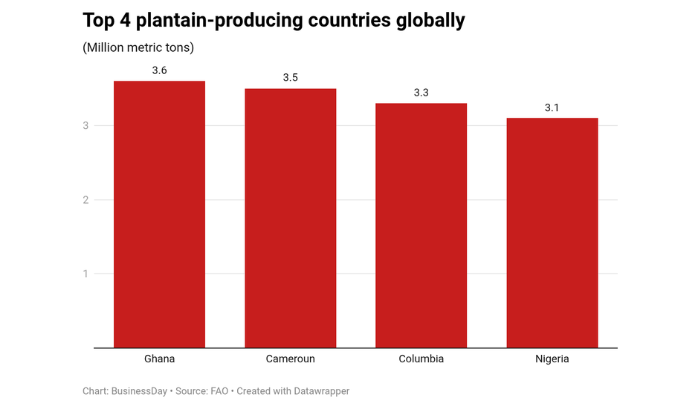
Nigeria ranks as the world’s fourth-largest producer of fresh plantains, with 3.1 million MT annually, behind Ghana (3.6 MMT), Cameroon (3.5 MMT), and Colombia (3.3 MMT), according to a recent FAO, 2022 report.
Africa accounts for about 65 percent of the global plantain output, which stands at roughly 130 million MT each year.