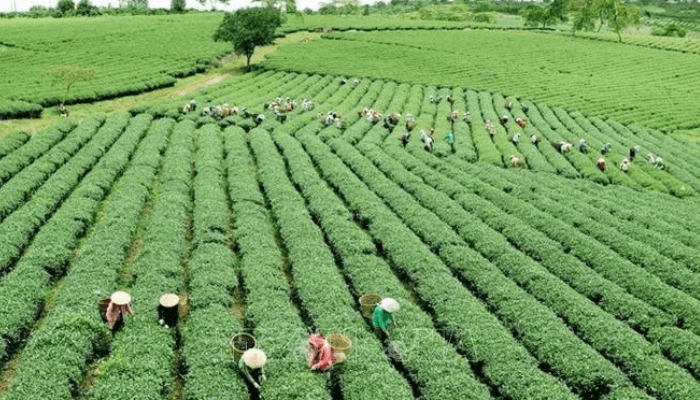
Agriculture is fast becoming a profitable enterprise. Many people desire to tap into its gains. It is on this premise that agribusinesses and farmers invite investors to become what is known as indirect farmers.
Agricultural real estate is a process where a person invests in agriculture through an agro company or an individual farmer.
These investment schemes are usually under different packages that come with a certain annual Return on Investment (ROI), depending on the type of crops and investment scheme.
It can also be in a form where a land owner leases out the land to farmers for a given period to receive an agreed ROI at the end of the year or planting season.

In January 2025, Toyosi Omotayo, chief executive officer of Palmira Farmtrade, an agribusiness firm that deals with cassava, publicised a cassava investment deal that promised 30 percent ROI in 12 months.
The deal meant that her company would cultivate the cassava farm, and all investors had to do was put their money and wait for a return.
Interested investors were to invest a minimum of N350,000 to receive an interest of N105,000 at the end of one year, including the initial capital. This would give an investor a total of N455,000.
“A lot of people want to invest in agriculture, but they don’t know how,” said Omotayo. “Since we have the farm lands, we just ask farmers in the community where our farms are located to cultivate the farms, and the investors get their interest at the end of the year.”
For Omotayo, it was a win-win situation for both her company and willing investors. “Investing in agriculture is contributing to food security. At the end of the day, the investor is assured of getting a profit and the capital.”

She revealed that several people indicated interest in the scheme. “I had to decline a lot of people who were interested in investing because I achieved my goal faster than I expected. Many people were interested.”
Nigeria has over 70.8 million hectares of arable land suitable for cultivating mainly maize, yams, rice, potatoes, and cassava, according to the Food and Agriculture Organisation (FAO). This makes agriculture a viable sector for investors.
With a population of over 200 million, food is an essential need, hence why investment in agriculture is gaining prominence. It is also leading to an overall expansion in the food sector.
Paul Olubori, founder of GoFarm, an agro investment company, said that investment in agriculture should be seen as investing in homes or land.
According to him, agricultural investment is common amongst young people who see it as investing in homes, “only that in this case, we are trying to help people plant on those lands”.
Olubori cautioned against investing in companies without reputable track records.
Beyond the gains
Investing in agriculture is profitable, but like every other investment, caution is needed to avoid running into losses.
When Cordelia Edet, an IT specialist, made millions of naira from her first investment in agriculture in 2018 with Agropartnership, an agribusiness firm involved in cash crops cultivation, she was elated and motivated to invest more of her money with the same company. For her, the first cashing out was the green light she needed to continue.
She invested a second time with Agropartnership and got an average of N500,000. Her joy knew no bounds, and so she invested a third time. Only this time, things were different. The company’s portal stopped opening. Edet and many fellow investors did not get back their capital or promised interest.
“It was good while it lasted, but apparently it didn’t turn out to be profitable at the last round,” Edet told BusinessDay in a telephone interview.
Like Edet, several Nigerians have fallen victim to fake agricultural companies. In trying to key into Africa’s most populous nation’s food security vision, they have lost millions of Naira through wrong deals.
In 2021, Uche Ugwu suffered the same fate when he invested over N500,000 in Phresh Farm, an agritech group that claimed to provide affordable food for Nigerians.
But soon after it was time to receive his ROI, the company had “issues with its account” that remained unsolved to date. “It was a huge loss for me at the time,” he told BusinessDay.
Things to check before investing
Experts warn that before investing in an agro firm, investors must be sure that it is registered under the State Corporation Commission (SCC), the central filing office for corporations in Nigeria.
This ensures that companies with questionable behaviours are easily monitored and tracked.
“The reason why it was easy for me to be a victim of fraud is that the agro firm I invested in didn’t have SCC registration,” Edet said. “If anyone is looking to invest in anything at all, look out for SCC. That way, you can get your money back if anything happens,” she cautioned.