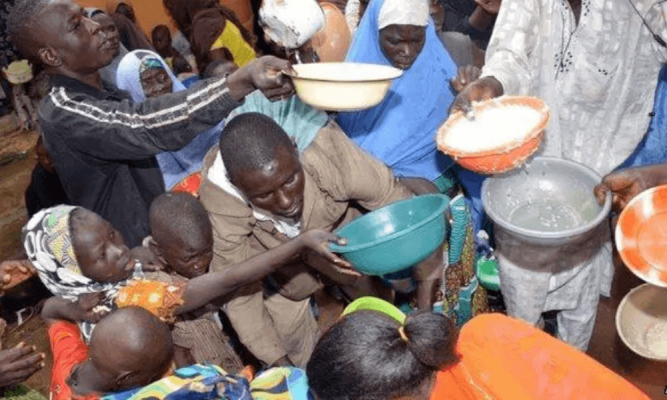
As Nigeria joins the rest of Africa to mark the 16th Africa Food Security and Nutrition Day, International Non-Governmental Organisations (INGOs) have raised fresh alarms over the country’s worsening food and nutrition crisis, describing it as “a national emergency” and “a crisis of rights.”
According to a joint report by the World Food Programme (WFP) and the Food and Agriculture Organisation (FAO), an estimated 31 million Nigerians are projected to face acute food insecurity during the 2025 lean season — making it the largest food crisis globally.
The report also indicates that 3.5 million children under the age of five are suffering from severe acute malnutrition (SAM), with 1.2 million of them urgently requiring life-saving treatment.
The findings were presented during a joint press briefing by members of the Nigerian INGO Forum in Abuja on Thursday, they include Duncan Harvey, country director, Save the Children; Thierno Samba Diallo, country director, Action Against Hunger, Nigeria; and Helen Idion, director, Program Quality and Influencing, Plan International.

Citing the report, the trio revealed that 5.4 million children nationwide are affected by acute malnutrition. Between October and December 2025, about 600,000 children under five in six northern states — Adamawa, Borno, Katsina, Sokoto, Yobe, and Zamfara — face severe acute malnutrition.
Without urgent intervention, the report warns, 96,000 children could die, translating to more than 1,000 preventable child deaths daily
Based on the Integrated Food Security Phase Classification (IPC) covering May 2024 to April 2025, the report highlights alarming hunger levels across 26 states and the Federal Capital Territory (FCT). It emphasises that hunger and malnutrition should be treated as non-negotiable human rights issues.
“Food security and nutrition must be seen as a right, not a privilege. No child should die from hunger or malnutrition — not today, not tomorrow, not ever,” the coalition stated.
The Forum called on the Nigerian government, development partners, and international donors to declare an emergency response and prioritize increased funding for life-saving nutrition commodities, including locally produced Ready-to-Use Therapeutic Food (RUTF) and Therapeutic Milk and expand targeted nutrition support for 800,000 pregnant and breastfeeding women at risk of acute malnutrition.

Read also: Nigeria’s hunger crisis deepen, ranked 115th in Global Hunger Index
It further calls for support for local production of fortified foods to enhance sustainability and community resilience, strengthen data-driven coordination through Cadre Harmonisé and IPC analyses and scale up investment in the Child Nutrition Fund (CNF) to expand life-saving impact for vulnerable children.
Humanitarian actors warn that malnutrition has irreversible effects on children’s physical growth, cognitive development, and learning capacity — with long-term consequences for Nigeria’s human capital and economic productivity.
The Forum urged that within the next three months, all available resources and efforts must be focused on preventing deaths among the 600,000 children at imminent risk across northern Nigeria.
“No child should die from preventable causes like hunger or illness,” the statement read. “This is not just a humanitarian issue — it is a test of our collective resolve.”