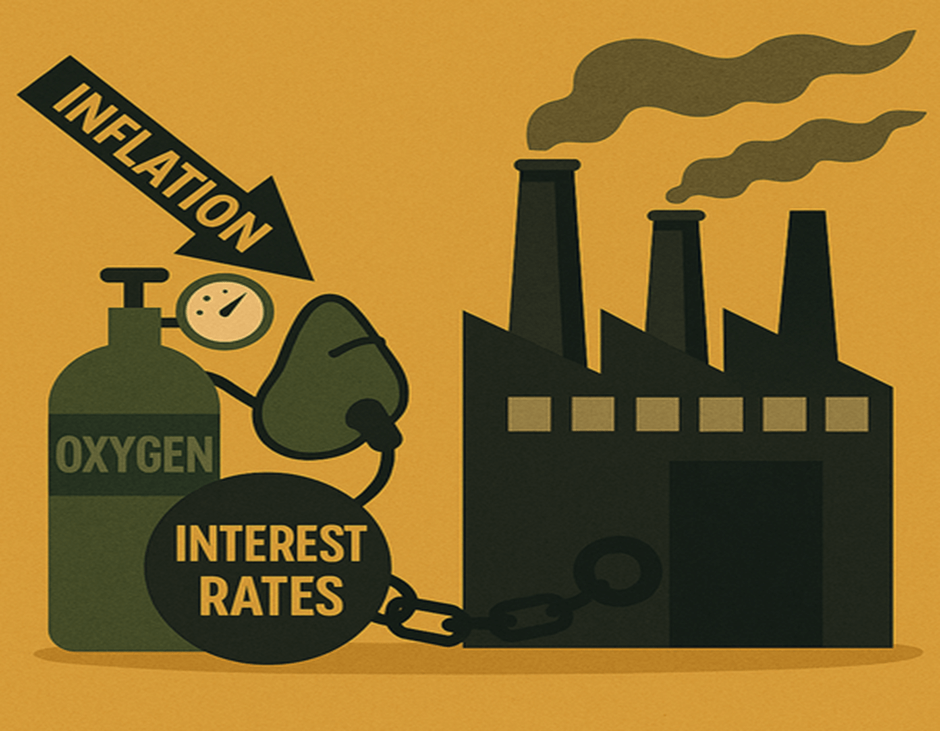
Inflation is falling, but businesses are still gasping for air
By Oluwatobi Ojabello
Inflation is cooling in Nigeria. According to the National Bureau of Statistics, the inflation rate fell for the second straight month down to 22.97 percent in May 2025 from 23.71 percent in April. After months of soaring prices, that’s supposed to be good news.
But for those who actually power the economy; businesses that grow food, run factories, and employ workers, it hasn’t changed much. The cost of borrowing remains painfully high. Investment is slow. And despite the headline relief, Nigeria’s real economy is still stuck in neutral.

In most economies, a decline in inflation gives central banks room to cut interest rates. Lending becomes cheaper, businesses borrow more, and productive investment picks up. Short-term government borrowing costs, measured by Treasury bill (T-bill) rates, also ease.
But Nigeria isn’t most economies. Inflation is falling, but interest rates aren’t. And that mismatch is choking the very sectors the country needs to grow.
A tight corner for the CBN
The Central Bank of Nigeria is trapped in a tough balancing act. Inflation is easing, but the naira remains fragile. Foreign investors are wary. Government borrowing needs are ballooning. If the CBN cuts rates too soon, it risks renewed pressure on the currency and capital flight. But keeping rates high as it’s doing now makes it even harder for the real sector to breathe.
Despite cooling inflation, T-bill yields remain above 17 percent. This disconnects points to deeper issues: fiscal stress, structural inefficiencies, and investor uncertainty. High rates are being used as a defense mechanism to attract foreign capital, stabilize the currency, and plug funding gaps in the budget. But they’re also stifling local enterprise.

Hot money over hard work
Investors aren’t irrational; they’re doing the math. With inflation down but yields still sky-high, the safe bet is to stick with short-term government instruments like T-bills. Returns of 17–22 percent on a 364-day bill? Minimal risk, fast payout.
“Why choose the hard path?” asks Adeola Adigun, an investment analyst in Lagos. “Manufacturing comes with power problems, logistics costs, regulatory uncertainty, and FX headaches. But a T-bill? You sit back and earn.”
That logic is driving capital away from production and into speculation. The result: a financial system chasing yield, not value. And that’s a problem.
What happens to growth?
“When money avoids the real economy, growth suffers. Factories shut their doors. Farmers can’t scale. SMEs struggle to survive.” says Idris Oyekan, a capital market analyst, during a group chat discussion with BusinessDay. With lending rates exceeding 25 percent, even well-run businesses can’t afford to expand. Many are cutting staff, freezing investment, or walking away altogether.
Also, a recent survey by the Manufacturers Association of Nigeria ranked lack of credit access among the top threats to industry. Inflation may be falling, but real-sector players are still being priced out of the economy.
Experts also point to Nigeria’s wide interest rate spread as a deeper structural barrier. “It discourages investment and stifles productivity,” says Mustafa Chike-Obi, Chairman of the Bank Directors Association.
Adetilewa Adebajo, CEO of CFG Advisory, adds that narrowing the spread requires greater banking efficiency and stronger policy coordination from the Central Bank.
What are others doing right?
Other developing countries have managed this challenge better.
Vietnam kept real interest rates manageable during price shocks, while supporting key sectors with targeted loans and stable currency policy. The result: continued growth in exports and manufacturing.
Bangladesh took a similar route, partnering with development banks to offer subsidized financing for textiles and agriculture. It protected investment and employment without compromising inflation control.
Both countries proved that stabilizing prices doesn’t have to come at the cost of real-sector investment.
What should Nigeria do now?
Nigeria’s policymakers must face the facts: high interest rates in a cooling inflation environment risk killing off the country’s growth engine. The answer isn’t just to cut rates but to do it smartly, as part of a coordinated reform strategy, economists say.
That means:
- Gradually reducing rates as inflation trends improve
- Cutting fiscal deficits to ease government borrowing pressure
- Fixing infrastructure and policy inconsistencies
- Restoring investor confidence through transparency and stability
Without these steps, even a well-intended rate cut won’t be enough to shift capital toward production.
The choice: Hot money or hard work?
Inflation may no longer be front-page news, but the real question now is: will Nigeria use this opportunity to invest in the right places?
Right now, easy money is winning. Capital is chasing yield, not growth. And that leaves the economy stuck, stable on the surface, but stagnant underneath.
It’s time to choose. Will we keep feeding short-term profits, or will we finally build the kind of economy that works, one investment, one job, and one product at a time?