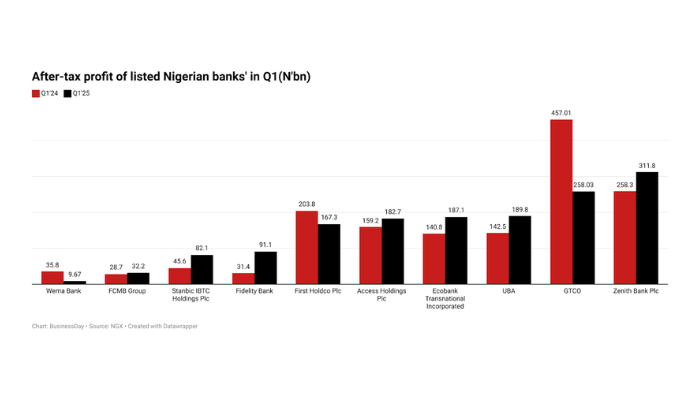
Ten (10) Nigerian banks recorded a modest 0.57 percent increase in after-tax profit during the first quarter of 2025, a BusinessDay analysis of the financial results has revealed.
The slight uptick reflects the stabilising impact of interest rate levels on income-generating operations across the sector.
The lenders surveyed include Zenith Bank Plc, United Bank for Africa (UBA) Plc, Access Holdings Plc, FCMB Group Plc, Stanbic IBTC Holdings Plc, Fidelity Bank Plc, Guaranty Trust Holding Company (GTCO) Plc, First HoldCo, Ecobank Transnational Incorporated (ETI), and Wema Bank Plc.
These banks collectively generated N1.51 trillion in Q1 2025, up from N1.5 trillion reported in the same period of the previous year.

Read also: 4 banks post 679.37 bn profit in Q1 2025, customers react over charges -NGX
Leading the pack in terms of profitability were Zenith Bank, GTCO, and UBA, posting after-tax profits of N311.8 billion, N258.03 billion, and N189.8 billion, respectively.
However, not all banks shared in the marginal gains. GTCO, despite raking in a high profit during the period, reported a 44 percent decline compared to the previous year. First HoldCo and Wema Bank also posted declines in after-tax profits, down 18 percent and 72.9 percent, respectively.
The drop signals that not all institutions have been equally shielded from the effects of monetary policy and other market variables.
This subdued growth marks a shift from the robust earnings environment experienced last year, driven largely by elevated interest rates that benefited banks’ interest income margins.

The Central Bank of Nigeria (CBN) at its 299th meeting, retained its benchmark interest rate, the Monetary Policy Rate (MPR), at 27.5 percent.
This decision followed the adoption of a rebased Consumer Price Index (CPI) by the National Bureau of Statistics. With the MPR unchanged, borrowing costs for banks and lending rates for consumers remain steady, narrowing the opportunity for banks to earn higher yields on loans and investment instruments.
Read also: Banks report increased credit availability for unsecured, corporate lending in Q1
“The flat interest rate environment is having a cooling effect on interest income for banks, even as they continue to adjust their strategies for non-interest revenue growth,” said Tunde Abidoye, analyst at FBNQuest Merchant Bank.
He added, “The CBN has closed the loophole—they’ve taken banks’ net open position to zero, meaning they can’t hold dollar assets. I expect that the trend of declining profits will continue till H1, and non-interest income will fall, which will affect earnings.”
Additionally, the MPR’s accompanying asymmetric corridor used to manage liquidity by setting upper and lower bounds for CBN lending and deposit rates also remains unchanged, reinforcing the stability in monetary conditions.
At the Nigerian Foreign Exchange Market (NAFEM), the naira has gained 3.8 percent of its value against the dollar in the last four months, closing at N1,599.70 on Tuesday compared to N1,661.12 on December 2, 2024, when transactions commenced on EFEMs.
The naira also appreciated in the parallel market, also known as the black market, gaining 3.2 percent or N52 year-to-date, as the dollar was quoted at N1,608 on Tuesday compared to N1,660 in January 2025.
The NAFEM window recorded an inflow of $735 million, compared to $1.42 billion in the previous week, a report by Coronation Merchant Bank Limited said.
Read also: Banking consolidation less likely as Nigerian banks meet capital requirements – Fitch
Net interest income rises to 36.6%
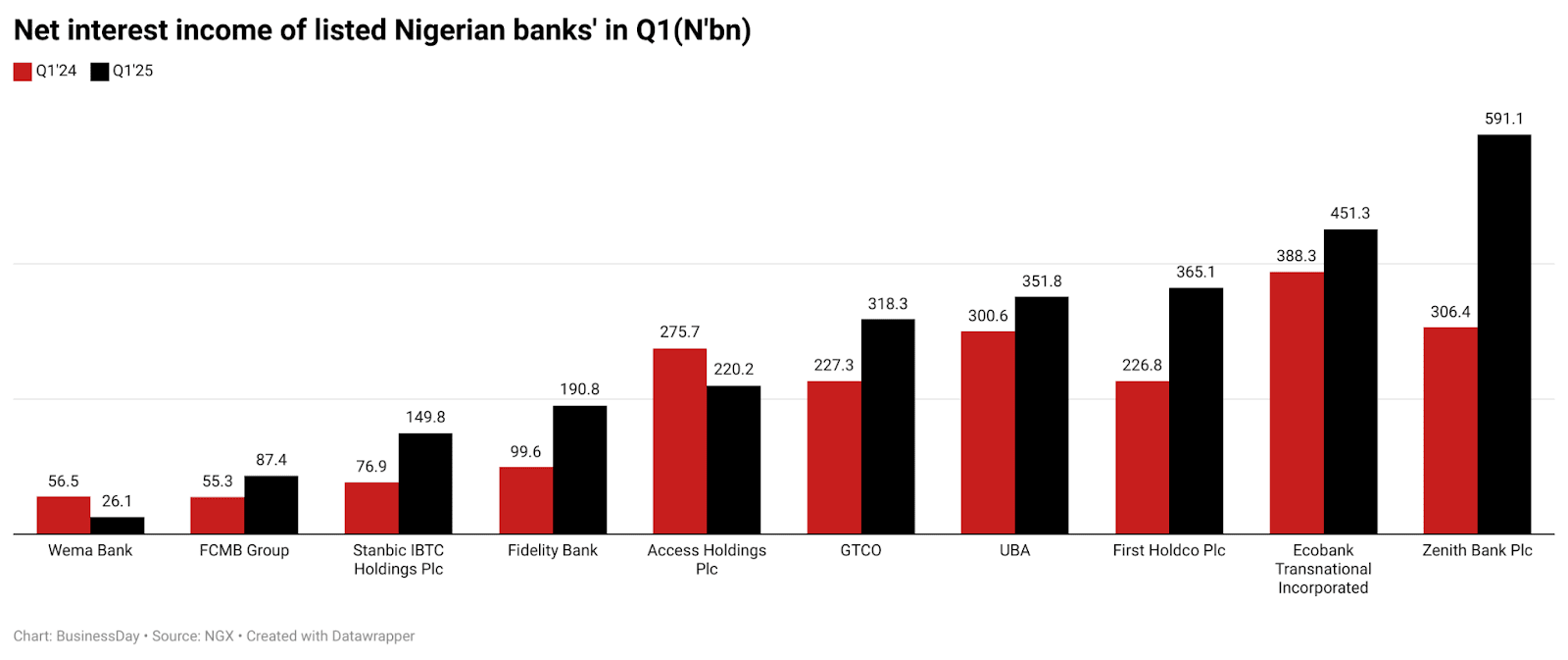
Out of the ten banks surveyed, eight reported an increase in their net interest margin during the first half of 2025.
These banks collectively reported N2.75 billion from N2.01 billion.
Zenith Bank led the pack with the highest net interest income at N591.1 billion, followed by ETI with N451.3 billion and First HoldCo with N365.1 billion.
Net interest income represents the difference between the interest income a bank earns and the interest it pays to its depositors.
The growth in net interest income is attributable to the high yield environment brought on by the interest rate raises by the CBN that seeks to rein in rising inflation and lure in capital inflows.
Despite the overall positive trend, Access Holdings and Wema Bank saw declines in their net interest income, dropping by 20.1 percent and 53.8 percent, respectively.
Read also: Recapitalisation: Banks need to raise N2.47 trillion in the next one year
Non-interest income falls by 25.7%
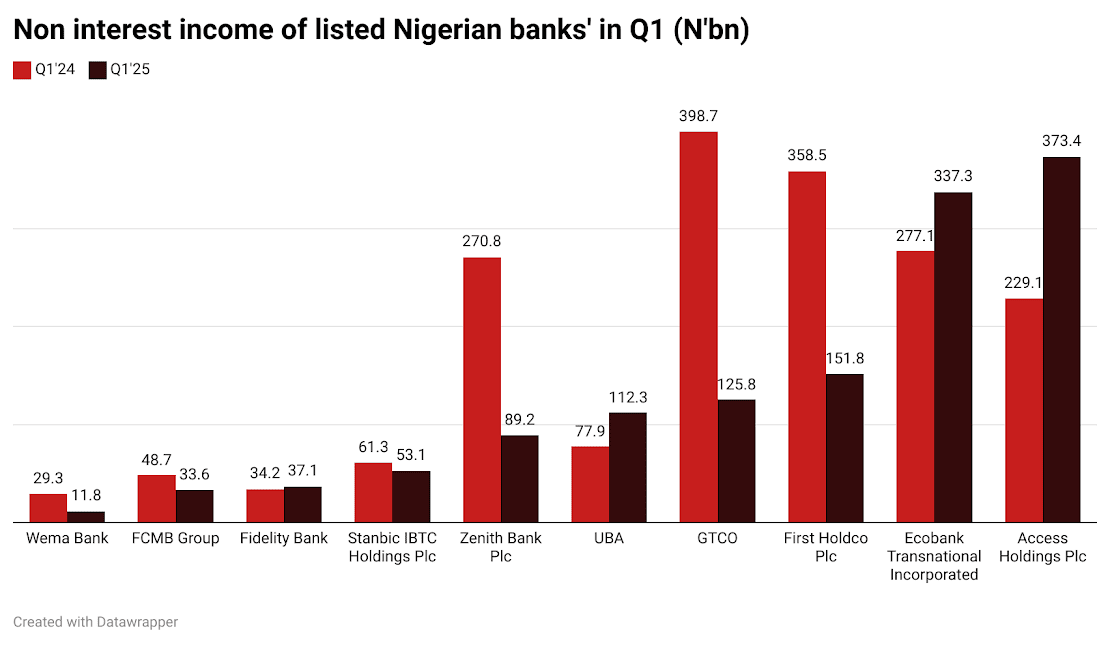
Across six surveyed banks, their non-interest income fell during Q1 as the naira maintains stability.
First HoldCo, GTCO, Zenith, Stanbic IBTC, FCMB, and Wema reported a 57.6 percent, 68.4 percent, 67.1 percent, 13.4 percent, 31 percent, and 59.7 percent drop, respectively.
This downturn is largely attributed to a significant drop in their income from investment securities, driven by the current macroeconomic environment and stable exchange rates.
Non-interest income refers to the money that financial institutions, like banks, microfinance banks, and fintech companies, earn from activities that do not involve lending or investing
According to analysts, interest rates may remain unchanged in the near term. Should that occur, banks might seek to reprice their loan portfolios downward to maintain profitability.
Furthermore, as interest rates decline, the gains from investment securities are expected to decline. While falling rates initially lead to mark-to-market gains on existing securities, over time, these benefits erode. This is because maturing securities are reinvested at lower prevailing yields, leading to reduced income from the securities portfolio.
Read also: Seven firms project N59bn profit jump in Q1 2025
Stanbic IBTC leads the pack as earnings per share rise
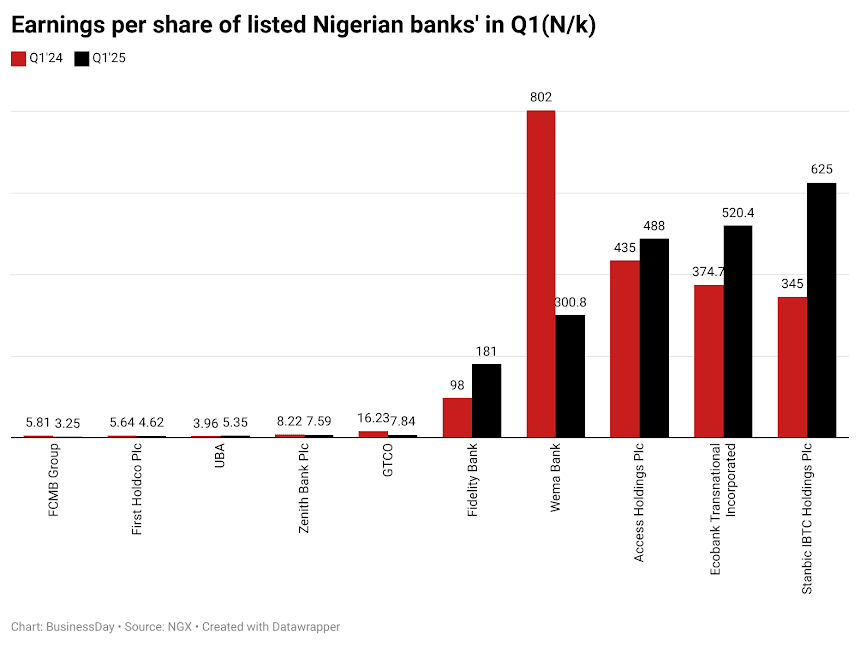
According to an analysis by BusinessDay, Stanbic IBTC recorded the highest EPS among the banks reviewed, indicating that investors are willing to pay N625 for every N1 of the bank’s stock.
In contrast, FCMB reported the lowest EPS during the period, standing at N3.25k.
Earnings per share (EPS) is calculated by dividing a company’s net profit by its total number of outstanding common shares. It reflects how much profit is attributed to each share of stock and is a key metric for assessing a company’s financial performance and value.
Read also: Nigeria’s stock market stumbles in Q1 as investors seek safety in Treasury bills
Shareholders’ fund rises to N23.1trn
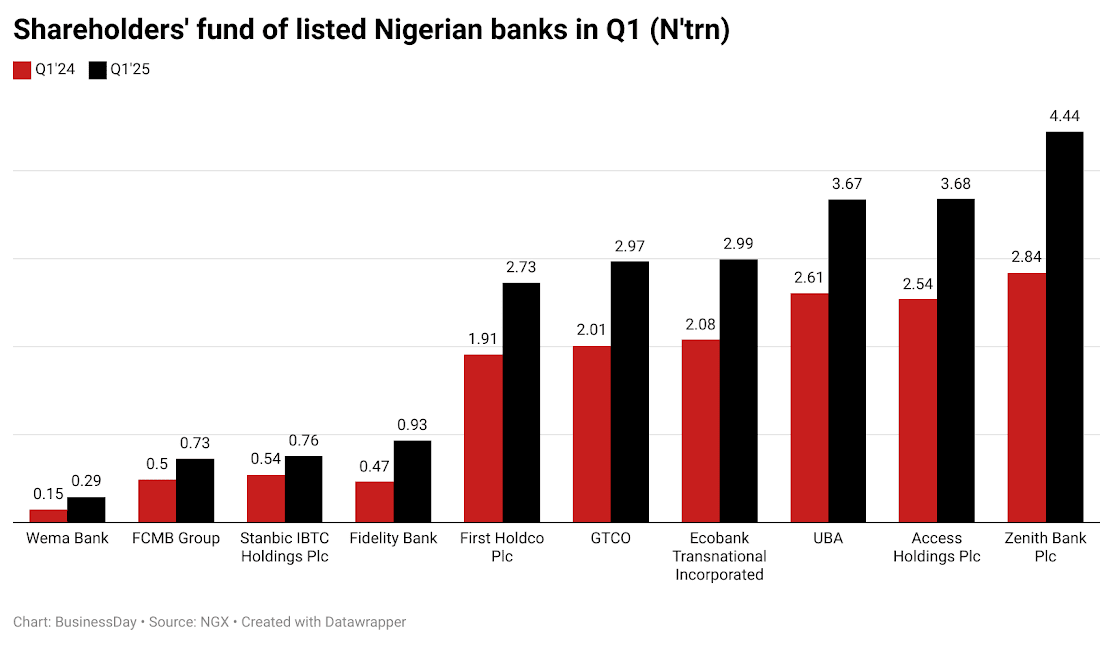
The shareholders’ fund of the ten listed Nigerian banks surveyed rose to N23.1 trillion in Q1 from N15.6 trillion in the same period of last year.
According to the BusinessDay survey, Zenith bank reported the highest rise, amounting to N4.4 trillion, followed by Access Holdings with N3.68 trillion and UBA with N3.67 billion.
Shareholders’ equity or net asset position represents a company’s net worth, which is the amount that would be returned to shareholders if a company’s total assets were liquidated and all of its debts were repaid.