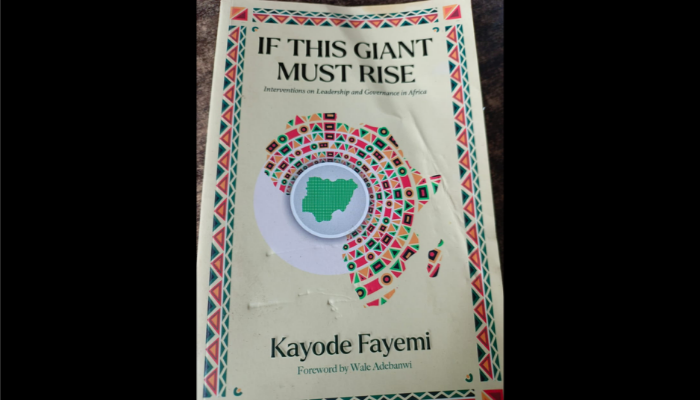
How to awaken the African sleeping giant
Kayode Fayemi (2025). If This Giant Must Rise: Interventions on Leadership and Governance in Africa. Lagos: Makere/Masobe Books & Logistics Ltd.
With Nigeria as a fulcrum, Kayode Fayemi presents a pan-African vision and analysis, much like the founding fathers. Leaders such as Mzee Jomo Kenyatta, Dr. Nnamdi Azikiwe, Kwame Nkrumah, and Chief Obafemi Awolowo held expansive visions in the era before the idea of a global village emerged. So, what does one do after serving as a two-term governor, minister, advocate, and policy enthusiast? Kayode Fayemi has chosen his well-established path of involvement and engagement with pressing issues.
If This Giant Must Rise: Interventions on Leadership and Governance in Africa by Dr. Kayode Fayemi, a Nigerian scholar-politician and former two-term Governor of Ekiti State, compiles Fayemi’s post-office reflections, including lectures and policy papers delivered after his tenure as governor (2010–2014, 2018–2022) and Minister of Solid Minerals Development (2015–2018).

Structure & Themes
The book is a rich combo of theory and practice. Sections include a rich Foreword by Prof. Wale Adebanwi, Preface, nine chapters, and a Post-script titled Moving Forward and Rebalancing ‘Glocal’ Order.
The masterful Foreword is so detailed and engaging that it should be extracted as a monograph for debate and discussion.
Key chapters include “Facing the Future with Courage and Conviction, “ “Twelve Lessons in Governance and Leadership, “ “ Addressing the Conundrum of Insurgency, Banditry, and Kidnapping, “ and “Nigeria in the Changing World Order”.
Chapter Two offers twelve lessons in governance and leadership, representing the essence of the work. It combines praxis and theory and is the must-read section of this engaging book, inviting thoughtful Nigerians and Africans to grapple with our everyday issues. In it, Fayemi distils insights from his career, emphasising institutional building (e.g., Centre for Democracy and Development), gender equality (via policies like Ekiti’s Equal Opportunities Bill), and adaptive governance (e.g., leveraging AI for development). He expresses tough love in labelling Nigeria as a “sleeping giant” due to elite failure, client-state mentalities, and reliance on foreign blueprints.

The author proposes ideological party politics over the current “election-winning machines” and local-global policy synthesis (e.g., aligning Ekiti’s reforms with UN SDGS).
In his view, Nigeria’s insecurity, featuring banditry and insurgency, is a symptom of governance gaps. Fayemi advocates instead for community-centric peacebuilding and regional cooperation. Nigeria has tackled the challenge with a centralised security architecture and apparatus. Failure has attended the efforts in the first quarter of 2025.
The core argument is Fayemi’s critique of Africa’s leadership deficit. He advocates for a blend of visionary governance, policy innovation, and Pan-African solidarity to tackle systemic challenges such as insecurity, economic instability, and global marginalisation.
Two strands are apparent in the theoretical framework of If This Giant Must Rise. One is praxis in leadership. Fayemi emphasises the interplay of theory and action, drawing from his dual identity as a scholar (PhD in War Studies) and practitioner (governor, minister, pro-democracy activist). Pan-Africanism is the other.
The book calls for a renewed African agency in global affairs, leveraging technology, subnational governance, and youth empowerment.
As a former president of the Forum of Regions of Africa, he has some exposure and experience with how this could work.
If This Giant Must Rise was released simultaneously as Fayemi’s Amandla Institute for Leadership and Policy Advancement, a Pan-African think tank that mentors next-generation leaders. A symposium held as part of the launch featured discussions on Renewing the Pan-African Ideal for Changing Times, echoing the book’s call for actionable sovereignty.
Relevance
Fayemi’s work bridges academia and policymaking, offering a roadmap for Africa’s “rise” through leadership, accountability, technological leapfrogging, and pan-African collaboration.
Kayode Fayemi’s Philosophy and Ideology: A Synthesis of Scholarship, Governance, and Progressive Politics.
Dr. Kayode Fayemi has shaped a distinctive philosophy rooted in intellectual rigour, democratic accountability, and inclusive development. His ideology, influenced by his academic background and activism, blends progressive governance with pragmatic leadership.
He has been outstanding among governors since 1999 for creating time to interrogate the issues, policies, and outcomes in Nigeria’s democratic journey.
Critics and fans alike compare him to Plato’s philosopher-king ideal, as discussed in an essay by Hakeem Jamiu.
https://www.premiumtimesng.com/opinion/772765-kayode-fayemi-a-philosopher-king-at-60-by-hakeem-jamiu.html.
The elements are a solid academic grounding, participation in the struggle for democracy and involvement in day-to-day politics. Kayode Fayemi’s philosophy intertwines intellectual depth with actionable governance, striving to balance progressive ideals with the realities of Nigerian politics.
Box: Books by John Kayode Fayemi
Mercenaries: The African Security Dilemma (edited with Abdel-Fatau Musah – Pluto Press, 2000);
Deepening the Culture of Constitutionalism: The Role of Regional Institutions in Constitutional Development in Africa (CDD, 2003)
Out of the Shadows: Exile and the Struggle for Freedom and Democracy in Nigeria (CDD & Book Craft, 2005)
Reclaiming the Trust: Reflections on Two Years in Office (Amandla, 2012)
Legacy of Honour and Service: Governance and Politics in an Election Year (Amandla, 2014)
Staying the Course (Amandla, 2018)
Unfinished Greatness: Envisioning a New Nigeria (Prestige Books, 2022).