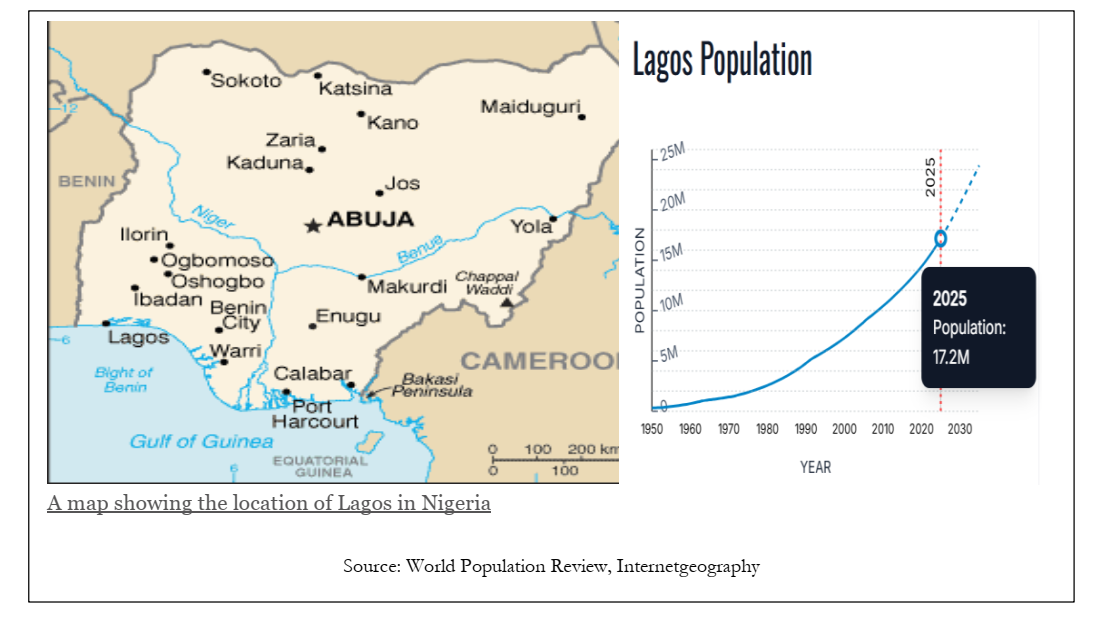
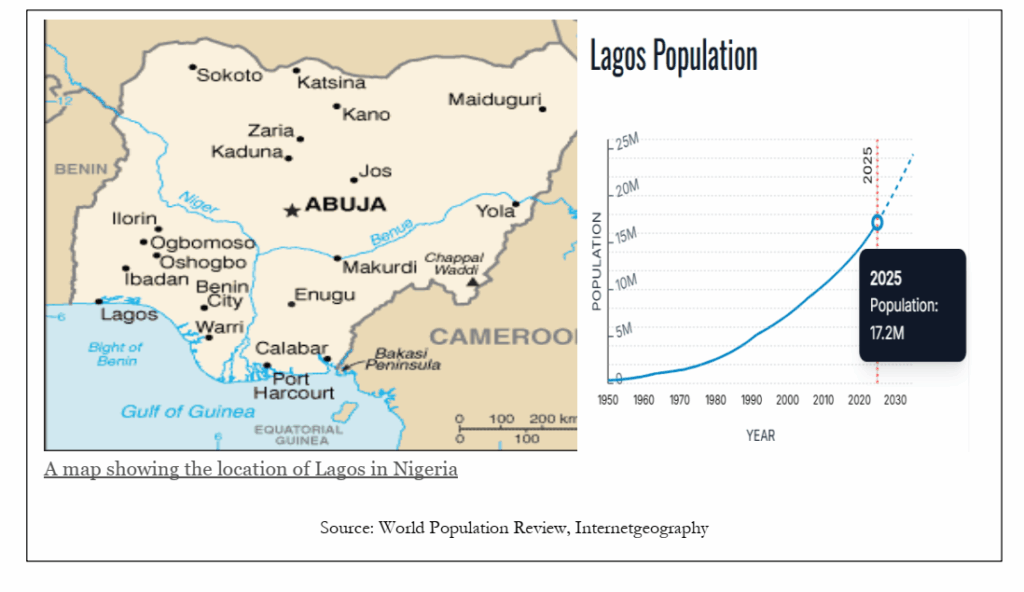
Lagos, Nigeria’s economic hub, is struggling with its rapid growth. Estimated to have 17.2 million residents by 2025, according to InternetGeography, the city faces a severe housing shortage of 3.4 million units, causing rent increases of up to 80% in some areas. Its population, growing by about 600,000 annually, has transformed what was once a modest city of fewer than one million in 1960 into a large megacity. Lagos reached four million residents by 1990 and eight million by 2015. Today, the metropolitan area probably exceeds 20 million, highlighting a crisis that surpasses available solutions.
Lagos’s intense city pressure shapes daily life even for middle–income professionals. The city’s density, at roughly 14,469 people per km², creates constant competition for land, housing, and essential services, pushing up living costs and straining overall quality of life. These pressures are reflected in external assessments such as the 2025 Economist Intelligence Unit’s Global Livability Index, where Lagos ranks as the fifth most challenging city to live in, scoring 43.5 overall and 30 on stability.
Despite being Nigeria’s economic powerhouse, Lagos faces challenges posed by rapid urbanisation: traffic jams, housing shortages, rising insecurity, and chronically underfunded public services. The constant noise, congestion, and financial strain have led to a quiet demographic shift: more residents are now looking beyond the city for space, stability, and a slower pace of life.

Ibadan’s Rising Pull
Ibadan, the capital of Oyo State, located just 120 kilometers away and once the largest city in West Africa, has the potential to relieve some of this strain. Its calmer pace, sparse population, far cheaper building costs, and the kind of open land Lagos can no longer provide make it the natural place for Lagosians to breathe again, reset, and rebuild their lives.
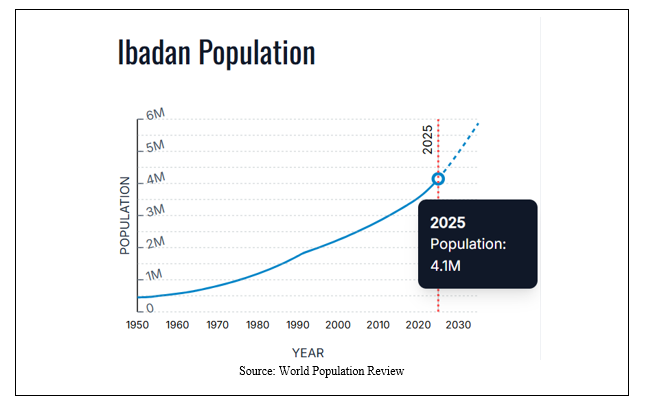
The economic factors driving this change are evident; people are primarily looking for an affordable way to live. However, it’s not only about the money; Ibadan’s lighter traffic and more relaxed pace provide what Lagosians seek daily: room to breathe. For professionals and young families, the city offers a lifestyle that is financially sensible without sacrificing other vital aspects of life.
The shift is further enabled by infrastructure development. The Lagos–Ibadan Expressway and the new standard-gauge railway aren’t just big projects; they are lifelines. They link where people work to where they can actually afford to live, making daily life more manageable for thousands.
Regional bodies like the Southwest Development Commission (SWDC), working alongside the Nigerian Railway Corporation (NRC), are also pushing to revive old rail routes. Their goal is simple: make it easier for people and goods to move freely across the region. If this multi-modal transport network continues to grow, it could be the game-changer that turns Ibadan from a backup option into a true, long-term counterpart to Lagos, reshaping how people live, work, and imagine their future in the Southwest.

A Path to Middle-Class Relief
The rising cost of living in Lagos is redefining what many Nigerians once saw as the middle-class dream: owning a comfortable home in the city. For countless families, that dream now feels out of reach. And so, without any grand policy push or government directive, people are naturally drifting toward Ibadan in search of something more attainable.
The difference in cost is staggering. In Lagos’s hotspots like Lekki, a 4-bedroom terrace easily starts above ₦120 million, often climbing far higher. But in Ibadan, you can get the same kind of home, sometimes even bigger, for ₦40 million to ₦60 million. And it’s not just the price, you get more land, room to park without stress, and a calmness that Lagos’s density simply can’t offer anymore.
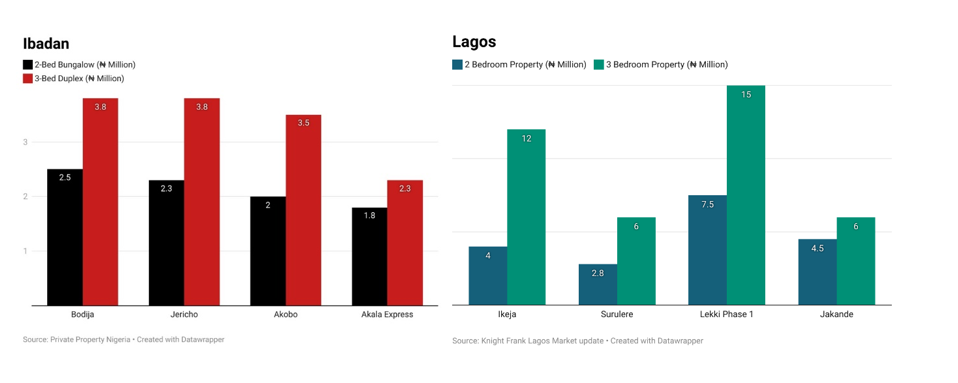
This extraordinary value proposition explains why new gated estates are springing up across Ibadan’s growth corridors: Akala, Elebu, Ajibode, Apete, Akobo, and Alalubosa. They want room for their children to play, neighbourhoods that feel safe, mornings without traffic anxiety, and evenings where they can actually hear themselves think. In Ibadan, families are rediscovering the possibility of building a stable, balanced life; something Lagos’s relentless pace has made increasingly difficult.
This affordability gap is rapidly facilitating the dream of a higher quality of life. Developers in Ibadan are currently focused on building spacious residential communities that prioritise living space and security, offering homes where children have room to play and traffic-induced stress is minimised. Combined with an operational Lagos–Ibadan rail link and highway improvements, this infrastructure will effectively shrink the distance between the two cities, allowing professionals to maintain ties with Lagos while enjoying a peaceful, asset-building life in Ibadan.
The Nigerian government’s push to strengthen intercity transport, especially through rail, makes Ibadan increasingly attractive. If urban planning is carefully managed, through zoning, transit-oriented development, and strong building standards- the city can grow gracefully, maintain affordability, and avoid the inefficiencies that plague Lagos. In doing so, Ibadan offers not just homes but a healthier, more balanced way of living for its residents.
For Ibadan to develop in a way that genuinely benefits both new and longtime residents, smart planning is crucial. The city needs housing that can grow sustainably, neighborhoods that remain affordable, and development that respects the environment. If executed properly, Ibadan can provide not just homes, but a healthier, more balanced lifestyle for the increasing number of families choosing to start anew there.