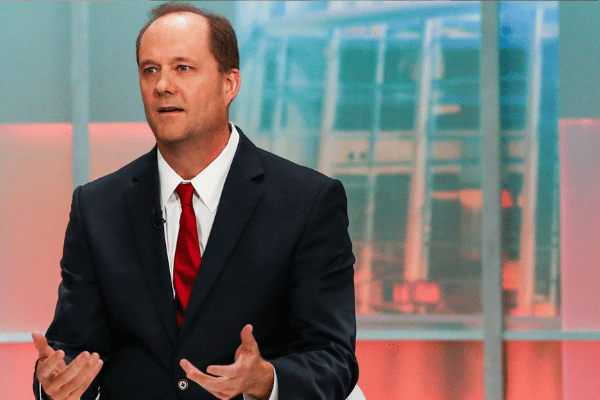
HSBC’S efforts to build a strong franchise in the US — long a priority of the London-based, Asia-focused bank — have again come up short of its own expectations. But the outgoing head of the US operation insists that, despite years of struggle, it has no plans to withdraw from any of its US businesses or to reduce its investment in the country.
While the bank abandoned its 2020 US profit goal this week, that was “in no way an abandonment of the strategy”, Patrick Burke told the Financial Times. “We are facing headwinds from the interest rate environment and market conditions [but] we are committed to the strategy. We think it’s going in the right direction.”
That strategy has focused on winning business from companies and consumers with strong international links. “We don’t see anybody in the market who has our model,” Mr Burke said. But analysts are split on whether the turnround will gain traction.
The abrupt departure of John Flint, HSBC’S global chief executive, announced with half-year results on Monday, captured headlines. But lower down in the same statement was the news that the bank’s US unit would not hit its target of a 6 per cent return on tangible equity (ROTE) in 2020 — a goal the company set as part of a strategic update just a year ago.

Relative to its peers’ results, the target looked modest. HSBC’S US operation, which encompasses commercial, investment, and retail banking, has over $300bn in assets, enough to make it one of the 20 biggest banks in America. Many of those others boast returns in the low double digits. But the 2020 target was ambitious in the context of the US operation’s 2018 ROTE, which was just 2.7 per cent.
Analysts have speculated that a change in US strategy might be in the works after the company announced changes to its American management team last month. Mr Burke, 57, chief executive of HSBC USA since 2014, will retire in October and be replaced by an outsider, Michael Roberts, who previously led Citigroup’s global corporate bank. The company has also announced that Kavita Mahtani, another Citi veteran, would assume the role of chief financial officer of the US unit.
Mr Burke was emphatic that while the leadership team was changing and market conditions have changed, the strategy and its justification have not.
He said that true returns of the US business were not fully
captured by standard metrics, because big US customers also generate revenue for the bank in other regions. It would be impossible to win international business from those clients without serving them in the US as well, he said.

HSBC North America’s efficiency ratio — its costs as a proportion of its revenues — remains over 80 per cent, very high by industry standards. But, Mr Burke argued, operating efficiency would come with higher revenues, and the bank was finally in a position to grow.
As recently as 2017, the emphasis in the US unit was putting its regulatory troubles behind it. A money-laundering scandal earlier in the decade, culminating in $1.9bn of fines in 2012, as well as smaller run-ins with the authorities in foreign-exchange trading and mortgages, kept the team focused on updating governance and controls rather than expansion.
These regulatory tangles followed a painful financial crisis for HSBC in the US. The bank bought subprime lender Household International for $ 14bn in 2003, and ultimately wrote down the entire purchase price, and more.
Mr Burke pointed to HSBC’S increased marketing investment at the US retail bank as an engine of growth. The US was “the most international country in the world by far”, he said, and the retail bank was going after customers who were born elsewhere and have economic links back home.
Loans at the retail operation grew by 8 per cent in the second quarter from the year before, but deposits fell. The division operates at a loss.
Wall Street analysts were split on whether persistence in the US makes sense for HSBC. “This is a business that has been unprofitable since the crisis — different strategy, different management, I am not sure that it will make a huge difference,” said Ed Firth of Keefe, Bruyette & Woods.
“I don’t see the competitive advantage in the US . . . Why does HSBC have to [have a big operation] in the US to give access to global markets to US clients?” he asked, suggesting that those clients could be served from other global hubs.
Magdalena Stoklosa of Morgan Stanley disagreed. “I buy into the strategy — I just think they have given themselves too little time,” she said, welcoming the incoming management team. “The objective is to steady the ship and scale the commercial bank . . . but by dropping the target they have opened the door to rethinking the execution of the strategy.”