Trade wars aren’t just about Washington and Beijing, they shake economies worldwide, and Nigeria’s banks aren’t spared. As tariffs rise and supply chains strain, our financial sector faces risks that could shake its foundation.
While oil remains Nigeria’s top export, financial services have become the backbone of our economy, contributing 57.38 percent to GDP in Q4 2024. Banks fund trade, infrastructure, and businesses, but their reliance on foreign credit and investment makes them vulnerable to global economic shocks.
Trade Tensions Are Everyone’s Business
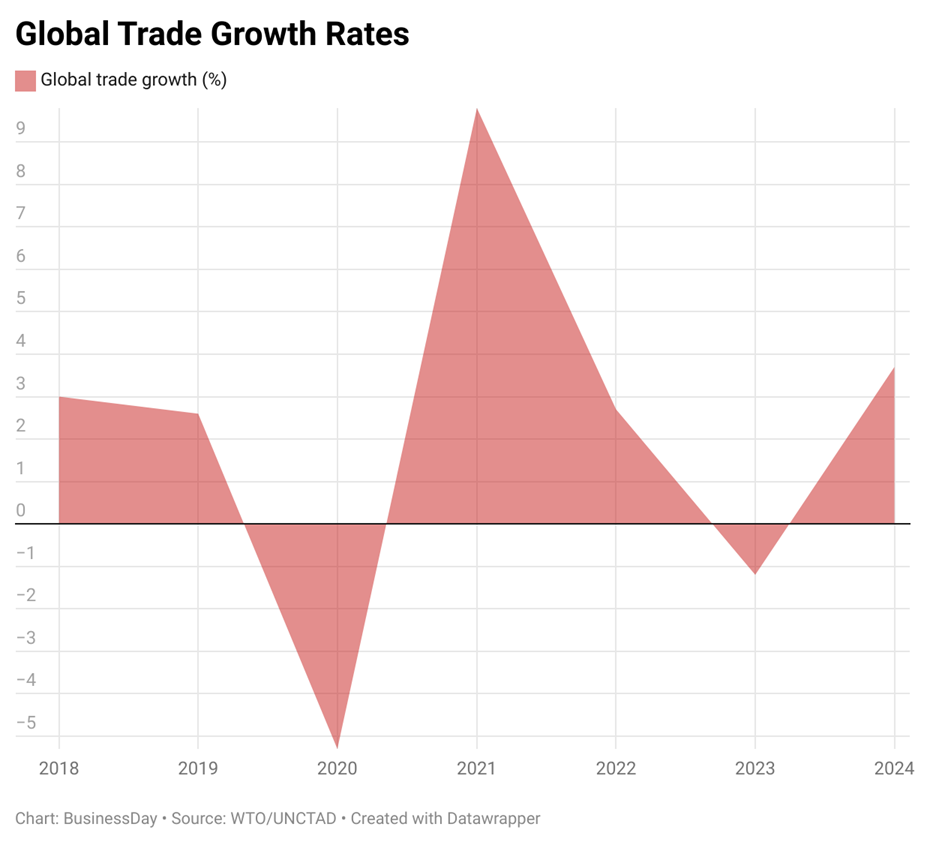
The U.S.-China trade war in 2018 was a lesson in how deeply interconnected economies are. Global trade fell by 1.2 percent in 2019, the sharpest drop since the 2008 financial crisis. For Nigeria, weaker oil demand led to a drop in foreign exchange inflows, hitting the naira and shaking investor confidence.

Foreign investment in Nigeria fell by nearly 30 percent between 2018 and 2020, according to the National Bureau of Statistics. This made it harder for banks to finance trade and meet foreign currency obligations.
To ease the pressure, Nigeria and China signed a $2.4 billion currency-swap agreement in 2018, allowing direct naira-renminbi exchanges and reducing reliance on the U.S. dollar. While this helped, liquidity pressures persisted.
Muda Yusuf, CEO of the Centre for the Promotion of Private Enterprise (CPPE), highlights three key implications of the tariff war: trade, investment, and currency stability. He notes that while Nigeria is exposed to risks, it also has opportunities.
“Most affected countries, including the U.S., will be seeking new trading partners, and this presents a chance for Nigeria to expand its trade relationships.
If positioned correctly, Nigerian businesses could benefit from trans-shipment and export opportunities, particularly in sectors where we hold competitive advantages.”

He further explains that import substitution could emerge as an advantage, allowing Nigerian industries to replace goods from sanctioned economies.
“If we can develop local industries to produce alternatives to imported goods, we can deepen trade partnerships and attract fresh investments into export-driven sectors,” Yusuf adds.
Why It Matters Now
The risks are back. New trade restrictions, not just between the U.S. and China but across major economies, could once again disrupt Nigeria’s financial stability.
The IMF warns that a fragmented global economy could shrink world GDP by 7% in the coming years. For Nigeria, this means potential losses in export earnings and even tighter foreign capital inflows.
The naira has already lost over 40 percent of its value in the past year. In response, the Central Bank of Nigeria has hiked interest rates to combat inflation, but higher borrowing costs are squeezing banks and increasing loan defaults.
Foreign investment remains sluggish, dropping more than 20 percent in 2023. Meanwhile, non-performing loans (NPLs) jumped 16 percent in H1 2023, reaching ₦478 billion. Key sectors, manufacturing, oil and gas, and trade are struggling with external shocks and rising costs.
The Nigerian Economic Summit Group (NESG) warns that banks must prepare for further trade-related disruptions. Rising tariffs are driving up the cost of imported goods, hurting businesses and raising credit risks for lenders.
What Banks Should Do
Banks must act now to protect themselves. Strengthening capital buffers is crucial to absorb potential shocks. Diversifying funding sources by reducing reliance on foreign borrowing and increasing local deposits will also be key.
Some banks are already taking action. Expanding across Africa and leveraging the African Continental Free Trade Area (AfCFTA) could provide new opportunities and reduce dependence on volatile global markets.
The NESG advises banks to enhance risk assessment frameworks, ensuring they can manage the impact of trade conflicts on clients and financial stability. Banks also need to support local manufacturing, helping reduce Nigeria’s reliance on imports.
Foreign exchange risk management is another priority. Offering hedging tools can help businesses navigate currency volatility and protect against sudden shocks.
The Bottom Line
The 2018 trade war was a wake-up call for emerging economies like Nigeria. In 2025, history may repeat itself. Nigerian banks cannot afford to be caught off guard.
Trade conflicts may not cause immediate disruption, but their long-term effects could be severe. Staying ahead of global shifts is no longer optional; it’s a necessity for survival.