Gone are the days when tax was an afterthought handled by back-office staff. Today, tax strategy sits at the heart of business and wealth planning.
Nigeria’s 2025 Tax Administration Act marks a turning point in how companies and high-net-worth individuals (HNWI) plan and manage their taxes.
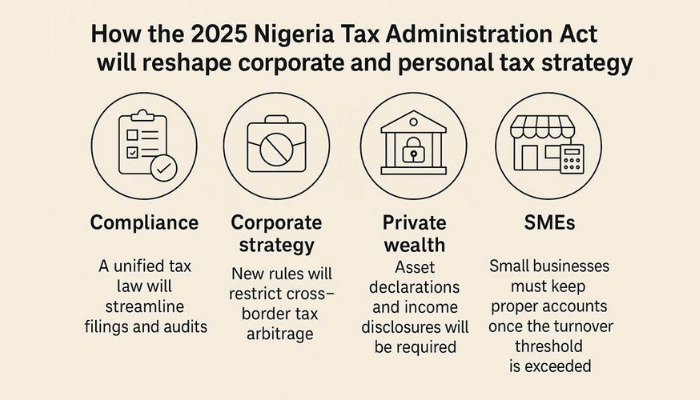
The Act unifies multiple fragmented tax administrative laws into a single legal structure. The goal is to simplify compliance, eliminate duplication, improve audit efficiency, and close long-standing revenue leakages. But beyond these reforms, the law is triggering a shift in mindset across corporate boardrooms and private wealth offices.
According to PwC Nigeria, the Acts “comprehensively overhaul the Nigerian tax system to drive economic growth, increase revenue generation, improve the business environment and enhance effective tax administration across the different levels of government.”

Read also: Nigeria’s Free Trade Zones get 3-year countdown to adopt new tax laws
KPMG adds that the new law is intended to “modernize tax collection processes, enhance compliance, optimize revenue, and promote accountability within Nigeria’s tax system.”
Corporate strategy: No more arbitrage
Previously, firms could delay filings, take advantage of weak oversight across tax agencies, and structure transactions across jurisdictions to minimise exposure. The new Act puts an end to that. It introduces standardised forms, timelines, audit cycles, and penalties across the board.
Taxpayer Identification Numbers (Tax IDs) are now mandatory for all entities doing business in Nigeria, including non-resident firms with Nigerian-source income. Tax filings, remittances, and contract documentation must all carry this ID.

Self-assessment has become the default model. Businesses must file complete and accurate returns, including accounts, computations, and evidence of payment. The Nigeria Revenue Service (NRS) is now empowered to issue assessments, demand books, and enforce compliance using digital records.
This has forced companies to rethink how they organise their accounting systems, transfer pricing documentation, and intercompany transactions.
Many businesses are investing in software upgrades to capture and process tax-relevant data in real time. Legal teams are reviewing internal approval processes, because mistakes are now easier to detect, and objections must be filed within set periods. Delays in resolving disputes could lead to frozen accounts or denied refunds.
Private wealth: Transparency takes centre stage
The reforms also reshape tax planning for high-net-worth individuals (HNWIs). Under the new law, asset declarations and income disclosures are now compulsory, including for offshore holdings. With automatic exchange of information gaining ground globally, Nigerian taxpayers with accounts in jurisdictions like Dubai or Mauritius are under growing scrutiny.
All personal income tax filings must now reflect total income not just employment earnings but also investment income, capital gains, and business profits. Documentation is no longer optional. Records must be kept and presented in case of audit.
Wealth advisers are encouraging clients to review trusts, shell companies, and nominee arrangements to ensure they meet the new transparency rules. Penalties for non-disclosure include asset seizure and criminal prosecution.
Sector impacts: Compliance in motion
A few industries are already taking early action. A cement company listed on the Nigerian Exchange has begun a six-month compliance review. The aim is to clean up legacy filings and prepare for the Act’s full implementation.
In fintech, platform-based firms are hiring additional tax staff and integrating invoice systems with the NRS to meet digital transaction requirements.
Real estate developers are under increased scrutiny too. The Act emphasises documentation of ownership, land title disclosures, and tax on capital gains. Projects without clean filings are now struggling to access financing.
SMEs: Simplified but not excused
Small and medium-sized enterprises (SMEs) are not excluded from the new tax regime. While the 2025 Act offers simplified filing and grace periods for businesses earning below ₦25 million annually, once that threshold is crossed, full compliance begins requiring Tax ID registration, record-keeping, and e-filing.
Section 117 exempts smaller firms from e-invoicing and some reporting requirements, while Section 119 mandates the NRS to create digital tools tailored for them.
But waiting until growth forces compliance can be costly, experts warn. And further recommend adopting simple accounting systems early and keeping personal and business finances separate.
What Businesses should do now
i. Confirm Tax ID status for all legal entities
ii. Map all return deadlines and payment obligations
iii. Align Enterprise Resource Planning (ERP) and accounting systems with filing requirements
iv. Archive and reconcile VAT, PAYE, and withholding tax data
v. Train authorised signatories on objection protocols
What HNWIs should consider
i. Compile a full ledger of income sources and asset holdings
ii. Review structures used to hold offshore wealth
iii. Update declarations and keep supporting documentation
iv. Monitor timing and amount of tax payments to avoid penalties
Final thought
The 2025 Nigeria Tax Administration Act is not just a new law. It is a new standard. It demands clarity, discipline, and planning. For corporates, tax must now be embedded in core strategy. For individuals, the margin for secrecy has narrowed.
Compliance now starts before the audit. And in this new regime, survival will depend on how quickly you adapt.