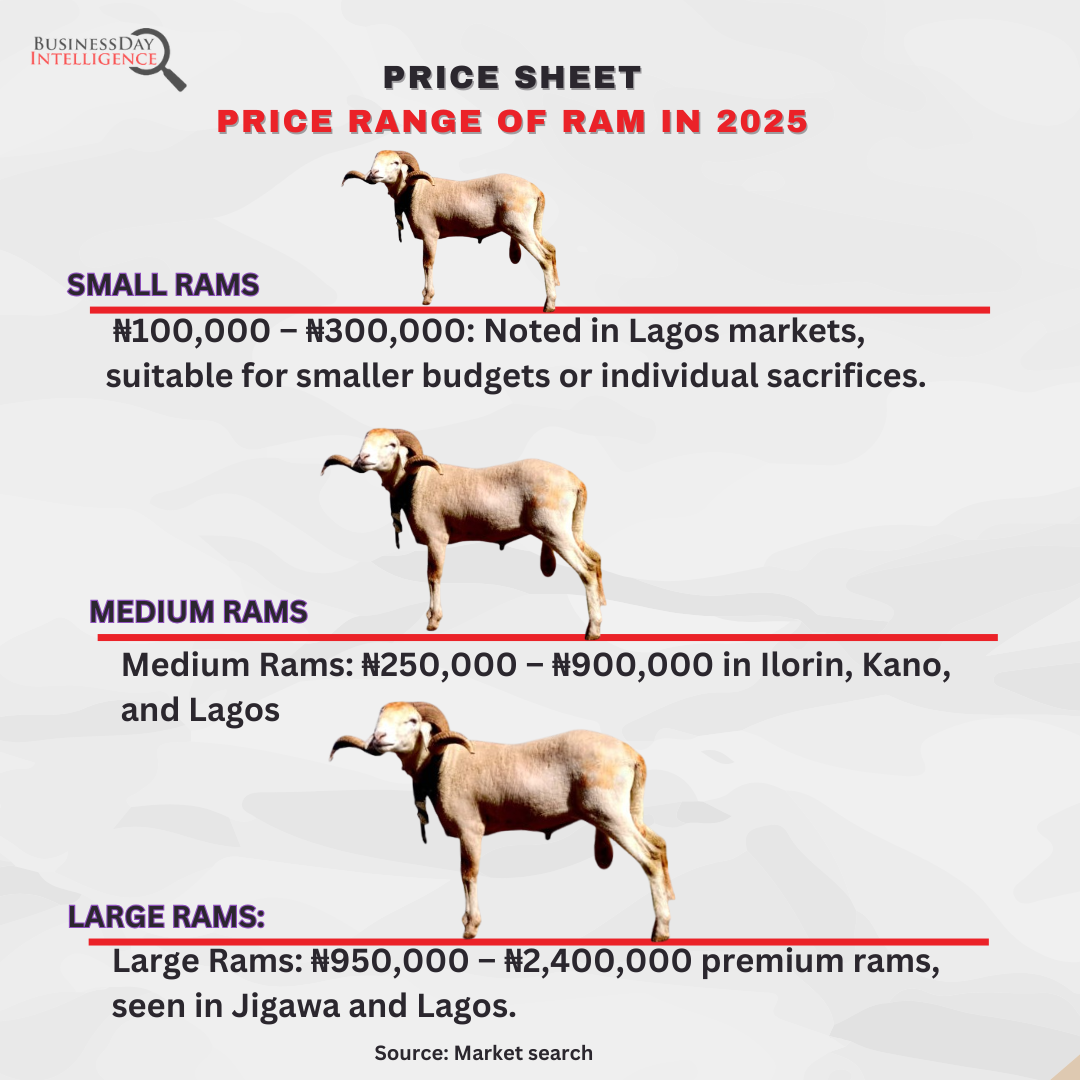
As festivities begin to mark Eid-el-Kabir also known as Sallah , soaring prices of rams are reshaping traditional celebrations across Nigeria, forcing many Muslim faithful to reconsider how they mark this sacred festival.
For millions of Nigerian Muslims, Eid-el-Kabir or Eid al-Adha is a time to honour Prophet Ibrahim’s willingness to sacrifice his son to Allah by slaughtering a ram or other halal livestock. But this year, the economic realities are rewriting that tradition.
Across major cities — Abuja, Lagos, Kano, Sokoto, and Yola — the price of rams has surged dramatically, pushing many households out of the market for this symbolic animal sacrifice. With inflation skyrocketing, insecurity disrupting livestock supply chains, and feed prices climbing, a growing number of Nigerians are turning to more affordable alternatives like goats, chickens, and cooperative cow and camel purchases.


Ram prices surge 45–100% across major markets
From Lagos to Abuja, ram prices have exploded, with some animals now costing nearly double what they did last year. According to a Market research by Daily Trust, traders in Ipaja, Lagos report medium-sized rams that sold for about N120,000 in 2024 now fetching between N220,000 and N250,000, with premium breeds hitting nearly N1 million.
In Abuja, the Federal Capital Territory, prices are even steeper. At markets like Unguwar Sabon Tasha and Kwali Area Council, small rams that went for between N120,000 and N150,000 last year now sell for between N200,000 and N250,000. Medium-sized rams have jumped from N200,000-230,000 to N270,000-300,000, while the big-sized ones are now priced at N450,000 to N520,000 — up from last year’s N300,000 to N350,000.
At Gwagwalada cattle market, medium-sized rams cost between N250,000 and N300,000 this year, compared to N170,000 to N200,000 in 2024. Large rams have risen from N350,000-400,000 to N600,000-750,000.
In Kano, where markets remain relatively buoyant despite inflation, an average ram costs between N200,000 and N250,000. Larger rams fetch up to N800,000, with some selling for as high as N1.5 million. According to Professor Abdulmalik Auwal, chairman of livestock dealers at Gandun Albasa Market, sales have slowed but are ongoing, with many buyers waiting until the last minute or after salary payments.

In Yola, prices have also jumped sharply, with medium-sized rams costing upwards of N750,000 in some cases. Supply here has tightened due to reduced local rearing and a sharp decline in imports from Cameroon and Chad, a consequence of unfavorable currency exchange rates and rising feed costs.
|
Location |
Ram size |
2024 Price Range(N) |
2025 Price Range(N) |
%increase (Approx.) |
||
|
|
Medium |
120,000 |
220,000-250,000 |
83%-103% |
||
|
Abuja (Unguwar Sabon Tasha & Kwali)
Abuja (Gwagwalada) |
Small
Medium
Large
Medium
Large
|
120,000-!50,000
200,000 – 230,000
300,000-350,000
170,000 – 200,000
350,000 – 400,000 |
200,000-250,000
270,000 – 300,000
450,000-520,000
250,000 – 300,000
600,000 – 750,000 |
67%
30%
50%
47%-76%
71%-114% |
||
|
Kano (Gandun Albasa) |
Average |
150,000 – 200,000 |
200,000 – 250,000 |
33% – 25% |
||
|
Yola |
Medium |
150,000 – 200,000 |
650,000 – 750,000 |
325% – 275% |
||
|
|
|
|
|
|
Credit: Based on interviews conducted
What’s driving this price explosion?
The surge in ram prices reflects a complex mix of factors.
Inflation and economic pressure: Nigeria’s inflation rate, driven largely by rising food and transport costs, reached a 30-year high of 34.8% in December 2024. Though it declined to 23.7% by April 2025 after the rebasing of the consumer price index, it ticked up again slightly to 24% in May. The consistent price hikes have severely eroded household incomes and savings, shrinking consumer purchasing power.
Feed and transport costs: Prices for animal feed have nearly tripled from around N3,000 per sack last year to over N8,000. Transportation from livestock hubs like Sokoto to Lagos or Abuja now costs over N1.5 million per truck, pushing final prices even higher.
Security challenges: Insecurity across Northern Nigeria has made open grazing routes unsafe and disrupted livestock supply chains. The government’s ban on livestock imports from neighbouring countries such as Niger Republic has worsened shortages of smaller, more affordable rams.
Reduced local rearing: Losses and high costs have pushed many small-scale herders out of the business, further reducing supply.
Alternatives to the traditional ram

Faced with these rising costs, many Nigerian Muslims are recalibrating how they celebrate Eid-el-Kabir — opting for more affordable or communal alternatives that still fulfill religious obligations.
Goats
Goats remain the most popular substitute for rams due to their affordability and religious acceptability. Prices range from N35,000 to N80,000, depending on location and size.
Chickens and turkeys
Some are turning to poultry. While not traditional for sacrifice, Islamic scholars affirm that intention is what counts.
“I may buy three big chickens,” says Muhammad Abdullahi, a buyer in Abuja. “I pray Allah gives me the means to afford a ram next year.”
Cooperative cow and camel purchases
A growing trend is where groups pool money to buy a cow or camel for collective sacrifice. This practice is increasing sharply in places like Sokoto.
“We started this when individual costs became unbearable,” explains Malam Salisu, a community leader who spoke to Daily Trust. “Last year, we contributed N250,000 each; this year, N350,000 per person. It’s a way to share costs and get more meat.”
Religious leaders emphasise flexibility and intention
Islamic scholars and imams are stepping in to guide communities through these tough times.
Sheik Fuad Adeyemi, national chief Imam of the Al-Habibiyah Islamic Society, says:
“A six-month-old ram or a one-year-old goat is permissible. Seven people can jointly buy a cow. Those who can’t afford a ram can borrow interest-free, with repayment expected.”
Ustaz Ismail Mohammad from Ilorin adds: “Allah sees the heart. It’s about intention. Even if you offer a chicken, the effort counts.”
The human side
For many Nigerians who spoke to newsmen, Eid-el-Kabir is about faith, family, and gratitude — not just the size or type of sacrificed animal.
Zainab Yusuf, a provision seller in Agege, Lagos, shares her approach:
“I priced a ram last week at N220,000. I just smiled and walked away. I’ll buy a turkey or two big chickens, cook well, invite family, and still celebrate. Sallah isn’t only about rams — it’s about gratitude.”
Similarly, civil engineer Bashir Adebayo from Lagos says:
“I might buy a smaller ram or a goat. What matters is the sacrifice, not the size.”
Economic impact beyond the festival
The ripple effects of rising ram prices are felt beyond the festival itself. Livestock traders are struggling with inventory and cash flow, with many scaling back purchases or exiting the business. Some report that fewer customers are willing to pay even the minimum prices, forcing traders to consider price cuts or offloading stock at losses. Consumers are diverting budgets from other essentials, increasing pressure on household finances.
Adapting traditions amid economic realities
While the high prices and supply challenges cast a shadow over this year’s Eid-el-Kabir, they also highlight the resilience and adaptability of Nigerian Muslims.
From group sacrifices and alternative animals to an emphasis on intention and faith, families and communities are finding ways to uphold tradition without breaking the bank.
Muhammed A. who spoke to BusinessDay, is hoping that his decision to hold out until the last minute before going ahead to buy a ram will getting him a fair price. Fingers crossed. “When I heard the prices, I was supprised” he said.
In a country where economic headwinds continue to batter households, the essence of Eid-el-Kabir — sacrifice, reflection, and gratitude — remains intact, even if the rams are fewer.