A new rhythm is stirring in Abuja, a city too long seen through the haze of official documents. This awakening finds its voice and vision through Olorogun Jeff Ajueshi, the curator of the inaugural Abuja Art Fair, whose personal journey is deeply woven into the event’s ambitious fabric. His curatorial statement for the theme, “Art in the Heart of Nigeria”, frames the fair not as a mere exhibition, but as a deliberate act of cultural centering—both geographically and philosophically. It is an assertion that art must be the core from which a nation’s identity and discourse pulse outward.
Read also: SOTO Gallery stages first show at ART SG, Asia’s largest art fair
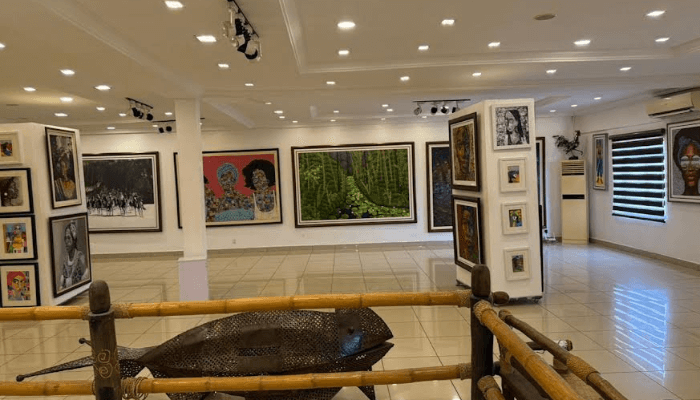
The five-day gathering is the culmination of a vision nearly two decades in the making. The curator’s own trajectory, from founding the Thought Pyramid Art Gallery in 2007 in a city then perceived as culturally dormant to establishing a nationwide network of creative centres, mirrors Abuja’s own evolution. The fair stands as his, and the city’s, most definitive intervention—a challenge to the established hierarchies that have long concentrated Nigeria’s artistic conversation in a few urban centres. It is a purpose-built platform designed to democratise and celebrate a truly pan-Nigerian creative ecosystem. “Abuja became the canvas upon which my vision for a transformed Nigerian art ecosystem took shape, grew, and eventually became fully realised with the establishment of our purpose-built centre,” Ajueshi says.
The works selected for the fair are chosen to provoke and to question. They engage with the urgent themes of the times—from environmental sustainability and governance to technological transformation—interrogating them in the very heart of the nation’s democracy. This convergence of modern and contemporary practices is not accidental; it reflects a mission to articulate the complexity and resilience of the Nigerian spirit.

Read also: Nigerian art on spotlight at +234 Art Fair
What unfolds from December 3-7, 2025, is therefore more than a programme of events; it is the natural evolution of a foundational belief in art’s capacity to reshape perception. The fair represents a transition from building individual spaces of excellence to establishing a continentally significant cultural institution. It is a long-term commitment, born from perseverance, to shape the trajectory of African art.
For observers of Nigeria’s cultural landscape, the Abuja Art Fair is a compelling study in how a personal vision can align with a city’s moment of transformation. Under the curator’s guidance, the event becomes an invitation to a nation to collectively demonstrate that when art is placed at the heart of a nation, it has the power to influence the entire body politic. The city, long defined by its administrative purpose, is now being redefined by this aesthetic ambition, signalling that Abuja is ready to be seen not for the memos it produces, but for the masterpieces it gathers and the dialogues it inspires.