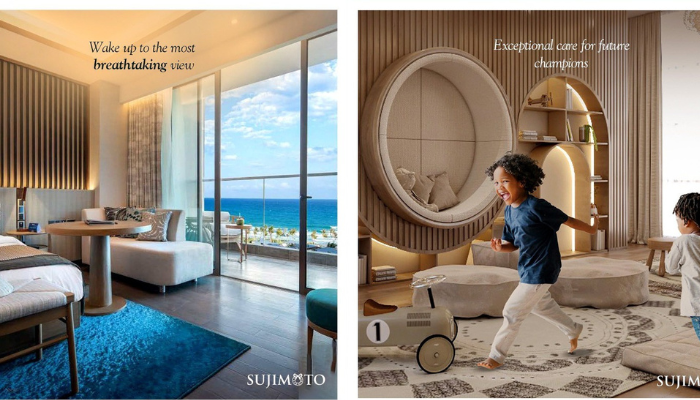
In Nigeria’s luxury property market, debate continues about which developments truly define value and sustainability. Banana Island, regarded as the country’s most affluent neighbourhood, is at the centre of this discussion. One project drawing attention is Lucrezia by Sujimoto, a residential tower designed for the ultra-wealthy.
The project, led by entrepreneur Sijibomi Ogundele, has been described in real estate circles as a landmark in scale, features, and ambition. It is marketed not only as a residence but also as a financial asset. Sujimoto presents seven reasons why buyers should carefully consider the property—reasons framed as “why you must not buy Lucrezia” until the facts are understood.
The Folklore of Empty Towers
Luxury apartments in Ikoyi and Banana Island are sometimes accused of remaining unoccupied, with critics pointing to underutilisation. While this has been true for certain developments, there are examples of the opposite, such as 4 Bourdillon and The Belmonte, which sold out quickly.

Sujimoto places Lucrezia in that category, stating that units were purchased “faster than hot Jollof rice at a Saturday Lagos Owanbe.” Unlike some projects funded by family conglomerates or corporate groups, Sujimoto is positioned as the vision of one man, with direct oversight from design to completion.
1. Quality Beyond Compromise
According to the developer, Lucrezia was built without reducing standards, even during downturns. Imported materials, reinforced brickwork, Zaha Hadid sanitary wares, and limited-edition fixtures are part of its design.
Facilities include an interactive lobby, a crèche, private pool, cinema, gym, home automation systems, EV charging points, and high-level security infrastructure. A 24-hour concierge service is also part of the offering.
Past projects such as Medici and Giuliano are cited by Sujimoto as evidence of consistent delivery, including imported marble, Philippe Starck interiors, and Technogym installations.
2. Return on Investment
Sujimoto positions Lucrezia as a financial instrument. The company claims early investors recorded significant gains, with one unit purchased for $850,000 at groundbreaking now valued at $2.5 million.

The project is marketed as a hedge against inflation and as part of the limited land supply within Banana Island. Completion is expected before the end of the year, with investors already shifting attention to another development, Leonardo.
3. Built Beyond Mediocrity
The building’s design draws inspiration from the Italian Renaissance, particularly Lucrezia de’ Medici. Sujimoto highlights the use of glass, marble, and reinforced concrete sourced globally.
The façade is constructed with Glass-Reinforced Concrete (GRC) by a Spanish manufacturer, designed for durability over a century. Influences from Dubai, Milan, and New York informed the architectural approach.
4. Pioneer of Firsts in Africa
Lucrezia incorporates several features described as firsts in African residential real estate. These include Oikos security doors, Kohler smart kitchens, Crestron home automation, and Porcelanosa sanitary ware designed by Zaha Hadid.
The tower also includes an IMAX cinema, world-class spa, virtual golf bar with access to over 2,500 courses, and Africa’s most exclusive penthouse with a private elevator and infinity pool.
Sustainability features were also built into the project, making it one of the first to adopt eco-living infrastructure at this scale.
5. The Most Coveted Address in Africa
Banana Island is regarded as Africa’s richest square metre. It is home to business leaders, high-net-worth individuals, and global celebrities. Forbes Africa ranks it Nigeria’s second safest location after Aso Rock.
Property values in Banana Island have grown over 100 percent in the past 18 months. Sujimoto positions Lucrezia not only as a residence but also as an architectural landmark in the neighbourhood.
6. Developer Track Record
Sujimoto Holdings, led by Ogundele, has delivered projects including Giuliano, Medici, and Leonardo. The company emphasises its focus on lasting value, claiming Lucrezia’s infrastructure avoids common problems in Nigerian high-rises, such as plumbing faults and frequent repairs.
The project involved input from landlords, tenants, and investors to refine design and function. Sujimoto states this differentiates its developments from competitors and has raised the benchmark for luxury real estate in Nigeria.
7. Rewriting the Market
The company argues that Lucrezia is more than a project; it is a redefinition of luxury real estate in Nigeria and across Africa. With other developers now measured against its standards, Sujimoto claims the building has already changed industry expectations.
Ogundele continues to expand into other developments such as the Twin Towers, Queen Amina, Leonardo, and Sujimoto Farm. His strategy is to merge architecture with modern engineering while marketing real estate as long-term financial instruments.