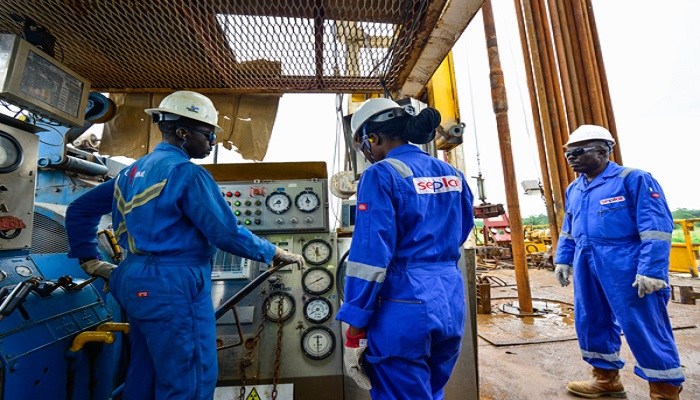
Kenyon International West Africa Limited, an indigenous firm has disclosed how it deployed 100 percent local manpower and expertise to contain the oil and gas leak from a wellhead blowout.
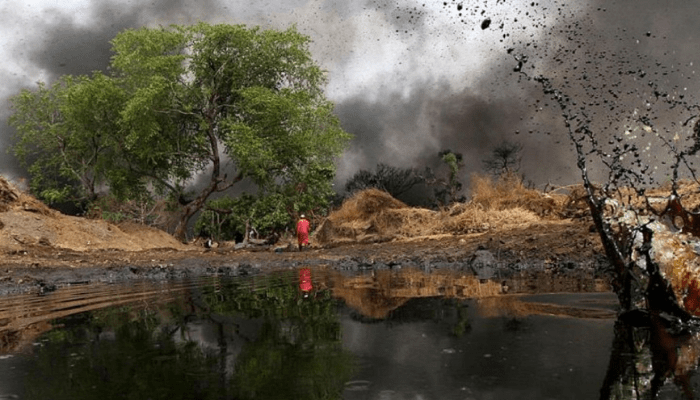
The blowout at Oil Mining Lease (OML) 29 operated by Aiteo Eastern Exploration in Nembe, Bayelsa State at the Santa Babra SouthWell 1 occurred on November 5, 2021 and discharged thousands of barrels of Bonny Light crude blend into the Santa Babra River for 32 days.
Only about 18,600 barrels of emulsified crude and water sediments were recovered after the leak was stemmed.
Aiteo had approached Boots and Coots, a subsidiary of United States Halliburton to plug the well, but the firm was unable to mobilise its expatriate workforce due to the COVID-19 restrictions and hiccups which compelled the operator to look inwards.

Victor Ekpenyong, chief executive officer of the indigenous oil servicing firm said the feat was attributable to the enactment and implementation of the Nigerian Content Act 2010.
Speaking to BusinessDay, Ekpenyong, a member of International Well Control Forum, appealed to oil firms operating in the company to give opportunities to Nigerian companies as they have developed competencies to match their foreign counterparts.
Ekpenyong noted that the Nigerian Content Development and Monitoring Board (NCDMB) has helped in building the capacity of Nigerian companies by facilitating collaboration between local players and Original Equipment Manufacturers (OEMs).
He explained that prior to the Nigerian Content Act 2021, the OEMs dominated the scene and enjoyed monopoly on oil and gas projects that Nigerians had the potential to execute, but were marred by challenges.
Read also: NNPC records $224.29m proceeds from export of crude oil, gas in August

Ekpenyong explained that the NCDMB has been assisting Nigerian firms to overcome the challenges they faced in the industry and listed the $500 million Nigerian Content Intervention Fund as a boost to local capacity in the oil and gas sector.
His words: “Many companies are having difficulties and challenging experiences in the industry through a lot of challenges.
“Some companies may stay for a long time without any job. Also, the issue of marketing support in the sector is equally a cause for concern because it is very expensive amidst limited capital environments to engage in marketing communications.
“Equally, COVID-19 affected a lot of businesses and some businesses were not able to meet up with orders. On the other hand, some companies have been showcasing their services at Nigerian oil and gas conferences without getting the desired patronage.”
On the over 10 years of operating under the Nigerian Content Act 2010, Ekpenyong noted that the law enabled Nigerians in the oil and gas space to be in business as it reserved categories of jobs for them.
He continued: “Prior to the implementation, the operations we do now would not have been possible for an indigenous company. It would simply be the exclusive reserve of the OEMs.
“These days, OEMs partner with indigenous companies which enables these companies to develop their capacity.
“It has also made some Nigerians in the diaspora move to Nigeria knowing full well that their expertise would be well utilised. Without a doubt, the implementation of this act has been a vehicle for talent development in the country.
“We are very excited we have been given the privilege to establish businesses. I would say it is a win-win situation. There are some jobs we still partner with OEMs to deliver. It has been an inclusive venture where we work together.”
Ekpenyong, an alumnus of Federal University Owerri, noted that there was available Nigerian technical expertise drilling services which encompasses piling, cold cutting and supply and installation of well head casing adding that patronising Nigerian firms creates more jobs and checks capital flight.
He said that other areas of expertise by indegenous players like Keynon include pumping and sealant deployment technology; well remediation including repair of collapsed casing and wellhead jacket.
According to him, the above were in addition to well control service which entailed well capping and idle well management which include surface and subsurface securement and antitheft installation.