The Nigeria Police Force has become a thorn in the flesh of the citizens of Africa’s most populous country. Known for brutality and recklessness, the force is perceived as the most corrupt institution in the country, with its members demanding bribes from the public without compunction.
A 2019 public survey by the Socio-Economic Rights and Accountability Project (SERAP) revealed that the police was the most corrupt among five institutions surveyed. The second most corrupt in the country was the power sector while the judiciary, education and health ministries were third, fourth and fifth in ranking. Transparency International survey in 2019 also found the police as the most corrupt institution in the country, followed by the legislature and the judiciary.
The defunct rogue police unit known as the Special Anti-Robbery Squad (SARS) did irredeemable damage to many families. There are hundreds of tales of young people killed extra-judicially by the brutal unit, with many of the deceased parting with hundreds of thousands of naira before their gruesome murder.
Underfunding the Police

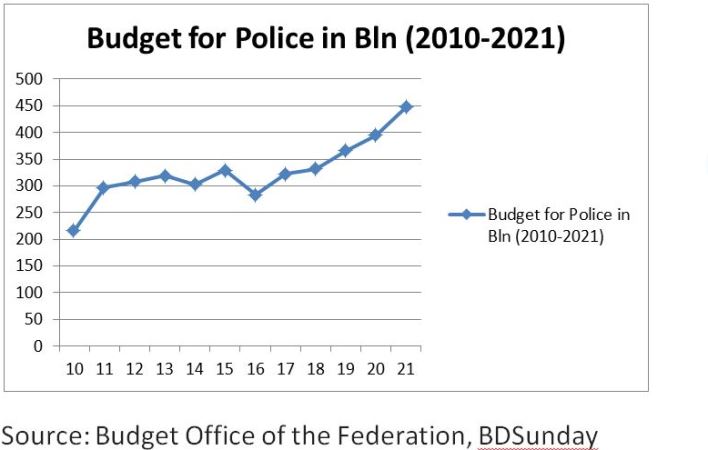
However, the Nigeria Police Force is grossly underfunded, according to data analysed by BusinessDaySUNDAY. Between 2010 and 2019, which is a 10-year period, the Federal Government budgeted N3.47 trillion for the remuneration and welfare of police officers and for police stations across the country. With 371, 800 police officers in the force, the data imply that each officer has had a total of N9.336 million for salaries, emoluments and welfare packages in the last 10 years. The N9.336 million was not just for one police officer. An officer shared that allocation with his/her police station and other police academies in 10 years. This money, therefore, amounts to N933, 557 per capita in the police force per year. Broken down further, it means that one police officer’s salary and allowances, shared with his or her police station, amounted to N77, 804 per month. Depending on the exchange rate, the amount is equivalent to just $216 or $172 per police officer per month.
The budget for the police force in 2021 is N447.6 billion, which means N1.2 million per police officer and his or her police station throughout the year. The money contains the salary, the welfare as well as budget for the station for the year.
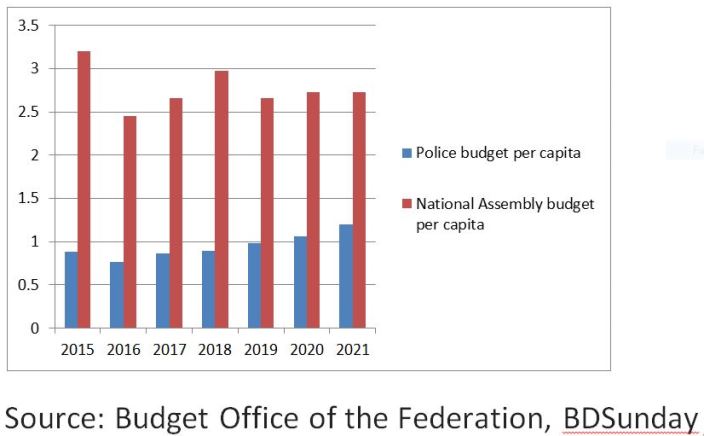
When compared with the incomes of National Assembly members, one would realise why well-meaning Nigerians are calling for a unicameral legislature or making the National Assembly a part-time job. In 2021, budget for 469 members of the National Assembly was N128 billion, which translates to N273 million per legislator. This means that the salary of a legislator in Nigeria’s grossly expensive National Assembly can pay N227 policemen in one year—with a balance.
To understand how much waste goes into the national budget, the National Assembly has budgeted N910.5 billion for itself from 2015 to 2021. This means that each of the Senators or House of Representatives members has received N1.94 billion in 2015 to 2021. On the other hand, the police force has received N2.48 trillion within the same period. Each police officer and his/her station plus police academies have got N6.66 million within these seven years. By implication, within this period, a National Assembly member could afford to hire and pay N291 police officers and have them at his/her beck and call. Moreover, a legislator could afford to pay the minimum wages (N30,000) of N64,712 youths in the country with his/her salary and allowances. In Nigeria, unemployment rate is 27.1 percent, according to the National Bureau of Statistics (NBS). Rough estimate says that youth unemployment is over 50 percent.
“One wonders why we still run a bicameral legislature in a country where extreme poverty rate is nearly 50 percent,” said Frank Umeh, co-founder of Vista.ng, an online news platform.

“Why not make the National Assembly a part-time job and use the money for the security and the youth clamouring for change,” he suggested.
Money not even fully released
One of the often ignored facts is that the so-called budget is not always fully disbursed.
In 2016, Solomon Arase, then inspector-general of police, submitted a document to the House of Representatives Committee on Police Affairs. The document detailed how the Ministry of Finance under-funded the police by releasing paltry sums to the force.
The document showed that in 2011, the police needed N46.7 billion for overhead expenditure but got only N5.5 billion, representing barely 12 percent of the approved fund. In terms of capital project, only N6.4 billion was released out of N57.9 billion earlier approved by the National Assembly. This was just 11.05 percent of the approved sum. In 2012, the police allocated N52.3 billion for overhead costs, but got merely N8.1 billion, representing 15.5 percent of the approved budget. Similarly, out of N49.9 billion slated for capital expenditure, only N7 billion was disbursed to the security outfit, representing just 14.02 percent of the entire budget.
The situation was not better in 2013, as the security outfit received only N8 billion for overhead costs out of N56.6 billion budgeted and approved by the National Assembly, representing just 14 percent.
In 2014, N56.6 billion was budgeted and approved by the National Assembly for overhead costs, but only N5.2 billion was released by the Ministry of Finance, representing just 9.1 percent.
For capital projects, just N3.4bn was released to the police out of N218.8 billion approved by legislators. This amount represented just 1.5 percent of total capital projects.
In 2015, the police allocated N71.8 billion for overhead costs but got N4.8 billion, representing just 6.6 percent. In terms of capital projects, only N8.9 billion was received by the police out of N345.7 billion budgeted and approved by the National Assembly.
Arase said the police had been expanding in terms of geographical and numerical spread, yet funding was declining—a phenomenon that was unhealthy for a fast-rising population. The situation is yet to change today, with Nigeria’s fiscal state worsening on the back of COVID-19, and growing insecurity and unrest.
South African example
In Nigeria, 371, 800 police officers are safeguarding the lives of 200 million people. The police budget of N447.6 billion represents $1.24 million per officer annually. Mathematically, one police officer protects the lives of 538 Nigerians. In South Africa with a population of 58 million, a police officer guards 383 people. This is still inadequate but better than Africa’s biggest economy. Coming to the budget, a police officer receives N1.2 million in 2021 budget, which is 50,000 rand. In South Africa, police budget for 2021 is 97.53 billion rand ($6.015 billion). For 150, 950 police officers, South Africa gives each police officer 646,107 rand, meaning that a South African cop can pay 13 Nigerian police officers. In Egypt, 500,000 police officers are guarding 98.42 million people, giving the country a ratio of 1 officer to 197 Egyptians.
Police and basic needs
The basic needs of man are food, shelter and clothing. Most policemen in Africa’s most populous nation cannot afford these basic things with their salaries. For example, a new inspector in the police earns N73, 231 monthly and N878,772 annually. The inspector is eight steps ahead of grade 1 recruit, yet he or she cannot afford a decent accommodation. A two-room accommodation in a city like Lagos costs N350, 000 to N500,000 in Lagos. For an inspector to afford it, he/she must save 50 percent of the salary monthly—which is sometimes a tall order given a double-digit inflation rate of 13.71 percent in September 2020 in the country. For the inspector to build a house valued at N10 million, he/she will spend 11 years and 3 months, and this is if he/she does not spend a dime from the salary. With 50 percent savings possible, it means the police officer will spend 22 years and six months in total discipline to be able to build a decent house.
A police officer who spoke with BusinessDaySUNDAY in anonymity said, “If you die in the job, your wife and family will be pushed out of the ‘dirty barracks’ six months after. Does it make sense anywhere for an inspector with enormous responsibility to earn less than most office workers he/she is expected to safeguard?”
Dirty barracks and absence of a clear future are clear risk factors in a country with surging insecurity risks.
Muhammdu Buhari on Thursday pledged to increase the salaries of the police, but analysts expect him to improve their equipment.
“Again, give them a living wage,” Ike Ibeabuchi, a budget analyst and managing director of MD Services Limited, said.
“With the way the country is now, security, education and health should get 50 percent of all budget,” he suggested.
A security analyst, however, said even if police recruits earn N1 million each in a month, it would not stop them from taking bribes.
“What you need is a reform, but also strong laws against erring officers. Yes, raise their pay, but also ensure they communicate better with the public. Prosecute erring officers without fail.”