



Experts say reversing the exit of industrial users from the grid will require tariff reform, targeted investments, tailored industrial pricing, and improved service partnerships to restore trust and ensure grid stability.
A recent report by BusinessDay shows that big energy users and spenders are increasingly shifting away from reliance on power distributed by Electricity Distribution Companies (DisCos), choosing instead to generate their electricity.
At the heart of the exodus lies the unreliability of grid power. Frequent outages, poor voltage quality, and prolonged load shedding have made it nearly impossible for manufacturers and other high-energy users to depend on the grid for their operations.
To regain trust, DisCos must invest in modernising their distribution infrastructure, adopting smart grid technologies, and reducing technical and commercial losses.

Habu Sadeik, an energy expert, suggested a comprehensive strategy that requires deliberate reform and customer-centric improvements.
“The departure of big energy users is not irreversible. But DisCos must act fast to earn back their trust,” Sadeik said.
He outlined investments in embedded generation and IPPs to enhance reliability and supply; development of hybrid partnership models with industries, enabling a blend of self-generation and grid supply; introduction of custom-tailored tariff plans for industrial users to make grid electricity attractive again.
“Improvement of customer service and relationship management, fostering better collaboration and responsiveness,” Sadeik added.
Sadeik believes that DisCos must abandon the one-size-fits-all approach and embrace flexible, industry-specific models to prevent further loss of commercial clients and revenue erosion.

“There’s no immediate or long-term benefit to big industrial users leaving the grid,” said Adetayo Adegbemle, Convener of PowerUp Nigeria. “Our present predicament can be traced directly to manufacturers and industrial users exiting the grid, these are the people who can offtake and pay for energy consumed.”
He added that the burden of sustaining the national grid has now shifted to residential users, pushing tariffs higher for households, while industries that can afford it switch to costly alternatives.
“The Federal Government should, as a matter of urgency, reverse this trend. Our power sector policy should be anchored on industries, with industrialisation as the goal,” Adegbemle said.
He added, “Bringing manufacturers back to the grid through tariff incentives and targeted network investments will ensure grid stability and financial viability.”
He also emphasised that redirecting the funds currently spent by manufacturers on alternative energy back into the grid could make electricity more affordable, improve generation capacity, and reduce the government’s subsidy burden.
Industrial exit deepens financial strain on DisCos
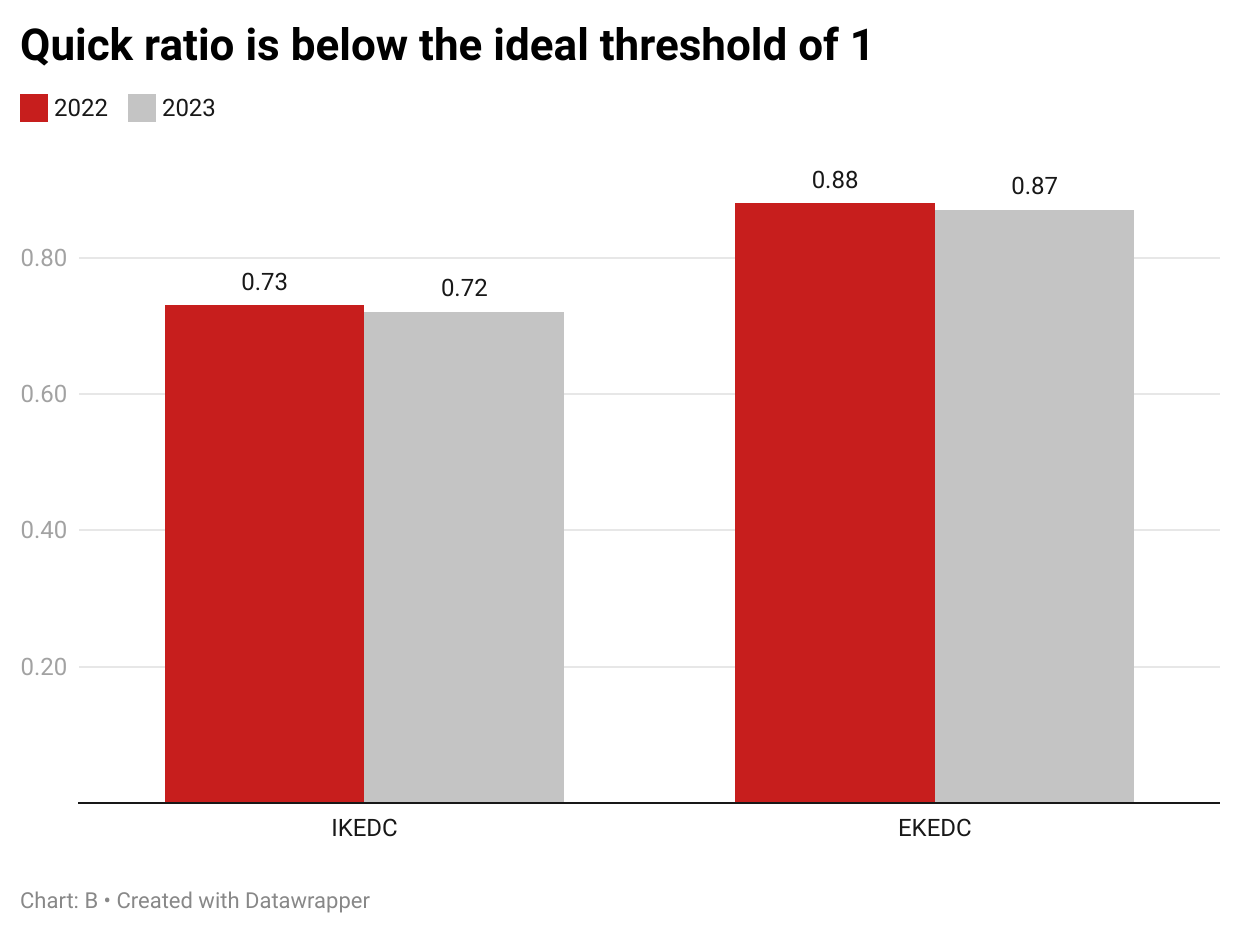
A deep dive into the financials of a few sampled DisCos reveals a troubling trend. Although the 2024 results are yet to be released, data from 2023 and 2022 suggest that major DisCos operating in Nigeria’s most industrialised regions may struggle to meet their short-term obligations without liquidating assets or sourcing external funding. The quick ratios for EKEDC and IKEDC stand at 0.87 and 0.72, respectively, both below the ideal threshold of 1, indicating potential liquidity stress.

In 2023, IKEDC’s net profit margin plunged to -1.98 percent, down sharply from 19.93 percent in 2022, despite an increase in revenue. Conversely, EKEDC improved its net profit margin to 5.56 percent in 2023 from a negative 0.50 percent the previous year, indicating better cost recovery and operational control.

According to data from the Nigerian Electricity Regulatory Commission (NERC), major DisCos such as AEDC, EKEDC, IBEDC, and IKEDC experienced an increase in average energy offtake between 2023 and 2024, except for IKEDC, whose offtake declined from 533.44 MWh/h in 2023 to 520.91 MWh/h in 2024.

An energy expert explains, “Energy offtake is the quantity of electricity a DISCO buys for onward distribution. A decline in offtake often signals reduced demand, financial strain, or customer defection.” NERC adds that some DisCos deliberately reduce their energy offtake, citing “a combination of technical limitations as well as load rejection… largely due to commercial reasons,” especially in areas with high losses and poor revenue collection.
A further enquiry into billing efficiency reveals that most major DisCos improved their performance, except for IKEDC, which saw its billing efficiency drop from 87.86 percent in 2023 to 83.1 percent in 2024. Notably, IKEDC also holds the highest energy offtake among all distribution companies.
What DisCos and the Government must do to reverse the trend
While current results already show financial strain, experts warn that the exodus of big energy users could amplify DisCos’ woes in the near future.





