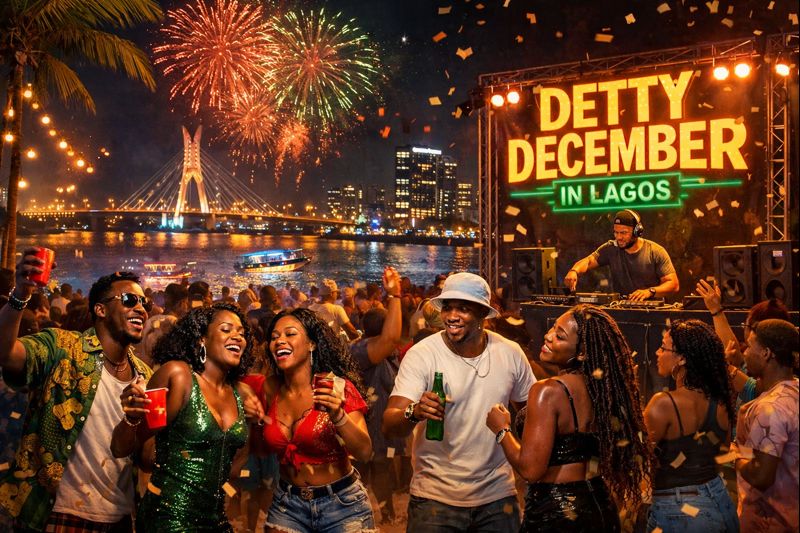
Every December in Nigeria arrives not merely as a month but as a mood. The phrase “Detty December” has become shorthand for that mood: a season of travel, music, reunions, nightlife, and unapologetic celebration.
We are 22 days into December. With only a few days to Christmas, it may seem like business as usual to many Nigerians at home; still there is evidence that the horde of arrivals began even before the first day of the month, despite fears that the country’s insecurity problems might make celebrations less attractive to diasporans this year.
Yet alongside its popularity sits an unease in the form of a question, sometimes whispered, sometimes loudly expressed: is Detty December simply festive, or has it become a euphemism for moral looseness and social excess, much like the way Valentine’s Day is often criticised as an excuse for morally questionable and bankrupt behaviour?
The word “detty” itself is at the heart of the debate. Rooted in Nigerian Pidgin, “detty” is a playful distortion of “dirty”, but in usage it rarely carries a literal moral judgement. Rather, it implies freedom, abandon, and release from routine. In the dictionary of youth culture, to “get detty” is to celebrate without inhibition, not necessarily without values. Still, language matters, and the semantic closeness of “detty” to “dirty” has allowed critics to frame the season as one defined by indulgence rather than intention.

It is obvious that Detty December did not emerge from government policy papers or tourism boards but from the streets, clubs, music scenes and digital spaces of the last decade. As Afrobeats gained global momentum and Nigeria’s urban youth culture became more visible online, December naturally evolved into a homecoming period. Diaspora Nigerians returned, weddings and even funerals were fixed, concerts increased, and the social calendar expanded. The name seemed to have followed the practice, not the other way around. As one Lagos-based cultural analyst once observed, “Detty December is not a festival in the formal sense; it is a social rhythm that people agreed to dance to.”
However, the concerns remain. Stories of reckless partying, casual sexual encounters, alcohol and drug abuse, and occasional violence circulate widely on social media. For some observers, the season appears to normalise behaviour that society otherwise frowns upon. Religious leaders and social critics have likened it to Valentine’s Day, arguing that both occasions have been commercialised and stripped of ethical reflection. A cleric quoted in a radio discussion put it bluntly: “When pleasure becomes the organising principle of a season, consequences are never far behind.”
However, separating perception from evidence is important. There is little credible data to suggest that Detty December uniquely generates moral decay or a spike in serious crime beyond what typically accompanies large-scale festivities worldwide. What does increase are crowds, alcohol consumption, traffic congestion, environmental noise pollution and pressure on urban infrastructure — issues common to New Year celebrations in cities from London to Rio de Janeiro. In that sense, Nigeria is not exceptional; it is simply experiencing the growing pains of popular mass celebration.
Where Detty December becomes more defensible is in its economic footprint. Airlines report peak passenger loads and they unfairly hike fares, hotels operate at full capacity, short-let apartments multiply, restaurants extend hours, and thousands of informal workers — from event planners to ride-hailing drivers — find seasonal income. Tourism and hospitality professionals argue that December has quietly become Nigeria’s most reliable internal tourism season. As one hotel executive noted in a business forum, “December now carries the weight that Easter and summer carry elsewhere. You plan for it or you lose out.”
This economic argument has led some policymakers and business leaders to suggest that Detty December should not only be tolerated but deliberately shaped. Comparisons are often drawn with Ghana’s “Year of Return”, Brazil’s Carnival, or even the Notting Hill Carnival in the United Kingdom. These events were once criticised for their excesses but have since been structured, regulated, and reframed as cultural assets. They demonstrate that celebration and respectability are not mutually exclusive. As a tourism consultant put it, “The difference between chaos and carnival is planning.”

The real challenge, then, may not be Detty December itself but the absence of a coherent narrative around it. Left undefined, it becomes whatever its loudest participants project — nightlife and spectacle. But with intentional framing, it could expand to include art exhibitions, book readings, cultural tours, food festivals, and family-friendly events that reflect Nigeria’s diversity. Doing so would help dismantle the lazy assumption that “detty” must mean “dirty”.
There is also a role for civic responsibility and personal restraint. No season, however celebratory, suspends the social contract. Public conversations around consent, moderation, safety and mutual respect are not moral panic; they are signs of a society learning to manage its pleasures. As one sociologist succinctly remarked, “Maturity is not the absence of enjoyment, but the presence of limits.”
In the final analysis, Detty December is best understood not as a moral failure but as a mirror. It reflects Nigeria’s youthful demographics, its hunger for joy after a difficult year, its creative energy, and its economic contradictions. Like Valentine’s Day, it can be trivialised, exploited, or misused — but it can also be reclaimed and redefined. The choice lies not in banning the celebration or baptising it, but in guiding it.
If Nigeria succeeds in that task, Detty December may yet evolve from a controversial catchphrase into a respected season of culture, commerce and communal renewal — vibrant without being vulgar, festive without being dreaded.