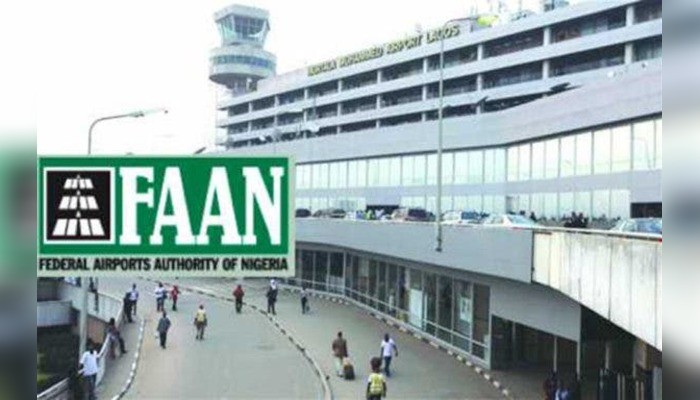
Recently, the Federal Airports Authority of Nigeria (FAAN) faced criticism for allegedly lacking insurance coverage for federal government-managed airports.
Edward Boyo, founder and CEO of Overland Airways, publicly expressed concerns at an industry event, stating that FAAN’s failure to insure airports across the country exposes airline operators’ equipment to potential damage.
Boyo urged the National Insurance Commission (NAICOM) to engage with relevant authorities to ensure that all airports in Nigeria are properly insured, lamenting that poor airport infrastructure has resulted in significant damage to aircraft, with airlines bearing the financial burden.
Read also: FAAN commence cashless payment system at Lagos, Abuja airports

Boyo highlighted the need for proper insurance coverage for airports, citing issues such as inadequate wildlife control and runway deterioration, which have caused damage to aircraft. “These infrastructures are not insured,” he emphasised. “The government would have to meet its own responsibility.”
However, Olubunmi Kuku, managing director of FAAN, debunked Boyo’s claims, stressing that all federal government’s airports managed by FAAN are insured, with the insurance coverage up to date.
“Derubberization and runway hygiene have been maintained; records are available. The only area I would concur is habitation and community issues that have impacted wildlife/bird strikes, and we have been working closely with relevant stakeholders to control,” she stated.
According to Kuku, historical runway issues based on structural and engineering problems on some of the runways, along with those exceeding their lifespan, are being corrected gradually with complete overhauls and maintenance.
Some stakeholders have raised concerns about why airlines still pay substantial sums of money for damage resulting from poor infrastructure at the airport, such as bad runways, bird strikes, broken conveyor belts, and tight parking spaces, among others. They argue that if the airports are truly insured, FAAN should be liable for damages caused by its inefficiencies.

Insurance experts, however, clarify that airport insurance does not function in this manner as individuals and companies are responsible for insuring their own properties.
Sunny Ateba, an airline insurance expert, explained that operators and agencies have the responsibility to insure their own equipment against damages and should therefore have their own insurance coverage.
“FAAN owns the airport terminals, so they are responsible for providing insurance to cover public liability and terminal buildings against damage,” Ateba said.
Ateba provided an example, stating that if an airplane or moving equipment damages another plane parked on the tarmac, a third-party claim should suffice. He noted that airlines are also expected to insure their passengers in case of crashes or incidents.
“If you rent a shop from FAAN to sell shoes, it’s your duty to insure your shoes. Similarly, if your aircraft hits the runway and the tyres are damaged, you can make claims for insurance to cover the damages, provided the aircraft is fully insured,” the aviation expert explained.
Read also: All FG managed airports are insured MD FAAN
Ado Sanusi, managing director of Aero Contractors, corroborated this view, stating that when airline operators insure their equipment, any damage would be covered by the insurance company.
“If I insure my airplane and damage it due to poor infrastructure, my insurance company would cover the damage. Insurance is a stabilising factor in everyone’s business, and everyone is expected to insure their properties,” Sanusi emphasised.
He added that FAAN’s insurance coverage does not extend to individual airline operators’ equipment, and each party is responsible for insuring their respective assets.
“As FAAN insures its assets, so do the airlines, vendors, ground handlers, and airline operators,” Sanusi concluded.