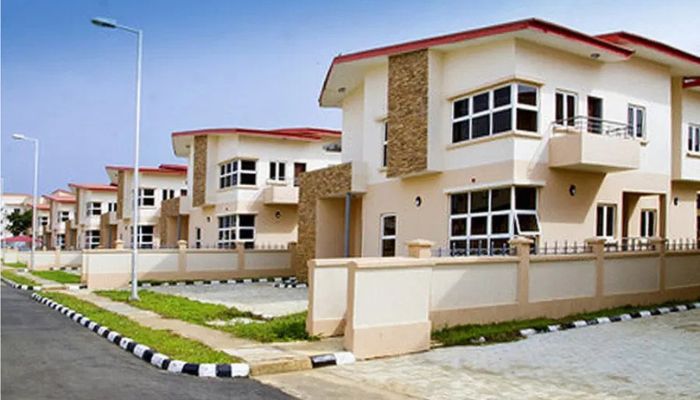
House renters have become easy and willing prey in Nigerian cities, especially Lagos, Abuja and Port Harcourt, where agents and landlords collude to make life hell on earth for them.
In these cities, particularly Lagos, searching for houses to rent is like embarking on a journey to Armageddon–a spiritual warfare in which one is presented with hard choices between a cheap, easy way to perdition, and an expensive, hard way to freedom and rest.
This situation is made worse by estate agents whose activities in the rental market are making life miserable for people seeking rental accommodation. These agents, most times on their own, hike rents to increase their fees.
Because of this, tenants in Lagos continue to grapple with rising costs in the rental market, as agency and legal fees frequently exceed the legally prescribed limits. For many, the total cost of securing accommodation now rivals or even surpasses the annual rent itself.

Nowadays, it is not unusual to see a two-bedroom flat move from N1m to N3.5m per annum with agency and agreement fee of N600,000 each for two years, giving N1.2 million, plus a maintenance fee of N300.
Chidinma Samuel, a single mother in Egbe area of Lagos, typifies agents’ exploitation. Chidinma needed just a single bedroom and got one for N350,000 per annum, but she ended up paying an additional N300,000, which was demanded for both agency and agreement fees.
Read also: High house rent forces low-income earners out of city centres
Similarly, Kingsley Odor, another Lagos resident, has been looking for a three-bedroom apartment to rent for the last six months. That size of apartment where he desires to live goes for N3.5 million. Recently, according to him, he got one in Surulere.
“I had my N3.5 million and was ready to pay, but could not because the agent wanted me to pay an additional N1.2million agency and agreement, giving a total of N4.7 million. That was unbelievable,” he fumed.

These so-called agency and agreement fees are not based on any known legal calculation or provision, especially in Lagos, where the state’s tenancy law of 2011 stipulates 10 percent of the annual rent as an agency fee.
If 10 percent had been charged as stipulated by the Lagos legislation, Chidinma and Kingsley wouldn’t have paid anything more than N30,000 and N300,500, respectively, as fees.
In the highbrow locations of the city, the story is even worse. According to Nigerian Property Centre, an online property marketing platform, for a two-bedroom apartment that rents for between N3.5 million and N4 million, the renter is expected to pay extra fees that include Agreement: ₦500k; Commission: ₦500k; Service charge: ₦300k, and Caution: ₦300k. In this case, the total cost of the rent is N5.1 million per annum.
Odor recalled an ugly experience where the problem was not just about the spurious fees, but also the inflated rent by the agent. “The landlord had told us that the rent for the three-bedroom flat we found was N2.7 million, but at the point of payment, he referred us to his agent, who told us the house was there for N3.6 million; almost N1million increase,” he lamented, noting that the landlord did not counter his agent when contacted on phone.
Market watchers have raised concerns over these dire situations, wondering what has become of the state government’s interventions in the housing market with legislation.
They blame the agents and landlords’ unwholesome activities on weak enforcement, unregulated practices, and the growing affordability crisis facing renters in this sprawling city, where the housing deficit runs into millions of units.
Read also: House rent ‘Wahala’: What landlords, tenants should not do
Besides the 2011 Tenancy Law, which was specifically meant to shield renters from mindless landlords and their agents, Lagos has also intervened with the Lagos Home Ownership Mortgage Scheme (LagosHOMS), which sought to make home loans both affordable and accessible to low-income workers in the state.
The establishment of the Lagos State Real Estate Regulatory Authority (LASRERA) was also meant to check the fraudulent activities of estate agents and land grabbers. It is also meant to ensure that both sitting and intending tenants are not unduly exploited.
A new legislation is currently in the works to ensure that both landlords and tenants are protected, and also to check the exploitative tendencies of estate agents, who not only inflate house rents but also charge outrageous fees.