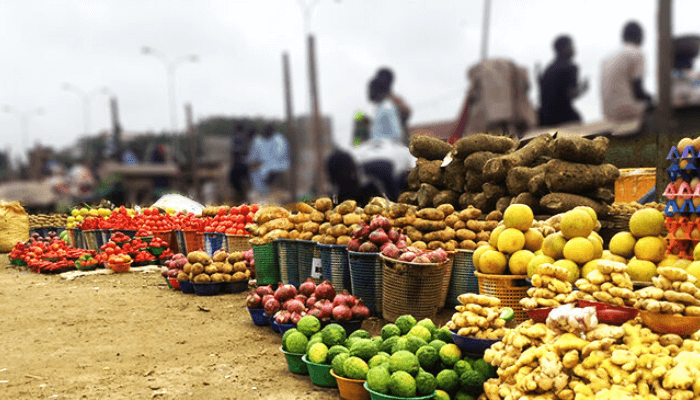
Rising food demand during the Christmas and year-end season is placing renewed pressure on household spending in Nigeria, driven less by headline inflation figures and more by seasonal food consumption and rising logistics costs. Across Lagos, many families are finding that the challenge is no longer only what food costs, but how to access it.
Recent inflation data shows that headline inflation eased to 4.5 per cent year-on-year in November 2025. However, month-on-month inflation increased by about 29 basis points to 1.2 per cent, with food prices accounting for most of the rise. This pattern reflects a recurring trend at the end of the year, when demand for food items rises sharply due to celebrations, travel, and gifting. Staples such as rice, grains, tomatoes, peppers and proteins are in high demand during this period.
For households in Lagos, the strain is being felt beyond market prices. Transportation costs have increased in recent weeks, particularly for shared rides, as traffic congestion, higher fuel-related expenses, and seasonal travel combine to push fares upward. As a result, market visits now involve higher transport fees, longer waiting times and greater uncertainty.
These conditions are reshaping how households shop for food. Many residents are visiting markets less frequently, buying smaller quantities, or turning to delivery services that often charge more. Bulk buying, which traditionally offers lower prices, remains difficult for many households because of cash flow limits, storage challenges and unstable electricity supply. The gap between affordability and convenience has become more visible during the festive period.

In response, alternative distribution models are beginning to gain attention. One of these is being developed by Iyaloja Direct, a Lagos-based foodstuff sharing and distribution service. The company aggregates demand across communities, purchases food in bulk from major markets and distributes smaller quantities to individual customers. This allows households to benefit from bulk market prices without making large purchases.
The model draws from a long-standing Nigerian practice in which groups pool funds to buy food or livestock and share the outcome. Iyaloja Direct applies digital tools and coordinated logistics to scale this practice for urban households.
According to Cecilia Lawrence, Director at Iyaloja Direct, “What we are seeing this season is not just higher food demand, but also higher friction around access transport costs, time, and uncertainty. Our role at Iyaloja Direct is to remove that friction while still delivering market-level prices. You shouldn’t have to choose between affordability and convenience.”
The company’s approach is gaining wider public exposure through its participation in the holiday edition of Guaranty Trust Holding Company’s Food and Drink Festival, scheduled to hold in Lagos from 20 to 21 December 2025. This is the first time the festival is being held during the holiday season.
Food festivals in Lagos have traditionally focused on prepared meals, restaurants and packaged food brands. This year, festival attendees will be able to buy raw food items including yams, plantains, grains, rice, spices, fruits and vegetables at bulk market prices from a single location. Industry observers note that this signals a shift in how food access is being presented to consumers.

“This is about meeting consumers where they already are,” Lawrence said. “The festival attracts thousands of households preparing for the holidays. Making bulk-priced raw food available in that environment changes how people think about access and affordability.”
Beyond the festival, the broader food distribution system continues to face structural challenges. Nigeria’s food supply chain remains fragmented and heavily dependent on informal markets. During periods of high demand, these weaknesses often appear through supply gaps, price swings and rising transport costs, particularly at the final stage of delivery to households.
Demand aggregation and shared logistics models offer a way to reduce repeated market trips and spread transport costs across many households. These approaches do not rely on large infrastructure investments and can be deployed within existing market systems.
As households become more sensitive to price changes and time pressures, especially during festive periods, such models may play a growing role in urban food access. With food prices and transport costs still affecting budgets, the Christmas season is shaping how families adapt their spending and shopping habits.
Iyaloja Direct’s increased visibility during this period points to a wider shift in food distribution in Lagos, combining community practices with organised delivery. For many households, this balance may shape how food is accessed not only during the holidays, but in the months ahead.