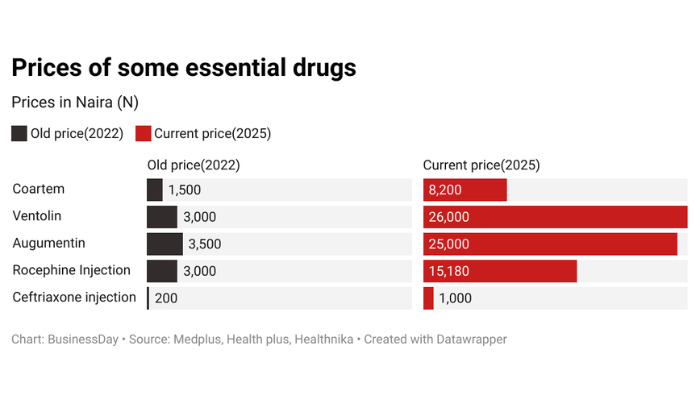
Drug prices have continued to rise despite the exemption of pharmaceutical ingredients from import taxes and duties.
This has left retailers, manufacturers, and consumers struggling with high costs of essential drugs.
In June 2024, President Bola Tinubu signed an executive order exempting equipment and raw materials used in the production of medicines, diagnostic kits, medical devices such as needles and syringes, as well as biologicals and medical textiles from import duties/tariffs for registered and officially recognised pharmaceutical manufacturing companies.
Read also: FG to collaborate with pharmaceutical society on drugs production Akume

The import waivers were introduced to boost local production of essential drugs, lower manufacturing costs, reduce drug prices for consumers, and improve the global competitiveness of local pharmaceutical manufacturers. But they have done little to lower prices of medicines.
Temitope Akindele, manager, Corporate Services, Fidson Healthcare Plc, shared these concerns with this reporter.
“The import waivers reduced production costs by roughly 10 percent to 15 percent. It has also boosted the competitiveness of local manufacturers in the global market, and most importantly, it stabilised drug prices. Otherwise, there would have been an explosion in drug prices if the waivers were not in place,” he noted.
“However, the gains are majorly eroded by high electricity tariffs and naira devaluation,” he added.
Pharmaceutical retailers say the waivers have not translated into lower prices at the point of sale.

Ikpe Chikamara, a pharmaceutical retailer based in Rivers State, attributed the high cost of medicines to naira depreciation, artificial scarcity, high logistics costs, multiple port clearance fees, and illegal dues collected by unions and touts along transport routes.
“At the retail level, prices are still high despite the import waivers, as high clearance fees, naira depreciation, multiple dues by unions and touts, as well as high logistics costs have driven the persistent rise in drug prices,” he said.
Chikamara cited Kano’s major drug market as an example of how informal charges inflate costs.
“In Kano drug market for instance, each truck pays N50,000 to the union for every trip of drugs brought into the market. This is not a monthly or annual fee; it is charged per trip,” he explained.
Similarly, the Pharmaceutical Society of Nigeria (PSN) has raised concerns about the high cost of local drug production. At its annual conference in October, the society cited rising electricity tariffs, currency depreciation, multiple regulatory charges at seaports, and high logistics costs as key drivers of escalating drug prices.
Read also: Dangote Refinery seen as catalyst for Nigeria’s pharmaceutical independence
BusinessDay’s analysis of the financial statements of two major pharmaceutical manufacturing companies listed on the Nigerian Stock Exchange (NGX) show that the cost of sales increased significantly within the first three quarters of 2025 (Q1 to Q3, 2025) compared to the corresponding period in 2024.
Fidson Health Plc, for instance, reported a 56.6 percent increase in the cost of sales from N35 billion in 2024 to 54.8 billion in 2025.
May & Baker, on the other hand, reported a 42.7 percent increase in their cost of sales from N15 billion in 2024 to 21.4 billion in 2025, implying high production costs, further buttressing the points made earlier by stakeholders in the industry.
About a year ago, Mojisola Adeyeye, director-general of the National Agency for Food and Drug Administration and Control (NAFDAC), assured Nigerians in a press statement that drug prices would decline following the implementation of the waivers. However, consumers across the country say prices have continued to climb.
Owolabi Samson, a resident of Abuja, shared his experience while purchasing Ventolin, an inhaler used by asthma patients. He said he bought the drug for N32,650 in November 2025, up from about N3,000 in 2022,a 967 percent increase.
“The prices of drugs have really gone up. Imagine an inhaler I used to buy for between N3,000 and N3,500 a few years ago now selling for N26,000 to N32,000 here in Abuja,” he said.
Othniel Obum, a resident of Rivers State, also shared how he spent N10,000 for the treatment of malaria, up from N1,500 to N2,000 in previous years.
“When I went for malaria treatment, the prescribed medications cost me about N10,000 – what normally cost just N1500 or N2000 before now.
What can be done?
Chikamara stressed the need for macroeconomic and structural reforms to support lower drug prices. He pointed to the importance of naira stability, improved road infrastructure to reduce logistics costs, transparent and firm regulatory institutions, reliable electricity supply, and the elimination of touts and illegal state actors. He also called for a unified system for collecting statutory dues.
“We need to prioritise factors that help to reduce drug prices, such as stable foreign exchange and electricity, improved logistics infrastructure, and reduced multiple taxation,” he said.
Read also: Pharmaceutical firm to host dialogue on strengthening pharmacy practice in Nigeria
The Pharmaceutical Society of Nigeria (PSN) made similar calls. In an article published on pharmanewsonline.com dated October 6, 2025, the society urged the federal government to fully implement the executive order, ensure stable power supply, reduce electricity tariffs, and review port fees.
The National Association of Industrial Pharmacists (NAIP), through its former president, Ignatius Anukwu, also argued that import waivers alone are insufficient to address rising drug costs, noting that raw materials account for only a fraction of total production expenses.
“Import waivers only affect raw materials, which make up just about 30 percent of drug supplies,” he said. “There is a need to adopt a more holistic, strategic, and long-term approach to addressing the high cost of drugs in the country,” he added.