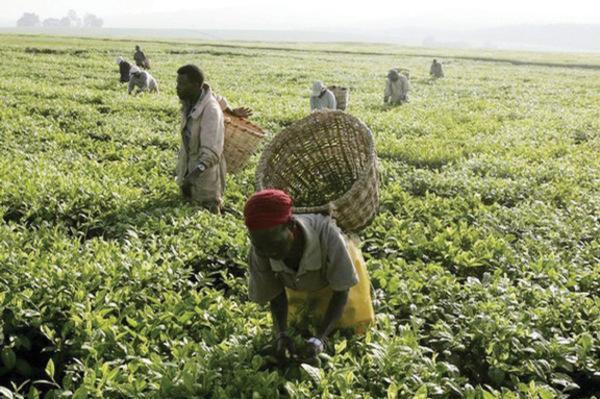
Now that the 2019 general elections are well and truly over, farmers in Nigeria want President Muhammadu Buhari’s ‘Next Level’ agenda to address inherent problems limiting growth in the country’s agricultural sector.
Buhari won a second four-year term as president of Africa’s most populous country on February 23. He had hinged his campaign on the promise of taking the country to the next level if re-elected.
Buhari’s change agenda in the last four years recorded marginal progress, but it failed to address the fundamental issues that would drive growth, according to experts.
As the president gets set to begin another term of four years, farmers say they need irrigation, innovation, single-digit interest rate, infrastructure and mechanisation to change the fortunes of Nigeria’s economy through agric with attendant exponential gains by way of earnings, employment, food provision and other spin-offs.

“We are hopeful of the next level agenda and we want irrigation and mechanisation on our farms to boost productivity,” Ibrahim Kabiru, national president, All Farmers Association of Nigeria (AFAN), told BusinessDay.
“We cannot grow our agriculture using hoes and cutlasses anymore. Mechanisation and irrigation are vital if we are going to feed ourselves,” Kabiru said from his Kano farm.
Data from the National Bureau of Statistics (NBS) show that growth in the agricultural sector has been on the decline since the first quarter of 2017, with marginal growth recorded only in the fourth quarter of same year.
Experts say the inability of the government to provide critical infrastructure – such as motorable roads in rural communities, mechanisation and irrigation facilities – to aid all-year farming is a major factor responsible for the persistent decline in agric growth in recent years.
“The main reason our economy has not grown the way it should have is lack of infrastructure and the problem with agriculture is infrastructure and low use of technology,” said
AfricanFarmer Mogaji, chief executive officer, X-Ray Consulting.
“We still do not have the number of tractors that we need and the irrigation facilities to get water from our dams to farm all year round. We want the next level agenda to focus on these areas to attain food sufficiency,” Mogaji said.
Nigeria is one of the least mechanised farming countries in the world with a tractor density of 0.27 hp/hectare, far below the Food and Agriculture Organisation’s 1.5hp/hectare recommended tractor density for Africa and other developing countries.

Wale Oyekoya, former chairman, agriculture group, Lagos Chamber of Commerce and Industry (LCCI), said Buhari’s re-election was a testimony of Nigerians’ confidence in his government and there was need for the president not to disappoint.
“The just-concluded general election shows how Nigerian masses put their trust in President Buhari and his government and he cannot afford to disappoint the average Nigerians,” said Oyekoya, who is also managing director of Bama Group of Companies.
“One of the major problems facing smallholder farmers is the lack of adequate food storage and processing facilities. The next level agenda should address this,” he said.
Also, farmers in the fishing and livestock sector have complained of neglect by the Buhari administration in the last four years and this has reduced their productivity and impacted their capacity to expand.
“In the last four years the entire focus of the government was for crop farmers. We expect Buhari to focus on the fishing and livestock subsector,” Oloye Rotimi Olibale, president, Catfish and Allied Fish Farmers Association (CAFFAN), said from his Ibadan farm.
“We were not entirely included in the Anchor Borrowers’ Programme (ABP). We want the government to totally include all fish farmers in the ABP so that we can have access to cheap credit,” Olibale said.
Victor Iyama, president, Federation of Agricultural Commodities Association of Nigeria (FACAN), said the Anchor Borrowers’ Programme has been helpful, but demanded the government provide key infrastructure to drive growth in the sector.
“The government has done well in the sector but much more still needs to be done,” Iyama said. “The government needs to provide single-digit agro credit for farmers to drive growth in the sector.”
Josephine Okojie