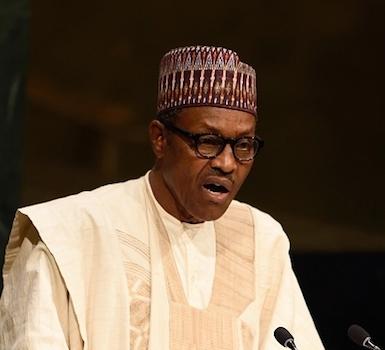
Buhari receives letter delisting Nigeria from polio endemic nations
 President Muhammadu Buhari on Monday directed the Federal Ministry of Finance to make provision for the basic healthcare provision fund in the yet-to-be concluded 2016 budget, just as he committed to ensuring a completely polio free Nigeria by 2017.
Such provisions in the budget – still being worked out by the budget office and National Planning Commission – would include some budget to sustain fight on complete eradication of polio, which figures showed Monday could still take as much as $155 million in 2016 and $249 million in 2017.
This comes as the president, in Abuja, received a formal letter delisting Nigeria from polio endemic countries from the director-general of the World Health Organisation (WHO).

Buhari promised that Nigeria would not relent in its campaign to stamp out polio until the crippling disease was completely eradicated.
“I would like to reiterate the Federal Government’s commitment towards the achievement of a polio free Nigeria in 2017. The government will sustain the needed funding for operations and vaccine procurement for the programme,” Buhari said during a visit by WHO director-general, Margaret Chan.
He announced also that the Presidential Task Force on polio eradication would be reconstituted under the leadership of the Federal Ministry of Health to provide political direction and oversight in order to avoid complacency and relapse.
Chan was in Nigeria for her first visit to the country since the WHO last month removed Nigeria from the list of polio-endemic countries.
Delisting is a first step towards being declared free of the disease, which is spread by poor sanitation and contaminated water and can cause irreversible paralysis.

Buhari said efforts to eradicate the disease, begun in 1998, and had taken a toll “in terms of human and material resources” in Africa’s most populous country.
“We are however not relenting as we are determined to achieve our collective goal of saving our children from further paralysis from polio,” he said.
Nigeria, which marked one year since its last case of polio was recorded on July 24, has had to battle major security issues in its efforts to vaccinate children in areas of the remote northeast hit by Boko Haram’s bloody six-year Islamist insurgency.
Another setback are rumours that the vaccine caused infertility, leading to many parents, particularly in the Muslim-majority north, refusing to have their children immunised.
The President commended development partners, particularly World Health Organization, UNICEF, Bill & Melinda Gates Foundation, USAID, US-CDC, Rotary International, and a host of others who contributed financially and materially to the over-all efforts so far.
He also commended vaccinators, community mobilisers, partners, parents and caregivers, traditional and religious leaders, who supported the polio eradication initiative of the government through the years.
In a presentation at the presidential villa, the Executive Director of National Primary Health Care Development Agency, Ado Muhammad said government will have to make concerted efforts at funding the campaigns against polio as well as procurement of vaccines until 2017, when Nigeria is fully certified polio free.
Ado, who spoke on Polio Eradication Initiative: Lessons learnt and way forward’ also pointed out that insecurity in the North Eastern part of Nigeria, recurring health workers’ strikes and dwindling government’s commitments are some of the challenges that may hamper the total eradication of the disease.
He called for consistent efforts to reach children in security-compromised areas, and also charged the government to meet its counterpart funding in the next two years. He urged the President to hold regular presidential meetings with governors to sustain political support at all levels.
Matshidiso Moeti, who represented the director-general of WHO, Margaret Chan, congratulated Nigeria on the interruption of Wild Polio Virus transmission, and being officially removed from the list of polio endemic countries. She said Nigeria still has a long way to go from the polio interruption to eradication.
“We must ensure that in the next two years no child is paralysed due to polio. Therefore, there is need for the efforts and investment to continue in order to sustain the gains.” She said.