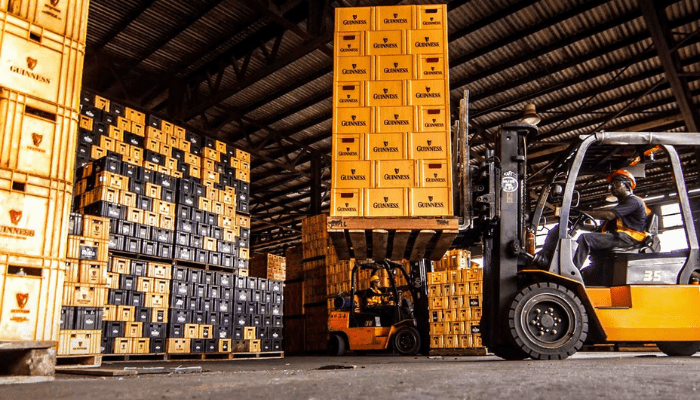
Guinness Nigeria has made a return to profitability, posting a net profit of N16.2 billion for the financial year ended June 30, 2025. This marks a turnaround from the N54.8 billion loss reported in the previous year, a 130 percent swing that highlights the recent strategic shifts, particularly following Tolaram’s acquisition.
This is according to the company’s unaudited financial statement for the financial year ended June 30, 2025.
Revenue for the period surged to N496.6 billion, up 66 percent from N299.5 billion in FY 2024. However, that top-line growth was closely followed by a 67 percent spike in cost of sales, resulting in a slight dip in gross margin, from 30.5 percent to 29.9 percent.
This suggests that the company’s pricing strategy marginally kept pace with the rising costs of inputs, ensuring margins remain stable despite inflation and currency volatility.

Operating efficiency comes alive under Tolaram
Where the company truly stood out was in its operating performance. Despite an environment where inflation plagued operating costs, the operating margin rose to 9.5 percent, up 106 basis points from 8.48 percent the previous year.
Operating expenses grew to N101.2 billion, a 46 percent increase from N69.2 billion. However, that growth was slower than revenue expansion, signaling improved cost management, partly attributed to the influence of Tolaram Group, which recently acquired a majority stake in the company. These early efficiencies reflect the beginnings of Tolaram’s restructuring and integration efforts.
Operating profit climbed to N47.4 billion, an 87 percent increase from N25.4 billion in the previous year. Notably, this was enough to absorb N75.5 billion in foreign exchange (FX) losses, which were largely offset by N83.8 billion in FX gains. These gains likely stemmed from revaluation of assets and liabilities amid the naira’s depreciation.
Zooming in on the fourth quarter (April–June 2025), Guinness delivered a standout performance. Net income during the quarter hit N9.5 billion, representing a 38 percent increase from the N6.9 billion posted in Q4 2024.
Gross margin in the quarter jumped from 30.1 percent to 37.8 percent, pointing to stronger volumes and better pricing. Quarterly revenue rose by nearly 50 percent, reaching N118.7 billion.

The marketing and distribution costs rose 29 percent year-on-year to N26.7 billion. However, the operating margin for Q4 improved significantly, from just 4 percent in Q4 2024 to 15 percent in Q4 2025. Observers note that the improved efficiencies may be down to Guinness’ integration into Tolaram’s distribution ecosystem.
Balance sheet sees big gains
Beyond the income statement, Guinness Nigeria’s balance sheet recorded significant shifts. Total assets grew 21 percent to N273.5 billion, while shareholders’ equity rose to N18.4 billion, thanks to the return to profitability.
Read also: Guinness reports N16.2bn H1 profit, stocks up 51.53% YtD
The company’s return on equity (ROE) spiked to a remarkable 157 percent, and return on average assets hit 6.5 percent, both signs of improved capital productivity.
Inventory nearly doubled, rising to N76.8 billion from N41.9 billion, driven largely by a buildup in raw materials which climbed to N47.7 billion from N8.7 billion. Trade receivables also surged to N48.7 billion, bringing current assets to N140.1 billion, up from N103.6 billion a year ago.
But these gains have come with trade-offs. Current liabilities also jumped, driven by new rounds of borrowing. Following Diageo’s exit and Tolaram’s takeover, the new owners cleared a N39.3 billion debt owed to Diageo but also took on a new N75.05 billion loan to restructure operations and stabilize liquidity.
Cash flow tightens
The company repaid N76.4 billion in loans and principal during the year, a move that helped clean up the balance sheet but significantly impacted cash reserves. As a result, the cash balance at year-end fell to N4.1 billion, down from N45.8 billion the previous year.
Operating cash flow stood at N38.4 billion, but after investing N26.2 billion in capital expenditure, Guinness was left with a free cash flow (FCF) of N12.2 billion.
This is a sharp contrast to FY 2024, when it reported N80.1 billion in operating cash flow and a FCF of N70 billion, translating to a 23.4 percent FCF margin. That cash surplus had previously provided the financial buffer needed for the company’s turnaround. This year, however, cash generation remains a weak spot that the company must address to maintain momentum.
Guinness Nigeria’s current ratio improved slightly to 0.55, up from 0.47, signaling a modest improvement in short-term liquidity. However, the company remains highly leveraged, with a leverage ratio of 13.9x, though significantly improved from a staggering 103.6x at the beginning of the year.
The transition phase is still ongoing, but the early signs suggest that Guinness Nigeria is turning a new leaf. In line with its impressive turnaround in 2025, investors are watching to see if this turnaround becomes a sustained comeback.
On the NGX, Guinness Nigeria is trading at a share price level last seen in January 2018. This year, the company has appreciated by 51.5 percent year-to-date, at a share price level of N106.45 as of July 28.