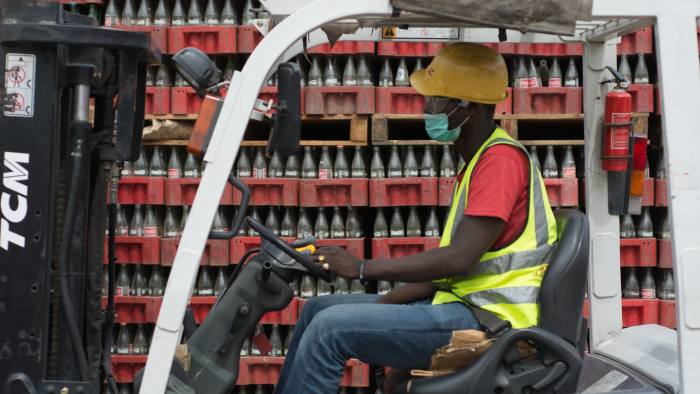
Bottles of Sprite spin along a gleaming new production line at the Coca-Cola plant in Maiduguri, not far from the one-time headquarters of Boko Haram, the jihadi group that continues to terrorise north-eastern Nigeria. The facility opened last month and will more than double the 30-year-old plant’s capacity, adding 10,000 cases of plastic bottles a day to the 8,000 cases of glass bottles it already produces. The expansion is a sign of how multinationals — from consumer group Unilever to telecoms company MTN — are adapting to and banking on one of the fastest-growing markets in the world, which also happens to be one of the most dangerous. While security forces have taken back population centres from Boko Haram, much of the countryside, particularly in Borno state, remains defenceless. Meanwhile, the army has closed borders to Niger, Cameroon and Chad, where merchants smuggled multinational goods bought legally in Maiduguri via centuries’ old trading routes.
But security has improved enough for business to rebound somewhat, particularly for those who have adapted to a crisis nearing its tenth anniversary that crippled the economy and left 2m displaced and 27,000 dead. Yaw Nsarkoh, head of Unilever Nigeria, said the north-east was one of its fastest-growing businesses in the country, which was one of the company’s fastest-growing markets in the world. Revenues for the first nine months of 2018 rose 11 per cent compared with last year, to N72.3bn ($200m). He attributed the growth to a revamped distribution system and hiring locally rather than recruiting employees from the south, the commercial centre that is very different culturally and logistically. Nigeria is Africa’s largest economy, but has been slow to recover from a recession brought on by the oil price crash.
It is also one of the fastest-growing countries in the world, and its population of about 200m is an essential market for multinationals looking to make headway in Africa. Michael Ubeh, a senior sales executive, said Unilever had made a concerted effort to focus on employing and empowering locals during the crisis. In Lagos, which has a much larger population, the company works with about 10 large-scale distributors, as it had previously in the north-east. But as the crisis intensified, Unilever began using about two dozen smaller, local operators located in safe pockets spread out across wide swaths of insecurity. “When the problems came we had to fragment our go-to-market in a way that would purposely keep people’s jobs, and serve the consumer . . . and keep people safe,” he said.
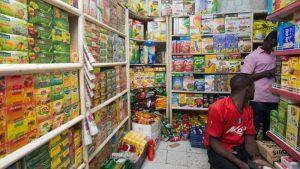
Coke also had to remodel its distribution system. The occupational safety manager at the plant — one of 11 in Nigeria run by the Nigerian Bottling Co, a subsidiary of Coca-Cola Hellenic, the drinks giant’s second-largest bottler — has an additional job beyond preventing workplace injury: he is among those tasked with keeping track of the security situation throughout the city and the state. “Our communication to dealers is any place that is prone to attack — don’t go there,” said Tijjani Ibrahim, the plant’s manager.

That puts all of Borno state — which is about the size of Ireland — outside Maiduguri, off limits. So the company had adapted, said Aminu Mohammed, a company spokesperson who previously worked at the plant, which is Maiduguri’s last big production facility. Traders from further afield now travel to the state capital — often with military escort — to buy products at the wholesale market to distribute to more dangerous parts of the state. “In the course of the insurgency we lost so many of our customers — some were killed, some lost their businesses or their customers,” he said. One of the plant’s staff was among the first Boko Haram members arrested in the city. But the insurgents also got word to employees that they would not attack it — despite its US connections — because it provided locals with jobs, Mr Mohammed said. So the facility never closed, even at the height of the insurgency, when the nearby airport was attacked and parts of Maiduguri were under Boko Haram’s control.
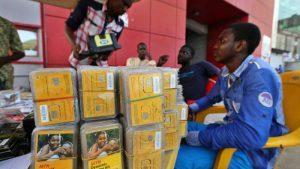
By contrast, the crisis crippled South African telecoms operator MTN’s infrastructure in the region. MTN lost 1,200 masts to the insurgency, which targeted communications infrastructure. But it had repaired 90 per cent of them, and changed the way it serviced them, said Mazen Mroue, chief operating officer of MTN Nigeria. That has helped turn the north-east into a big contributor to the double-digit growth MTN is achieving across northern Nigeria. The company is the country’s largest operator, with more than 50m subscribers, and Nigeria contributes about a quarter of the carrier’s annual revenues — R132bn ($9bn) last year.
The country’s power grid is shoddy, and most businesses power their operations on diesel generators. MTN’s telecoms masts — often situated in remote locations — run on small generators. In a more secure part of Nigeria, a technician might visit weekly to refill and service a mast. In the north-east, maintenance has been outsourced to a contractor experienced in operating in insecure environments, and masts have been fitted with bigger diesel tanks, so that they can be serviced monthly. MTN has also partnered locals to secure the infrastructure, “because they realise it’s so important for them”. “It’s not an easy area,” Mr Mroue said. “But we’ve really managed to expand our services . . .[by] working with local communities.”