



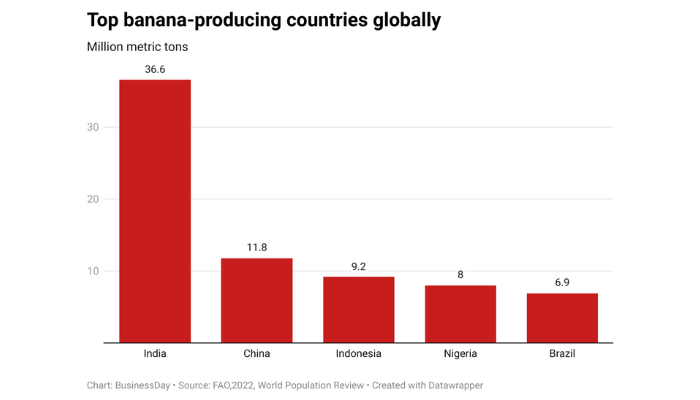
…Nigeria 4th largest producer globally
A global banana supply crisis has opened up a N22 trillion export opportunity for Nigeria, as climate change and plant diseases slash output in traditional producing nations, experts say.
Extreme weather and climate-related pests are hitting banana-growing countries such as Guatemala, Costa Rica and Colombia, cutting their yields and farmers’ incomes, a Christian Aid’s report said.
Pathogens such as Panama disease and Black Sigatoka are devastating banana output across the world, affecting over 50 percent of the crop in the global market, according to some reports.

Read also: U.S. soybean exports to Nigeria surge on rising demand
A recent study published in Nature Food (March 2025) warned that rising temperatures and socio-economic constraints could slash banana-growing areas in Latin America and the Caribbean by 60 percent. These two regions currently supply 80 percent of the world’s banana exports, largely feeding supermarkets globally.
The ugly situation has however opened up an opportunity for Nigerian businesses to process the crop for export.
In Europe, the United States and Asia, bananas are used for the production of chips, bread, puree, animal feed, syrup, biofuel, skin products, juice, starch, among others.
“Banana is a global commodity, but Nigeria’s banana export is still very low. This narrative can change if investors -particularly young agropreneurs – scale up production and boost exports,” said Dan Arubasa, agro-consultant, in an interview with BusinessDay.

Banana is the most popular fruit in the world and fourth most important food crop globally – after wheat, rice and maize. More than 400 million people rely on the fruit for 15 percent to 27 percent of their daily calories, the Guardian UK said.
Nigerians eat ripe bananas with snacks like groundnuts or fruits like cucumber. Yet the crop is facing dangerous devastation. The Food and Agriculture Organization (FAO) recently echoed warnings of a severe supply gap in banana production, citing climate shifts and disease outbreaks.
Del Monte is one of the world’s largest fruit and vegetable companies. During its second-quarter earnings call, Mohammad Abu-Ghazaleh, chief executive officer of the leading US-based fresh foods hub, said: “There is a global shortage in banana production, and it is due to shifting climate patterns, particularly warmer temperatures combined with humidity, which are accelerating the spread of disease in key growing regions.”
He pointed specifically to Fusarium wilt and Black Sigatoka, deadly diseases now ravaging banana crops in Central America and other parts of the world.
“These diseases are having a direct impact on supply,” he added.
Nigeria’s undeveloped value chain
Between 2019 and 2023, global banana exports plummeted by 33 percent, from 28.8 million tonnes to 19.3 million tonnes, according to the FAO data. With supermarket chains scrambling to secure stable supply chains, Nigeria’s underutilised potential is drawing attention.
“There’s a huge supply gap as our local demand is unmet, leaving banana export opportunities untapped,” said Precious Otuekong, CEO of Extragreen Harvest Industries.
Obiora Madu, director-general of the African Centre for Supply Chain, underscored the country’s underperformance.
Read also: Cassava industry insights and trends
“The growth of fresh fruit exports from Nigeria is slower than average, and the contributions from bananas are poor,” he stated.
Experts stress that Nigeria must address key bottlenecks such as poor logistics, lack of quality control, and low production scale to compete globally.
“There’s immense opportunity in Nigeria’s banana sub-sector—especially in production, value-addition, and exports,” said Dan Arubasa, an agro-consultant.
Nigeria’s edge
Nigeria’s climate and landmass give it a natural edge, but the real value lies in value-addition.
“Beyond sales of fresh fruits, processing into banana flour, chips, purée, baby food, alcohol, fertilizer, and fibre-based textiles opens multiple high-margin business opportunities on the global scene,” Arubasa said.
From international food markets to textile manufacturers, the global demand for banana-derived products is expanding. Yet Nigeria’s participation remains marginal due to low-scale production, weak infrastructure, and a lack of investment in value chains.
“Banana exports and businesses can generate steady monthly cash flow for farmers and investors,” Arubasa added. “But only if we take this moment seriously,” he added.
The global banana market is on a steady rise, projected to grow from $138.34 billion in 2024 to $143.33 billion in 2025 at a compound annual growth rate (CAGR) of 3.6 percent, according to the Business Research Company.
Nigeria ranks as the 4th largest banana producer globally, yielding eight million tons annually, behind India (34.5 million tons), China (11.8 million), and Indonesia (9.2 million), per FAO’s 2022 report.
In Africa, Nigeria leads, followed by Angola (4.3 million tons), Tanzania (3.5 million), Rwanda (2.1 million), and Kenya (1.9 million tons).
Investment strategies for 2025
Experts say banana farming offers one of the easiest and most profitable entry points into Nigeria’s growing banana sub-sector. Bananas grow all year round, ensuring steady supply and cash flow for farmers.
“With as low as N350,000 to N500,000, small-scale farmers can start farming if they have a plot of land,” said Akor Nosike, an Enugu-based banana farmer.
“Large-scale farming requires between N1 million and N5 million to establish a commercial operation,” he added.
A typical small plot needs 102 to 120 suckers, according to Bamidele Babatunde, a banana farmer in Ibadan.
“Weeding, fertilizers, healthy suckers, and organic manure are key to boosting yields,” he said.
The International Institute of Tropical Agriculture (IITA) recommends a density of 1,300 plants per hectare at 3m x 3m spacing for optimal growth.
To compete globally, organic farming and value addition are crucial, said Precious Otuekong, CEO of Extragreen Harvest Industries.
“Investors must embrace organic farming methods and explore processing banana chips, flour, and organic fertilizers from the roots,” she said.
“A registered business, NEPC certification, and a certificate of origin from the Nigerian Customs Service (NCS) are essential,” said Arubasa, earlier quoted.
Building credibility is key in ensuring success in the business, analysts say.
“Search for buyers via social media, use proper packaging and labelling, and operate a domiciliary account to ease transactions and build trust,” analysts added.
Challenges and solutions
Despite its potential, banana farming and exports in Nigeria and across Africa face key challenges—namely pests, diseases, weak export regulations for fresh produce, and poor transport and storage infrastructure.
However, experts agree that with proper planning, effective management, and targeted investment, banana farming can become a profitable and sustainable agribusiness across the region.





