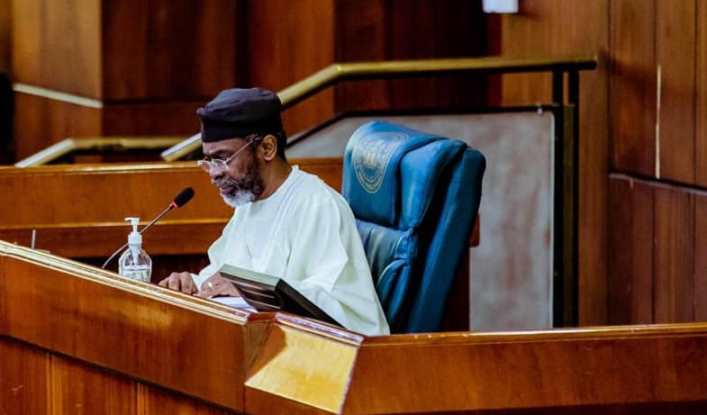
Nigeria lawmakers were welcomed Wednesday from their Christmas and New Year break with a cautious note from Femi Gbajabiamila, the speaker of House of Representatives, on their tendency to promote Bills that seek to establish additional institutions, reinforcing concerns over the bulging cost of governance.
His call comes at a time Nigeria is confronting a second recession in four years, dwindling income from oil and non-oil revenue, a spending plan that has resulted in over borrowing and interest payments that leave little for nothing, except paying salaries. The speaker’s warning is in line with the recent red flag the International Monetary Fund (IMF) lately raised over the dwindling revenues of the Nigerian Federal Government.
In its annual assessment of the economic and financial developments of Nigeria, the IMF said Nigeria’s near-term outlook was subject to downside risks from pandemic-related developments amid a second wave, lower oil prices, which have increased vulnerabilities to external shocks due to weak global demand, with the current account remaining in deficit in the first half of 2021.
In his address, Gbajabiamila said it had become increasingly difficult with each appropriation cycle for the government to meet its obligations. “At a time of reduced revenue, with pre-existing and worsening infrastructure deficits requiring significant investments, we cannot afford to keep establishing more institutions that impose a permanent liability on government income,” the speaker told the lawmakers.

Read Also: After 20 year struggle, Senate sets May 29 for presidential assent to PIB
Keeping in mind the realities that often necessitate such legislations, current economic situations must not be overlooked, he noted.
“Let us work together to reform and strengthen the institutions already in existence, and remove those no longer fit for purpose. I believe most sincerely that this is the pathway to a legacy that we can all be proud of,” he admonished.
The IMF worry that Nigeria’s economy is at a critical juncture – with one of the lowest revenue levels as a share of total economic output worldwide.
While oil earnings, which form quite a chunk of government incomes and budget funding, shrink, local revenue mobilisation remains low.

Over the medium term, a subdued global recovery and decarbonisation trends are expected to keep oil prices low and the Organisation of the Petroleum Exporting Countries (OPEC) quotas restrict oil-related activities, fiscal revenues, and export proceeds.
Non-oil growth is also expected to remain sluggish, reflecting inward-looking policies and regulatory uncertainties.
“But a large share of those revenues is spent on the country’s public debt service payments, leaving insufficient fiscal space for critical social and infrastructure spending and to cushion an economic downturn,” the IMF noted in its most recent Article 1V report, the outcome of its discussion about the Nigeria’s economic and financial policies with government and central bank officials.
The central bank is equally concerned. At its January Monetary Policy Committee meeting, members expressed concern over the rising public debt stock, recurrent expenditure that remains relatively high, as against planned capital spending. This, they said, signals future debt servicing challenges.
The Buhari administration has said it is committed to implementing an ambitious report of the Presidential Committee on Restructuring and Rationalisation of Federal Government Parastatals, Commission and Agencies led by Stephen Orosanye, a former head of the Civil Service, under Goodluck Jonathan’s administration.
The report, commonly called Oronsaye report, recommended an outright scrapping of 102 of the statutory agencies from 263 to 161 – there are 541 government parastatals, commissions and agencies (statutory and non-statutory) in the country.
The report also noted that the legislature and judiciary must make spirited efforts at reducing their running costs as well as restructuring and rationalising the agencies under them if the cost of governance must be brought down.
However, while cost of governance continues to balloon, government, including the executive, legislative and the judiciary are yet to summon the political will to do the needful.
Those who spoke with BusinessDay supported the House speaker’s caution that lawmakers should stop sponsoring Establishment Bills seeking to set up new institutions.
Ken Ike, a professor of economics, said the cost of governance was getting unbearable and new establishments should not be allowed. He rather called for the implementation of the Oronsoye report to be implemented to rationalise existing institutions.
Ike told BusinessDay, “We should rationalise the existing (ministries, departments and agencies), extend the mandate and ensure that you integrate. They should not just be creating, except it is the one that is part of our international treaty because some of the international treaties require some forms of establishments like human rights.
“I support what the Speaker is saying because of the cost of governance. The cost of governance is getting unbearable and we have the Oronsoye report, which shows you that it is easier to create new establishments than to get cooperation from them to merge existing establishments.”
He urged the lawmakers to stop compounding the problem at hand.
Paul Alaje, a financial analyst, supported the move by the National Assembly and called for merging of new of even some existing organisations.
Alaje asked the National Assembly to lead by example by cutting down both its budget and that of the executive, and also reducing the retinue of aides while such funds should be channel into creating jobs via private sector.
He said: We have to look at merging ministries, departments and agencies. We have to substitute them for private sector initiatives. National Assembly should cut down on its budget.
“They are not enterprises, they are performing public functions, the same with the executive where you have Special Assistants, Personal Assistants and Senior Special Assistants and Advisers, to do which work exactly.
“CEOs of companies perform more than these appointees we have but they don’t have more than one Special Assistant, and they get the job done. We need to have performance metrics for everybody, starting from Mr President, to Vice President, to Senate President.
“I think to a large extent National Assembly should reduce its budget but more importantly, executive should reduce. When we have this reduction, it should be channel towards creating jobs in the private sector.”
To a public affairs analyst, Oluwole Ojewale, it is a welcome development for the National Assembly to take steps towards stopping the establishment of unnecessary organisations that contribute little or nothing to the economy.
According to Ojewale, most of the institutions are established with a political motive as sponsors of the Bills establishing them do so to get jobs for “their boys and not for the development of the country.”