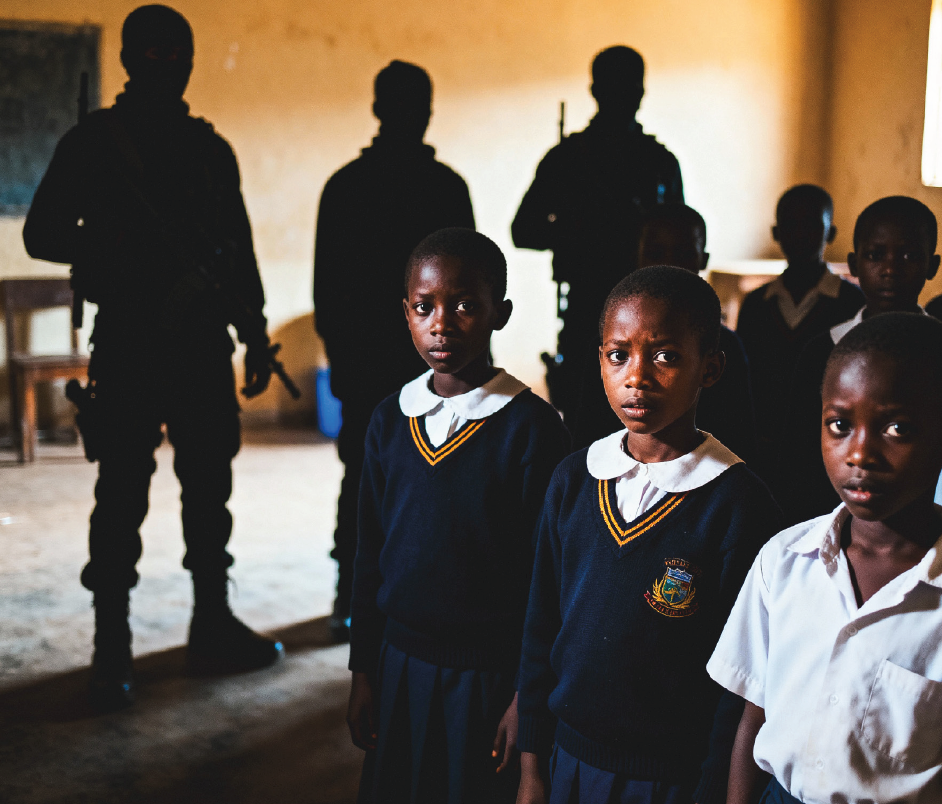
On November 17, 2025, armed bandits invaded the Government Girls Comprehensive Secondary School in Maga, Kebbi State, killed the vice principal, and kidnapped twenty-five schoolgirls. Twenty-four hours later, another group of gunmen attacked a CAC Church in Eruku, Kwara State, killing three worshippers, injuring scores more, and kidnapping thirty-five congregants. Less than one week after those attacks, on November 21 in Papiri, Niger State, 303 students and 12 teachers at St. Mary’s School were kidnapped in one of the largest school kidnappings in recent Nigerian history, with most of them still held captive.
These tragedies, one following another, shocked the nation and the whole world, bearing a frightening speed in which kidnapping now spreads across Nigeria. What once seemed like incidents has now become a national pandemic, demanding urgent and coordinated action.
Nigerians now walk in fear and uncertainty. Parents stand at school gates hesitantly, worshippers pray under threat, while families avoid highways altogether. The release of the Kebbi schoolgirls and Kwara worshippers brought relief. Still, the continued captivity of most of the Papiri pupils is a painful reminder that Nigeria’s security system remains fragile. That such mass abductions could have occurred so easily, almost in quick succession, speaks volumes to the extent of the crisis.
According to SBM Intelligence, over 3,600 people were kidnapped between July 2022 and June 2023, while ransom payments between 2011 and 2020 exceeded eighteen million dollars. In any other context, if a disease had killed this many people or drained this level of economic resources, a state of emergency would have been declared. Accordingly, many have wondered why it took the Nigerian government this long to make it an emergency matter, and citizens feel President Tinubu’s recent declaration has at least attested to some positive will, though they wait to see how it is implemented.
Kidnapping has mutated across regions and ethnic lines. Herders and bandits have often been blamed, but BusinessDay, in a report, said that 257 victims were abducted in the South-East in one year, with Anambra Governor Soludo describing many of the perpetrators as “Igbo criminals.” Some criminals even disguise themselves as ‘Fulani’ bandits to mislead communities. That is how pandemics behave: they adapt, they spread, and they exploit weaknesses.
The crisis has drawn international attention. President Donald Trump recently queried Nigerian leaders to stop what he described as “Christian genocide.” His statement, though controversial, spoke to millions of Nigerians who feel abandoned by their government. Rather than dismissing Trump’s words, Nigerian leaders should confront the failures that made such external intervention necessary. Nigerians themselves have tagged foreign leaders on social media, asking for help, a sign of how desperate the situation has become.
Nigeria needs to adopt a multi-layered vaccination strategy to contain this pandemic. Technology-driven safety systems are one layer. Countries like India, Mexico, and Brazil, all of which once fought large-scale abductions, reduced kidnappings through GPS-based citizen safety systems and rapid digital-reporting networks. Nigeria could introduce an encrypted, voluntary location-tagging system so families can instantly track abductees. Concerns about surveillance can be discarded using end-to-end encryption, ensuring safety and privacy. Another layer is creating a Kidnapping Alert and Response Portal, modelled after South Africa’s “Namola” platform, which links citizens directly to security agencies. Every kidnapping report must trigger action, with no bureaucracy getting in the way, because in kidnapping situations, speed is of the essence.
Legal deterrence will also have to be strengthened. Countries like Saudi Arabia and China reduced high-level organised crime through severe penalties. Nigeria will have to treat kidnapping as a capital-level crime, with summary trials and transparent processes that cannot be influenced by political interference. Transportation intelligence is the next point. If there have been several thousand cases of highway kidnappings in the last few years, then interstate-carrying vehicles should be compelled to install concealed GPS trackers registered to their parks. Passenger manifests, already recorded at motor parks, could be digitised into a national database, turning a routinely basic system into a powerful security asset.
Yet, no vaccination strategy can succeed without confronting sabotage within Nigeria’s security architecture. Investigations into the death of Brigadier General Dzarma Zirkusu in 2021 revealed that Boko Haram had received leaked intelligence on troop movements. Soldiers, journalists, and even retired officers have made claims that some security agents leak operational plans to terrorists and bandits. For any vaccination strategy to work, the security forces must undergo deep vetting, restructuring, and internal counterintelligence reviews. No system can survive betrayal from within.
Kidnapping thrives in contexts where communities fear cooperation with security agencies. A properly technology-enabled community-policing model, if adequately trained and depoliticised, could shrink the spaces where criminals operate with impunity. Citizens must be made to believe that reporting crimes will attract protection rather than retaliation or neglect. Today‘s Nigeria is like a nation walking on broken glass: tense, fragile, and fearful. The atmosphere is heavy, the roads are risk-laden, and the nights are long. The release of Kebbi schoolgirls and Kwara worshippers is a relief. However, the continued captivity of most of the Papiri pupils is a haunting reminder that the crisis is anything but at an end. Without decisive action, kidnapping could balloon into something far more catastrophic: a breakdown of national order, driven not by ideology but by unchecked criminality. In one sense, Nigeria must act now. Not to have a proper vaccination programme for this pandemic means it will not only continue spreading, but it will also mutate into a crisis that could push the nation towards an Armageddon.