Kaduna, Benue, Adamawa and Taraba are grappling with a deepening fiscal emergency, one that is now threatening the survival of their pension systems.
According to BudgIT’s 2025 State of States report, the four states collectively owe more in pension and gratuity arrears than they generate internally, a rare and troubling imbalance that underscores years of weak planning and chronic dependence on federal allocations.
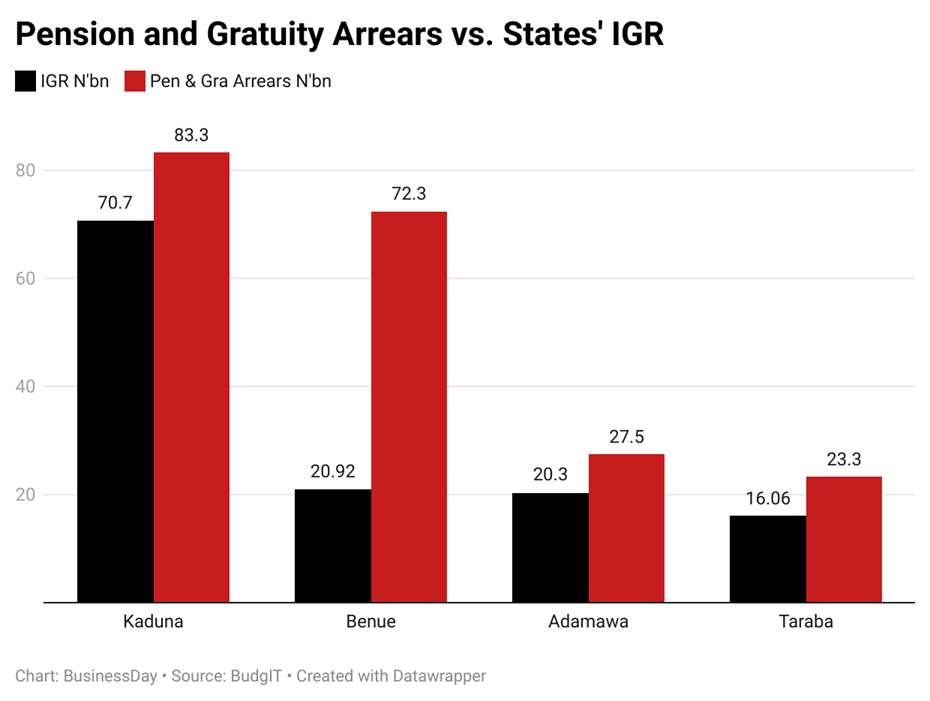
The combined arrears exceed N206 billion, far above their total 2024 Internally Generated Revenue (IGR) of N127.98 billion.
Kaduna tops the list with N83.3 billion in arrears against N70.7 billion in IGR. Benue follows with N72.3 billion owed while generating only N20.9 billion. Adamawa’s N27.5 billion liability surpasses its N20.3 billion revenue, and Taraba owes N23.3 billion well above its N16.06 billion IGR.

The human impact of pension arrears
The crisis is not abstract. It is felt most by pensioners who, after decades of public service, are left waiting indefinitely. In Benue, where repeated fiscal breakdowns have become routine, the frustration is palpable. “Many of our pensioners have died waiting,” a civil servant in Makurdi said, reflecting the despair among retirees who have gone months or years without the benefits they are owed.
The Nigeria Labour Congress has also raised alarms. “Retirement ought not to be a death sentence,” Joe Ajaero, NLC President warned at a pre-retirement summit, noting that arrears at multiple tiers of government have eroded the very purpose of the pension system.
The widening north–south revenue gap
The fact that all four affected states are in northern Nigeria points to a broader structural divide. While southern states such as Lagos, Ogun, Enugu and Rivers have steadily grown their IGR bases, many northern states remain overwhelmingly dependent on federal transfers. BudgIT data shows that Kaduna, Benue, Adamawa and Taraba rely on federal funds for more than 85 percent of their revenues.

Weak local economies, slow reforms, insecurity and poor financial planning have amplified the gap. Pension schemes in these states have been pushed aside for years, with liabilities rolled over rather than properly funded, and no credible sinking funds established.
The economic cost and how long recovery would take
The failure to pay pension arrears has consequences that stretch far beyond retirees. Economists say unpaid entitlements reduce consumption, deepen poverty, weaken institutional credibility and may fuel corruption. Younger workers, observing the treatment of retirees, tend to save less and spend cautiously, eroding confidence in the system.
“If a state owes more in retirement benefits than it earns in a year, it’s not just a labour issue, it’s insolvency in slow motion,” said Muda Yusuf, Chief Executive of the Centre for the Promotion of Private Enterprise (CPPE). He explained that these arrears represent “quasi-debt burdens that distort state balance sheets and discourage new investment.”
To understand the scale of the problem, a BusinessDay analysis estimates how long it would take each state to clear its arrears if 25 percent of annual IGR were devoted solely to pension repayments, assuming stable revenues and no new arrears. The results are sobering: Kaduna would need about five years, Adamawa and Taraba about six years each, while Benue, because of its weaker revenue base, would need roughly fourteen years.
This long repayment horizon underscores the gravity of the crisis. For pensioners, it means years more of waiting; for the states, it reveals how deeply unbalanced their finances have become.
What can be done?
Experts say the first step is a proper audit of pension liabilities, combined with full payroll verification and the removal of ghost workers that inflate wage bills. States must also create dedicated pension funds and make consistent payments, even if small, to gradually reduce arrears.
Strengthening IGR through tighter tax collection, digital payments and sector-focused investment is equally vital.
Some progress has been recorded. Kaduna and Taraba have begun automating parts of their systems, but reforms remain too limited to address the scale of the challenge. High-burden states such as Benue and Adamawa require stronger fiscal discipline, improved coordination and clearer long-term strategies to restore stability.
The federal regulator’s position
At the federal level, regulators acknowledge the bottlenecks slowing pension payments, particularly accrued rights and delayed remittances by government entities. Omolola Oloworaran, Director-General of PenCom, recently noted that “challenges remain in accrued rights and transition issues,” even as the commission works with ministries and agencies to improve compliance and cash flow into retirees’ Retirement Savings Accounts.
Her comments highlight that the pension crisis is not isolated to states, but part of a wider national pattern of underfunded obligations.
Beyond the numbers
BudgIT’s findings make one point clear: pension arrears are not just audit entries; they are broken promises. For many in northern Nigeria, the debts represent years of neglect and short-termism. Without urgent reforms, the next generation of workers may retire into the same uncertainty that today’s pensioners face.
The cost of inaction is rising. For these states, the longer the delay, the harder it will be to rebuild trust and restore financial stability.