Ede Dafinone, the Chairman, Nigerian Conservation Foundation (NCF), National Executive Council (NEC), has advised the Federal Government to involve stakeholders in the building of the Great Green Wall Project.
Dafinone gave this advice in an interview with the News Agency of Nigeria (NAN) in Lagos on Thursday.
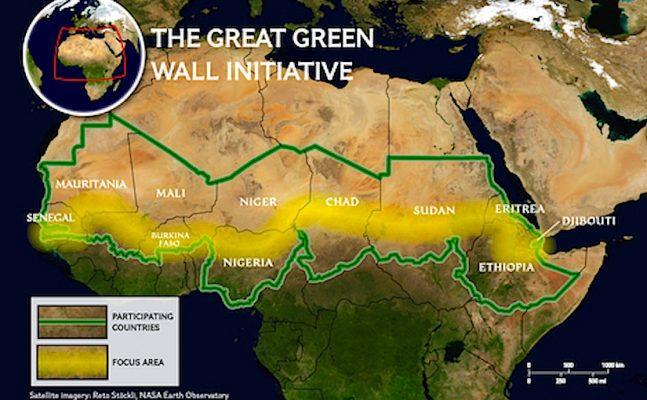
 The Great Green Wall is an African-led project with an epic ambition to grow an 8,000km natural wonder of the world across the entire width of Africa.
Its goal is to provide food, jobs and a future for the millions of people, who live in a region on the frontline of climate change.
According to Dafinone, work on the Nigerian side of the Great Green Wall project is very slow which is not encouraging.
“The Great Green Wall project progress is not good enough. Other countries have made much better progress than Nigeria.
“I think that there is need to involve more stakeholders while building the wall and also to provide alternative type of firewood for the community.
“Our experience in NCF shows that it is not good to ask the local people to protect the environment without giving them alternatives,” he said.
Dafinone said that to ensure speedy implementation, the local stakeholders should be involved in the project in enhancing its success.
According to him, if government or any organisation tries to do this kind of project on its own, it does not always succeed.
He said that the foundation would also try to link its initiated Green Recovery Project to the Great Green Wall project to fast track its building.
When Africa’s Great Green Wall is finished, it will cross 11 countries, from Senegal and Mauritania in the West to Eritrea, Ethiopia and Djibouti in the East.
Once completed, the Great Green Wall will be the largest living structure on Earth and a new Wonder of the World.

About 40 per cent of Africa is threatened by desertification, the loss of arable land to the encroaching Sahara desert.
The purpose of developing the Great Green Wall (GGW) Project is a Pan African proposal in greening the Sahel of Africa from Dakar to the East (Djibouti).
It aims at reducing poverty and soil degradation in this region, taking into account the effects of desertification and climate change on sustainability of livelihoods.

It also aims at tackling poverty and the degradation of soils in the Sahel-Saharan region, focusing on a strip of land of 15 km (9 miles) wide and 7100 km (4400 miles) long from Dakar to Djibouti.
However, the frontline states include Bauchi, Gombe, Borno, Yobe, Kano, Jigawa, Katsina, Sokoto, Zamfara, Kebbi and Adamawa.