Nigeria’s foreign exchange reforms have brought greater clarity to the naira and boosted dollar liquidity, but foreign investors in start-ups remain cautious, leaving the country’s once-thriving startup ecosystem starved of fresh capital.
Nigeria, the top destination for startup funding in Africa until 2023, has yet to recover its dominance. New data from ‘Africa: The Big Deal’ shows the country has slipped further behind as investor appetite remains muted.
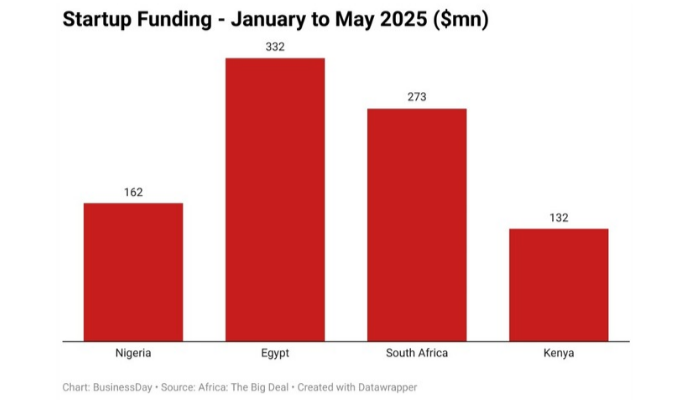
From January to May 2025, Nigerian startups have raised just over $162 million, out of the $1 billion secured across the continent. This lags behind Egypt’s $332 million and South Africa’s $273 million, putting Nigeria only ahead of Kenya’s $132 million among the traditional Big Four (Nigeria, Egypt, Kenya, and South Africa).
This underperformance comes despite a 33.3 percent increase in overall African startup funding compared to the same period in 2024, rising from $750 million to $1 billion, driven by improving investor sentiment. Of the total, 77 percent was raised as equity (over $810 million), and 13 percent as debt.

The naira has ranked as one of the worst-performing currencies in Africa since the Central Bank of Nigeria (CBN) floated the naira in 2023. The currency has fallen from N470 to N1,544.63/$, and it was one of Africa’s weakest-performing currencies last year, alongside the South Sudanese pound and Ethiopian birr.
As foreign funding slows, the shift has opened the door for local investors to play a larger role. In 2024, African investors accounted for 73 percent of private capital in Nigeria and 31 percent of the continent’s total investor pool, up from 19 percent a decade ago.
According to the Africa Venture Capital Association (AVCA), Nigeria attracted $417 million in startup funding in 2024, falling behind South Africa’s $589 million.
Much of the decline in Nigeria and across the West African region has been attributed to “ongoing challenges, including currency volatility and heightened competition for capital from other increasingly competitive startup ecosystems.”
Read also: These African startups have raised the most funding in 2025

A turning point
Investors expect the current downturn in startup funding to reverse in 2025 as the naira stabilises.
“We expect this to change this year because the naira has been more stable,” said Bernard Ghartey, principal at Norrsken22, a tech growth fund. Between January 1 and June 16, 2025, the naira has hovered between N1,538.50 and N1,543/$, according to CBN data.
“There has been sustained exchange rate stability,” said Abi Mustapha-Maduakor, CEO of AVCA, recently. “We are seeing more exits in Nigeria, and investors who had previously stayed away are beginning to return.”
Olusola Lawson, co-managing director at African Infrastructure Investment Managers, added, “The cycle has bottomed. Investing is all about timing, and I believe now is the right time for Nigeria.”
While this indicates optimism, investors remain cautious because the country has a longstanding history of backtracking on reforms. Currency volatility ranked among the top three concerns for foreign investors in 2025, according to AVCA’s investors’ outlook report.
“Concerns over exchange rate volatility, geopolitical and security risks, and interest rates were represented among all investors,” it said. As a result, Nigeria still ranks behind Kenya, South Africa, and Egypt in attractiveness for private capital between 2025 and 2027, according to AVCA’s investor sentiment and outlook.
Since 2023, startup investors have signed more cheques for Kenyan founders than their Nigerian counterparts. In 2024, Kenya raised $638 million in startup funding, compared to Nigeria’s $410 million, according to ‘Africa: The Big Deal.’
However, some investors argue that Nigeria’s slump mirrors a global trend. Since 2022, global startup investments have nosedived because of macroeconomic headwinds. Funding to African startups has fallen from $4.6 billion in 2022 to $2.2 billion in 2024.
“Funding to Africa generally has dropped after the high of 2022,” said Davidson Oturu, general partner at Nubia Capital, a US-based venture capital firm. “This is a market correction. Valuations are more realistic, and investors are backing startups with real services and strong fundamentals.”
‘Africa: The Big Deal’ notes that 2025’s startup funding has already crossed the $1 billion mark, seven weeks ahead of 2024’s pace. Nigeria may also be turning a corner, as long-awaited mega deals begin to materialise.
Two major Nigerian startups, PalmPay and Moove, are reportedly in the market for a combined $400 million. PalmPay is said to be raising between $50 million and $100 million in a fresh Series B round, potentially pushing it into unicorn status. Meanwhile, mobility startup Moove is targeting a $300 million raise, potentially pushing it into unicorn status too.
“We are seeing more optimism in Nigeria,” added Mustapha-Maduakor of AVCA. “More deals are happening, and we expect even more in the months ahead.”