…High cost of relocation, fear of losing land ownership
…Govt’s inconsistency in policy implementation
Water, they say, will always find its own level when people obstruct its path. Such often comes in a hot furry that clears objects, both animate and inanimate, on its way.
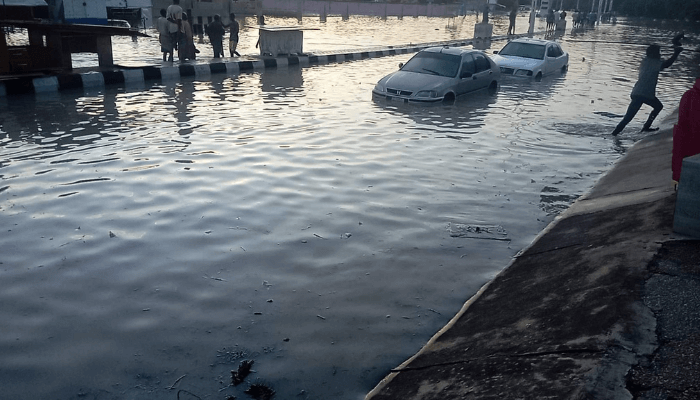
Such is the case in Nigeria, every raining season ushers in the menace of flooding, which has become a recurring nightmare for Nigerians for decades, with the country’s geographical location making it prone to severe flooding.

It may seem that many Nigerians have remained adamant to the warnings over impending flooding in their areas despite the signs that the forecasts are coming to pass.
Some others have also said that they were afraid to permanently lose their land to government or other private elements if they should move out because of flood.
A few also said that some state governments usually hide under such pressure to relocate occupants away from such areas only to turn around to appropriate the vacated lands.
It has been observed over the years that increasing construction activities have contributed to flood disasters across the country. While this is not the case in many places, construction activities in many towns and cities have contributed to worsening the situation.
Read also: Plateau government urges vigilance in flood-prone areas Alafter FG alert

Widespread flooding has affected more than 30 states, leading to the destruction of an estimated 180,000 cultivated farmlands nationwide, according to reports.
This is despite efforts by authorities to issue warnings at intervals; many Nigerians have remained unfazed by warnings and the impending disasters.
The incident of flooding in Nigeria has become a recurring issue, with many lives and property lost every year. For many victims, it appears there is no respite.
The floods have also caused significant damage to agricultural activities, further exacerbating food insecurity in Africa’s most populous country. The Middle Belt, known for its agricultural output, has seen widespread destruction of crops, contributing to food price inflation, which reached 35.41 percent in January 2024.
Recent floods in Niger State killed more than 200 people and displaced over 3,000 people. The situation was also the same in Plateau State, where hundreds were also killed, thousands displaced and properties damaged.
Some environmentalists have blamed the situation on the attitude of some Nigerians who block drains with waste and build on water channels, resulting in aggravation of flooding in communities, towns and cities.
Some environmentalists have also blamed the situation on the government’s poor waste management.
“I have lost everything; over 36 hectares of rice farm in Omelugboma here in Oko, and another 40 hectares at Ngegwu, Ajaji, Illah to flood.
“Also, flood has taken my rice mill at Abraka in Asaba; there is nothing left for me,” Sylvanus Ejezie, chairman, Rice Farmers Association of Nigeria, lamented his ordeal recently.
According to him, the situation is terrible and it will be difficult for me to start all over again without government support.
Why the warnings are not heeded
Many flood victims have denied ignoring government warnings to move away or relocate from their place of residence.
While some admit to being warned by relevant authorities, others said they had not experienced the situation before, blaming it on the changing pattern of the rains which caused flooding.
“Here in Lekki flooding is a regular occurrence every year, but because we don’t have anywhere to move to, we simply bear it and wait till the water dries, “Blessing Onakanya, a lawyer, told BusinessDay.
“It is because of the poor drainage system when this place was conceived. The government knows the problem, let them act,” she added.
Ebenezer Ojo, a resident of one of the flood-affected states, said: “I have been living here for 15 years now, this is the first time am experiencing this kind of flooding. How would I know my house and the area would be flooded and did not evacuate my family?”
Read also: Lagos residents cry out as floods submerge homes, vehicles
Many others said the changing pattern of rain occasioned by global warming and climate change should be blamed, arguing that the federal and state government should have made proactive measures to check the flooding.
Nigerians in the Middle Belt region have blamed the yearly release of water from the Ladon dam in Cameroon for the flooding in their community, noting that such occurrence was not seen until it first happened in 2012.
“This is my father’s land and ancestral compound, where do I go? We are not used to this kind of flooding. The first one was in 2012, after some time it dried up and we came back to our houses because we had nowhere to go to.
“There has not been such an incident since then, but it came again this year,” Michael Latan, a Plateau State resident, said.
‘Government should go after owners of illegal structures’
Some Nigerians have advised government at all levels to go after those who erect illegal structures that block channels and contribute to flood disasters.
“When we built our house in our current location, everywhere was peaceful and there was no incident of flooding. But as years rolled by, all manner of constructions began to springe up. Some were even building on water channels. We reported to government agencies on several occasions; they came but the constructions never stopped, which gave an indication of compromise. Today, we are all being affected. If the government had done what it was supposed to do, we would not be lamenting today. You can see how the irresponsibility of some people can affect innocent fellows,” Caroline Onos, a school proprietress, said.
As the flooding in many states in Nigeria continues, the country’s agricultural sector has been severely impacted by climate change and growing insecurity, a new report by SBM Intelligence has revealed.
The report, published in June 2025, states that since July 2024, 31 of Nigeria’s 36 states have been inundated by floods, affecting approximately 1.2 million people.
“Since July 2024, 31 of Nigeria’s 36 states have been inundated by floods, affecting approximately 1.2 million people. This widespread deluge has destroyed an estimated 180,000 cultivated farmlands nationwide,” it read in part.
In addition to flooding, desertification in the northern regions has worsened the crisis. The report notes that 350,000 hectares of arable land are lost each year due to desertification.
These factors, along with insecurity from farmer-herder conflicts and banditry, have disrupted farming activities and forced many farmers to abandon their land. Over 2.2 million people have been displaced by insecurity, particularly in the Northcentral and Northwest regions.
Thus, experts have suggested that the government should also share the blame as they often neglect flood forecasts by the Nigerian Meteorological Agency (NiMeT) and the Nigeria Hydrological Services Agency.
Read also: NiMet forecasts 3-day widespread rains, thunderstorms, flood risk across Nigeria
The report further stated that the absence of active town planning laws and poor implementation of existing ones were part of the causes of flooding.
It also stated that some states have obsolete laws while others cannot implement them due to corruption.
The experts added that these lapses had caused serious devastation in the country as many lives and property had been lost and many rendered homeless.
They, however, urged the government to immediately institute preventive measures both at the state and federal levels to tackle the menace.
Dimie Miebi of the Department of Geography and Environmental Management Sciences, Niger Delta University, Otuoke, said that poor or non-existent drainage systems caused flooding in Nigeria.
Miebi also said that Nigeria’s increasing urbanisation had contributed to the growing proportion of ground surface concrete, preventing percolation of water.
He further said that anthropogenic factors, including roadside dumping, dumping in canals, and dumping in drains worsened flooding problems in Nigeria.
A town planner in Lagos State, Samuel Umoren blamed the situation on state government’s neglect of town planners in building projects, noting that it contributed to blockage of waterways and submerging of buildings during flooding.
“If the government is serious, let the president set-up a committee to go round and see what is happening and they can at least check it. It is a natural occurrence but we can’t just sit down and allow our people to die like this,” Umoren added.