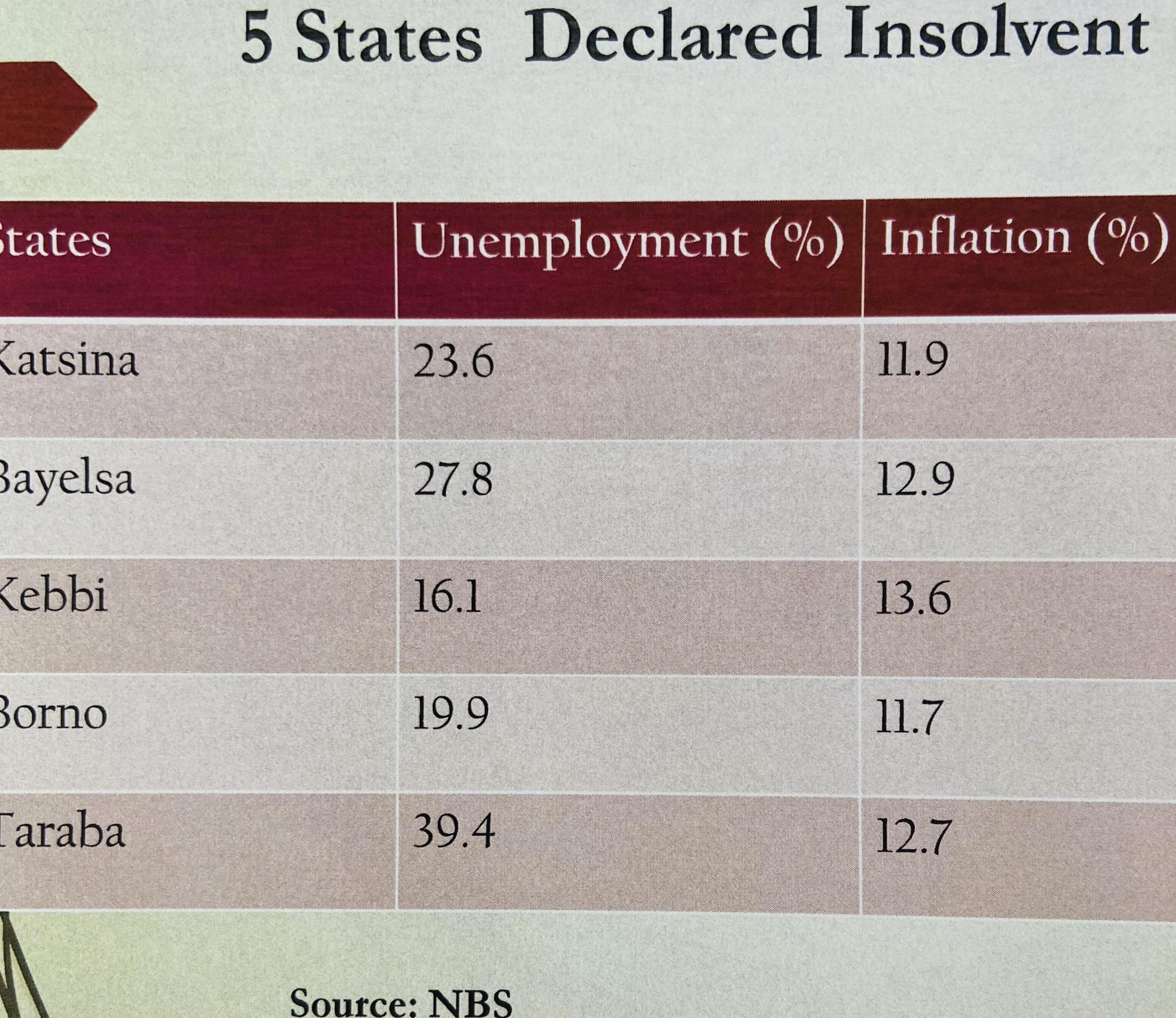
The criteria for this classification include but are not limited to anaemic or low internally generated revenue. It means that if you put all their monthly income from FAAC and IGR together, and remove the debt service cost, the states do not have enough for the simple task of paying the salaries of their workers.
Interestingly, ll five states have an average unemployment and inflation rate of 25.36% and12.56% respectively. Interestingly with Bayelsa being the only oil producing state in this unviable club.
At a time of negative growth and high unemployment, state government insolvency is the worst possible outcome when the government stimulus package needs funding.
On a positive note though, oil prices are above $44pb despite the weak global oil demand outlook and there is no reason why at least Bayelsa should be in this group.

Earlier this year when the computation of oil revenues for the purpose of transfers to FAAC was done on the basis of N360 from the old official exchange rate of N306, nearly N65bn was added to what was available to be shared by all tiers of government.
There is no reason now why the governors should not be clamouring for a more realistic dollar exchange rate for the calculation of revenues receipts. With a change in Nigeria’s official to near N420 will see an immediate improvement in the fiscal position of all governments and especially the states that are now said to be insolvent.
Bayelsa could be like a boy who has to go out to other homes to find food because he does not know or he is unable to access the huge wealth left for him by his father before he died.