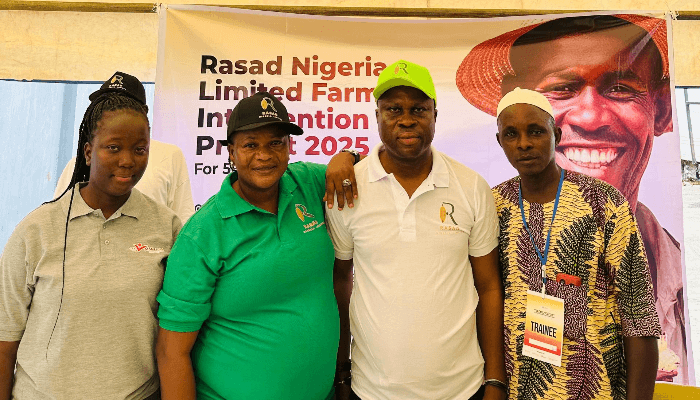
Rasad Nigeria Limited, a diversified agribusiness company, in partnership with Sahel Capital, a private investment firm, has trained about 500 farmers in cocoa sustainability guidelines, especially about the European Union Deforestation Regulation (EUDR).
Through the partnership, farm equipment like gloves, herbicides, boots, sprayers and others were given to the cocoa farmers to improve output.
The training, which took place recently in Ogun State, was to ensure that the farmers are knowledgeable about the EUDR guidelines.
The EUDR is a European Union law that prohibits companies from importing, exporting, or selling products that cause deforestation or forest degradation.

Read also: Firm offers supports for Kwara smallholder farmers
Rasaq Adeagbo, founder of Rasad Nigeria Limited, said the training is a way to give back to the farmers, who, according to him, are key players in the cocoa value chain.
“What we are doing today is like an empowerment programme for farmers to boost their production,” he said. “When these farmers experience a bountiful harvest, it’ll be good for me as an aggregator.”
For Adeagbo, if Nigeria will continue to earn from cocoa exports, then cocoa farmers must be EUDR-compliant. “With this training, the farmers will be able to apply insecticides without affecting their output.”
The EUDR, which now comes into effect in December 2025, will change how global trade works for key commodities that have been linked to deforestation.

These include cocoa, coffee, palm oil, soy, rubber, cattle, and timber.
Once the policy takes effect, the regulation will require that these products, or any products made from them, can only be placed on the European Union market if they are confirmed to be deforestation-free (not linked to land cleared or degraded after 31 December 2020), legally produced in their country of origin, and supported by a due diligence statement.
Femi Adeniji, project lead for Rasad Cocoa Expansion Project, noted that many farmers are unaware of the EUDR policy, hence why the training is important.
“Small-holder farmers are always constrained in terms of finance and input. Therefore, they need some financial support and input support. Many are also not aware of the EUDR compliance requirement,” he said.
“Even if they are aware, they can’t really comply because they don’t have the capacity. And that means that in the next few years, most of them will be left out of the purchase chain,” Adeniji added.
He disclosed that with the training, cocoa farmers stand a chance of competing on both the national and global stage.
“We decided that one of the things we are going to do is to have capacity building training as well as provide input support.”
Kola Oloyode, a cocoa farmer, highlighted the impact of the training on him and fellow farmers, noting that he believes that with the provision of farm inputs, his 2026/2027 output will be ramped up.
“The training was impactful. Some of the things we were taught are things we know about, but not many of us knew about the EUDR policy or how to position ourselves to be compliant.”
However, Oloyode noted that, “Today, we have learnt so much and believe that our next cocoa season will be better.”
Read also: WACOT gets €1.26m grant to empower 3,500 sesame farmers
Elizabeth Dara, training head of the cocoa expansion project, shared that farmers were trained on sustainable cocoa farming practices that can “help them to stand a chance with export standards”.
The event, which was held at Yewa North local government of Ogun State, is the first phase of the two-day capacity training programme.