…says Nigeria targeting top 80 nations in human capital development by 2030
The Federal Government on Monday said it would reposition Nigeria to be among the top 80 nations on the Global Human Capital Index (HCI) by the year 2030, with the creation of Human Capital Development Fund.
Stanley Nkwocha, Senior Special Assistant to The President on Media and Communications, Office of the Vice President, said Nigeria could achieve it by enhancing the nation’s workforce capabilities and improving socio-economic outcomes.
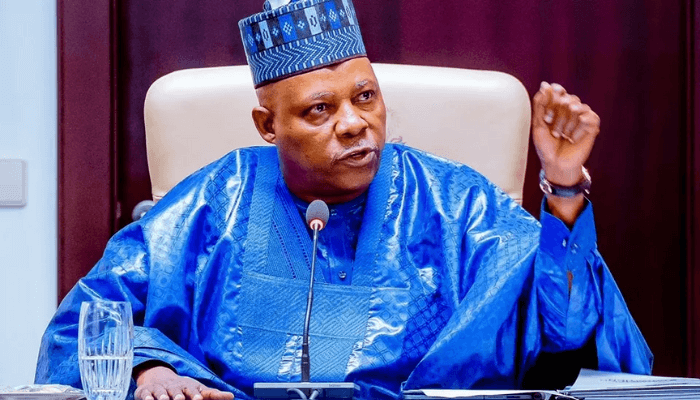
Kashim Shettima, the Vice President, speaking in Uyo, the Akwa Ibom State Capital, said the Federal Government had already introduced the second phase of the National Human Capital Development Programme (HCD 2.0), built on previous efforts with a greater focus on integration.

He said, “We are working to institutionalise the HCD Fund—to ensure that, no matter who occupies these offices tomorrow, the investments we make in people today will endure.
Read also: Shettima blames Nigeria’s problems on absence of fiscal responsibility
“If we must meet our target of reaching a Human Capital Index score of 0.6 and becoming a top-80 nation globally by 2030, we must act with boldness. Implementation must be swift. Data must guide us. Financing must be innovative.
“There’s no legacy that surpasses that of building our people. There’s no monument that would outlive the legacies of health, education, and opportunity.”
Shettima, who launched the State’s National Human Capital Development (HCD) Accelerator Project and the ARISE Human Capital Development Strategy, commended the State Government for becoming the first to implement the national blueprint across all Local Government Areas, noting that successful policies must be rooted in grassroots implementation.

Shettima also inspected ongoing work at several ARISE HCD projects, including model primary schools and the ARISE Park, an innovative environmental reclamation project. He explained that every policy or programme that intervenes in the life of the people can only succeed if it’s rooted in the grassroots.
“The true wealth of any nation lies in the certainty of its human capital: the education of its children, the health of its citizens, and the productivity of its workforce.
“At its core, HCD 2.0 is about integration and impact. It is built on the foundation of HCD 1.0 but goes further to incorporate cross-cutting themes. What Akwa Ibom State has shown us here isn’t just progress. It’s leadership,” he said.
Shettima emphasised the importance of data-driven policy implementation, announcing the launch of an HCD Dashboard to monitor key indicators with precision.
Read also: Tinubu’s bold decisions shield future leaders from tough choices — Shettima
“We are deploying data not for reports, but for results. Because behind every number is a story: a child not vaccinated, a mother lost to childbirth, a youth with promise but no pathway. These are not mere statistics. They are realities. And we must confront them with urgency and compassion,” he stated.
He also highlighted Akwa Ibom’s exceptional performance on several metrics, noting its achievements compared to national averages.
“With an under-five mortality rate of 80, compared to the national average of 110, and with only 3.5% of primary-age children out of school—far below the national average of 25.6%—your state is not merely compliant with our national vision. You are ahead of the curve,” he added.
As part of the national strategy, the Federal Government also unveiled Project Fuuku, a clean cookstove initiative that expands on a successful pilot in Nasarawa State.
“This intervention is more than a public health measure. It is a gender-sensitive, climate-conscious strategy that saves lives, preserves forests, and uplifts rural women burdened by indoor pollution and fuel scarcity,” the Vice President explained.
To ensure the sustainability of these initiatives beyond political terms, Shettima announced plans to institutionalise an HCD Fund.
Earlier, Governor Umo Eno of Akwa Ibom State, rated Human Capital Development as the bedrock of sustainable development, assuring that the State would continue to invest and collaborate with the National Coordinator of Human Capital Development in Nigeria.
Read also: Shettima tasks judiciary on sustaining integrity, rule of law
He noted that the State Government would send an Executive Bill to the State House of Assembly to domesticate the Human Capital Development Programme and assured that the State would continue to work with the Office of the Vice President to ensure that the programme scales down to Local Government Councils.
He commended Vice President Shettima for putting together the building blocks of the initiative and leading its implementation and delivery frontally.
“We are thrilled that our state was selected as the first for the launch of this programme. This has further reinforced the fact that the federal government under the leadership of President Bola Ahmed Tinubu doesn’t play politics with development, and this we deeply appreciate,” the Governor added.